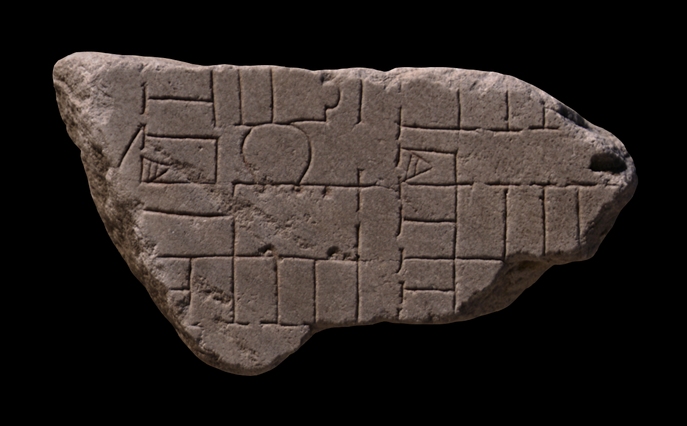
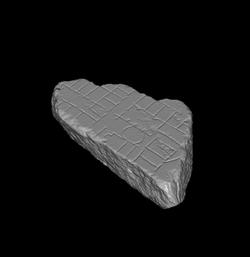
| Description The fragment depicts two insulae, separated by a narrow, vertical street or alley in the center. The left insula consists of tabernae that flank the left and lower sides, a rectangular hall with three columns or pilasters along the upper wall, two along the lower wall, and at top, two rooms, the larger of which features a semicircular niche or apse. Lodged in the center of the insula is a strange, circular structure. Two openings provided access to the insula from the central street, another gave way to the structure from a vertical street in the far left side of the fragment. An internal staircase demonstrates that the building was multi-storeyed. The insula to the right of the central street is fronted on the left by a row of tabernae and a staircase. An opening between the shops gave access to additional rooms inside the building. A large letter, "V", is visible in the vertical street to the far left.
Identification: Balneum? The colonnaded hall, rotunda, and apsidal room in the insula to the left has been interpreted as sections of a balneum, a small bath complex (PM 1960, p. 130; Staccioli 1961, p. 100). The apsidal room has also been identified as a neighborhood shrine (Sartorio 1988, p. 32).
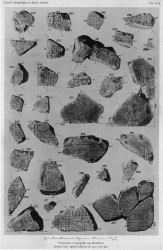
Identification: Vicus Stablarius(?) The authors of PM 1960 demonstrated that the small fr. 275 adjoined the large group, frs. 285a-h, in the top right corner of a slab, where it touched both the top and the right slab edges. The tail end of an inscription, [---]BLARIUS, labeled a vertical street that traversed the large group. In 1970, E. Rodríguez-Almeida suggested that this fragment belonged in a slab immediately above the large group 285, and that the V in this fragment constituted the beginning of the vertical inscription, which he reconstructed as either vicus Stablarius/Stabularius or Bublarius/Bubularius (Rodríguez-Almeida 1970-71, fig. 5; AG 1980, p. 149). He based this thesis on the regular layout of buildings in this fragment which matched exactly the topography in group 285. Rodríguez-Almeida further proposed that these groups must belong to a flat section of Rome, perhaps the rectangle enclosed by the Via Tebaldi along the Tiber, the Via dei Pettinari, del Monte di Pieta, and dei Giubbonari, Piazza Farnese, Piazza Ricci and Via del Giglio, and he located this fragment in slab IV-6 and the large group 285 in the slab below, #III-12 (AG 1980, pp. 149-150, pl. 33). In 1983, Rodríguez-Almeida confirmed the position of fr. 602 in the bottom left corner of slab IV-7 and of 37f and 37gi in the bottom right corner of slab IV-6; although this fragment does not join frs. 37gi and f directly, its thickness, marble color, veining, ductus, and architectural layout match these exactly (Rodríguez-Almeida 1983a). The name of the street, Stablarius, is a corrupt version of stabularius, or stables, he suggests, and the street must therefore be located near the stabula Factionum IV, the area of the stables of Rome's four chariot teams (AG 1980, p. 130).
Significance This fragment depicts a section of a little-known residential and commercial neighborhood, including a small bath, which can now be located, thanks to Rodríguez-Almeida, in the SW corner of the Campus Martius, between the Theater of Pompey and the Tiber. |
 Prev
Prev