ID AND LOCATION
| Stanford #
| 37l |
| AG1980 #
| 37l |
| PM1960 #
| 318 |
| Slab #
| IV-6 |
| Adjoins
| 37b |
CONDITION
| Located
| true |
| Incised
| true |
| Surviving
| true |
| Subfragments
| 1 |
| Plaster Parts
| 0 |
| Back Surface
| smooth |
| Slab Edges
| 0 |
| Clamp Holes
| 0 |
| Tassello
| no |
TECHNICAL INFO
|
|
|
|
|
|
|
|
|
|
|
| ANALYSIS
|
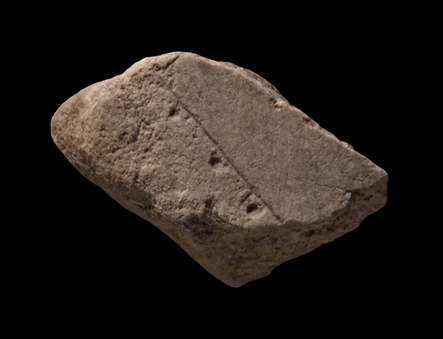
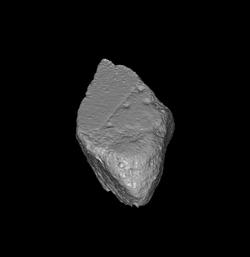
| Description The surface of the fragment is corroded. It depicts a row of columns abutting the edge or wall of an unknown structure. One of the columns is perhaps represented with a dotted square.
Identification: Porticus Pompeianae L Cozza identified the columns in this fragment as being part of the colonnades that surrounded the two large rectangular features, either garden plots or pools, in the Porticus of Pompey (Cozza 1968, p. 20, fig. 3; see also reconstruction in AG 1980, pl. 28). The poor state of the surface of the fragment makes it impossible to ascertain from the digital photographs whether E. Rodríguez-Almeida's rendering of the colonnade in his pl. 28 as a row of dotted squares as opposed to a simple line of dots is correct. This is crucial for the identification of this fragment, since frs. 39ac and 39b demonstrate that the colonnades that surrounded the rectangular planters or pools in Pompey's porticus were rendered as rows of dotted squares.
The porticus Pompeianae was one of the components of Pompey's immense theater complex in the Campus Martius, constructed as a whole and inaugurated in 55 BCE (LTUR IV, p. 148) or 52 BCE (Richardson 1992, p. 318). In addition to the porticus, the complex comprised a theater and temples (see fr. 39f for more info on the temples and on the theater itself).
Vitruvius (5.9.1) explains that Pompey built the porticus behind the theater as a shelter for the spectators in the case of rain, as a place for them to relax and converse, and as a storage area for stage machinery (LTUR IV, p. 148; Richardson 1992, p. 318). Fountains, trees, and expensive art works created an atmosphere of luxury and relaxation. According to Propertius (2.32.11-13) the porticus also contained trees that were trimmed to an equal height. Richardson (1992, p. 318) has suggested that the dotted squares surrounding the rectangular features, as perhaps in this fragment, represent such trees. This, however, would be inconsistent with the use of dotted squares elsewhere on the Plan, where they seem to denote columns on plinths (see Reynolds 1996, fig. 2.28). It is more likely that the large, rectangular features shown in this fragment and in frs. 39ac and 39b represented pools of water with fountains (or were planted with trees) and surrounded by columns (LTUR IV, p. 148; Richardson 1992, pp. 318-319).
Significance As Pompey's theater complex is only known through a few excavated remains and brief descriptions by ancient authors, fragments like this one provide important visual clues to its architectural layout. This fragment in particular is crucial to the identification of the large rectangular fields within the porticus proper: Are they pools of water, garden plots, or built structures? Precursor for solving the problem is determining the symbolic meaning of dotted squares on the Marble Plan: Do they always denote columns on plinths, or can they in some instances represent something non-architectural like trees or plants? |
|
| HISTORY OF FRAGMENT |
| Like the majority of FUR fragments, this piece was discovered in 1562 in a garden behind the Church of Saints Cosmas and Damian. From here, it was transferred to the Palazzo Farnese and stored there. The fragment was later used as building material in the 17th-c. construction of the Farnese family's Giardino Segreto (Secret Garden) near the Via Giulia, and was rediscovered in 1888 or 1898 when the walls of the garden were demolished. Since then, it has been stored with the other known FUR fragments in various places: the storerooms of the Commissione Archeologica (1888/1898-1903), the Antiquarium Comunale (1924-1939), the Capitoline Museums (1939-1955), the Palazzo Braschi (1955-1998), and since 1998 in the Museo della Civiltà Romana in EUR under the auspices of the Sovraintendenza ai Beni Culturali del Comune di Roma. (This fragment's history corresponds to Iter E'' as summarized in PM 1960, p. 56.) N.B. PM 1960 does not reveal the whereabouts of the fragment between 1903 and 1924.
Text by Tina Najbjerg |
|
| KEYWORDS
|
| colonnade, porticus, trees, pool, columns, plinths, |
|
 Prev
Prev