ID AND LOCATION
| Stanford #
| 383ab |
| AG1980 #
| 383a-b |
| PM1960 #
| 383 a b |
| Slab #
| unknown |
| Adjoins
| none |
CONDITION
| Located
| false |
| Incised
| true |
| Surviving
| true |
| Subfragments
| 2 |
| Plaster Parts
| 0 |
| Back Surface
| smooth |
| Slab Edges
| 0 |
| Clamp Holes
| 0 |
| Tassello
| no |
TECHNICAL INFO
|
|
|
|
|
|
|
|
|
|
|
| ANALYSIS
|
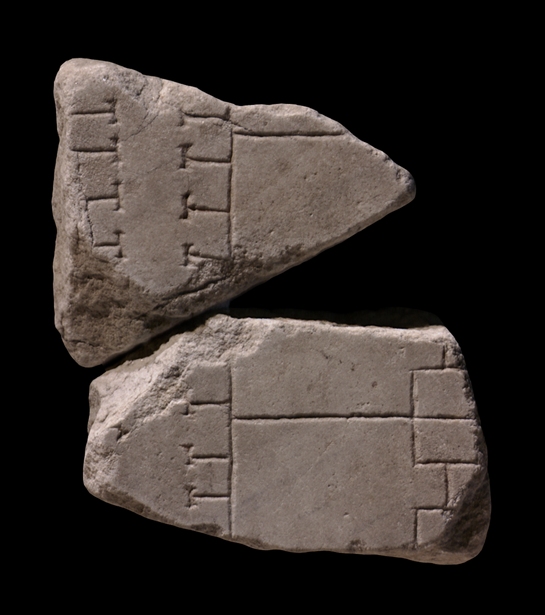
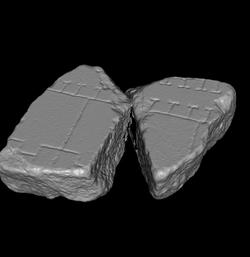
| Description A vertical street, flanked on both sides by tabernae, traverses the joined fragments on the left. The tabernae on the right back onto a series of at least three rectangular courtyards of similar dimensions. Smaller rooms are situated at the back of these courtyards.
Identification Rows of tabernae are ubiquitous on the Plan, and the type depicted here are of the most common type seen on the FUR. Each shop consisted of a single room with a wide opening towards the street that could be screened off at night. The owners probably resided with their families on a wooden platform in the back of the shop, although the small size of these particular tabernae may indicate they were strictly for commercial use. The courtyards in the rear may have served as common work spaces or additional residential areas for groups of shop owners. The architecture in this fragment is reminiscent of that in the top left corner of fr. 10abcd
, which represents a section of shops and courtyards along the via Sabuci, but is more rectilinear and perhaps belongs to an area of Rome with flatter topography.
Significance This fragment is typical of non-identified fragments of the Plan. No monumental buildings are represented, and the fragment instead provides a view of the lesser known structures that made up the urban fabric of Rome: the residential and commercial buildings.
|
|
| HISTORY OF FRAGMENT |
| Like the majority of FUR fragments, this piece was discovered in 1562 in a garden behind the Church of Saints Cosmas and Damian. From here, it was transferred to the Palazzo Farnese and stored there. It was not among the fragments that were reproduced in the Renaissance drawings that are now kept in the Vatican, but Giovanni Pietro Bellori included it in his 1673 publication. In 1742, the fragment was moved to the Capitoline Museums and exhibited with some of the other known fragments in wooden frames along the main staircase. Since then, it has been stored with the other FUR fragments in various places: the storerooms of the Capitoline Museums (1903-1924), the Antiquarium Comunale (1924-1939), the Capitoline Museums again (1939-1955), the Palazzo Braschi (1955-1998), and since 1998 in the Museo della Civiltà Romana in EUR under the auspices of the Sovraintendenza ai Beni Culturali del Comune di Roma. (This fragments history corresponds to Iter E as summarized in PM 1960, p. 56.)
Text by Tina Najbjerg |
|
| KEYWORDS
|
| tabernae, courtyards |
|
 Prev
Prev