ID AND LOCATION
| Stanford #
| 389 |
| AG1980 #
| 389 |
| PM1960 #
| 389 |
| Slab #
| unknown |
| Adjoins
| none |
CONDITION
| Located
| false |
| Incised
| true |
| Surviving
| true |
| Subfragments
| 1 |
| Plaster Parts
| 0 |
| Back Surface
| smooth |
| Slab Edges
| 1 |
| Clamp Holes
| 0 |
| Tassello
| no |
TECHNICAL INFO
|
|
|
|
|
|
|
|
|
|
|
| ANALYSIS
|
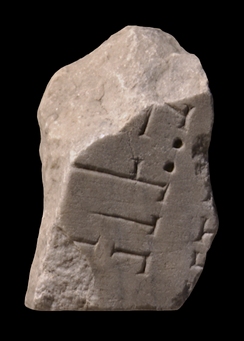
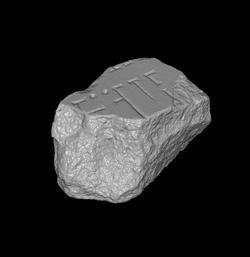
| Description The fragment was part of a slab edge. It depicts a narrow street or alley which separates a building on the left from a series of rooms (?) on the right. The building on the left consists on the bottom of a large room with at least three openings to the street and to an area below it. It is divided by a wall from rooms at top. Here, what seems to be a colonnaded entrance (two columns are visible) gives access to a larger room at top left.
Identification E. Rodríguez-Almeida has claimed that this fragment joined with fr. 710 (Rodríguez-Almeida 1978-1980). In AG 1980, however, he seems to have let go of that claim and merely suggests that this fragment belongs to the same slab as fr. 710 and the large group 711 (AG 1980, p. 181).
Significance If Rodríguez-Almeida's location of this fragment with fragment group 710 and 711 is correct, then it seems to have been part of a large section of mainly commercial nature. |
|
| HISTORY OF FRAGMENT |
| The fragment was discovered between 1867 and 1899, when the aula of the Forum Pacis was excavated (PM 1960, p. 138). Since then, it has presumably been stored with the other known FUR fragments in various places: the storerooms of the Commissione Archeologica (until 1903), the Capitoline Museums (1903-1924), the Antiquarium Comunale (1924-1939), the Capitoline Museums again (1939-1955), the Palazzo Braschi (1955-1998), and since 1998 in the Museo della Civiltà Romana in EUR under the auspices of the Sovraintendenza ai Beni Culturali del Comune di Roma. (This fragments history corresponds to Iter G as summarized in PM 1960, p. 56.)
Text by Tina Najbjerg |
|
| KEYWORDS
|
| street, columns |
|
 Prev
Prev