ID AND LOCATION
| Stanford #
| 391a |
| AG1980 #
| 391a |
| PM1960 #
| 375 c |
| Slab #
| unknown |
| Adjoins
| 391b |
CONDITION
| Located
| false |
| Incised
| true |
| Surviving
| true |
| Subfragments
| 1 |
| Plaster Parts
| 0 |
| Back Surface
| smooth |
| Slab Edges
| 0 |
| Clamp Holes
| 0 |
| Tassello
| no |
TECHNICAL INFO
|
|
|
|
|
|
|
|
|
|
|
| ANALYSIS
|
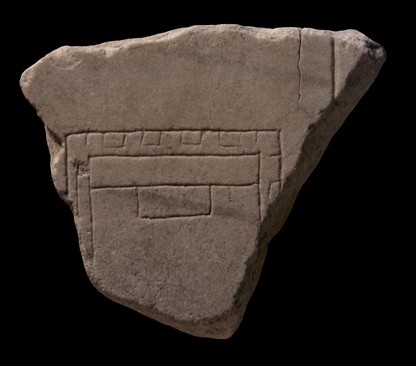
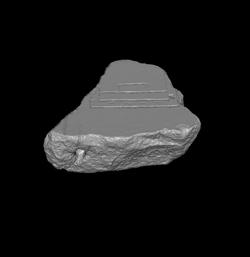
| Description The fragment depicts the rear of a podium temple. Square columns surround the cella, suggesting that the temple was peripteral. The individual columns are aligned along the outer edge of the podium. In the back of the cella an elongated podium or base spans the width of the building. It is fronted by another podium or perhaps a step. Top right, a vertical line runs parallel to the right side of the temple.
Identification During the printing of PM 1960, the authors realized that their proposed join between this fragment and frs. 375a and 375b was erroneous (PM 1960, p. 137). Instead, they joined it with fr. 391 (now 391b) in a drawing on p. 137. Peripteral temples like this one are ubiquitous on the Plan. They appear as the central temple in large, public porticus or in other public spaces, mainly in the monumental center of Rome. The join with fr. 391b demonstrates that there was a precinct wall close to the right side of this temple; it was therefore not the center piece of a large porticus. Unusual about this particular temple is the elongated pedestal at the rear of the cella.
Significance Given the generic nature of this temple, it is unlikely that we will ever discover to whom it was dedicated, unless the fragment is located within the Plan. |
|
| HISTORY OF FRAGMENT |
| Like the majority of FUR fragments, this piece was discovered in 1562 in a garden behind the Church of Saints Cosmas and Damian. From here, it was transferred to the Palazzo Farnese and stored there. It was not among the fragments that were reproduced in the Renaissance drawings that are now kept in the Vatican, but Giovanni Pietro Bellori included it in his 1673 publication. In 1742, the fragment was moved to the Capitoline Museums and exhibited with some of the other known fragments in wooden frames along the main staircase. Since then, it has been stored with the other FUR fragments in various places: the storerooms of the Capitoline Museums (1903-1924), the Antiquarium Comunale (1924-1939), the Capitoline Museums again (1939-1955), the Palazzo Braschi (1955-1998), and since 1998 in the Museo della Civiltà Romana in EUR under the auspices of the Sovraintendenza ai Beni Culturali del Comune di Roma. (This fragments history corresponds to Iter E as summarized in PM 1960, p. 56.)
Text by Tina Najbjerg |
|
| KEYWORDS
|
| temple, peripteral, columns, cella |
|
 Prev
Prev