ID AND LOCATION
| Stanford #
| 3A |
| AG1980 #
| 3A |
| PM1960 #
| 677 |
| Slab #
| X-7 |
| Adjoins
| none |
CONDITION
| Located
| true |
| Incised
| true |
| Surviving
| false |
| Slab Edges
| 0 |
| Clamp Holes
| 0 |
| Tassello
| no | |
|
|
|
|
|
BIBLIOGRAPHY
- AG 1980, pp. 57-62, figs. 14, 15, pl. 1
- LTUR II: Domus: L. Fabius Cilo (F. Guidobaldi), pp. 95-96
- PM 1960, p. 157, pls. 8, 59
- Richardson 1992, p. 124 (Domus: L. Fabius Cilo)
|
|
|
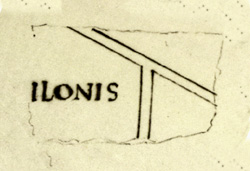
Detail from Cod. Vat. Lat. 3439 - Fo 18r,
reproduced from PM 1960, pl. 8 | |
PM 1960 Plates: 8 59
AG 1980 Plates: 1 60
|
|
| IDENTIFICATION |
| Renaissance drawing: House of L. Fabius Cilo (domus Cilonis)
|
|
| INSCRIPTION
Epigraphic conventions used |
| Transcription |
| None; the fragment itself is lost
|
| Renaissance Transcription |
| [---]ILONIS
|
| Reconstruction |
[DOMVS C]ILONIS (PM 1960)
[L. FABI C]ILONIS/H[ORTI ET DOMVS]/HORTI CELONIAE FABIA[E] (with frs. 45a and 45bc : AG 1980) |
|
|
|
|
|
| ANALYSIS
|
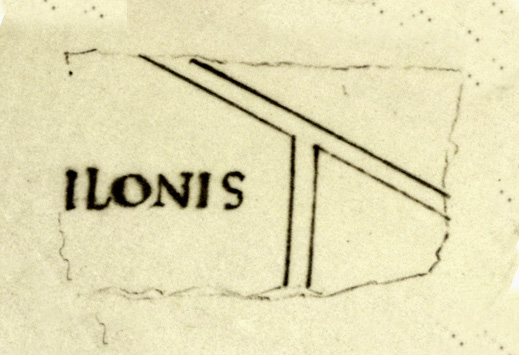
| Description The fragment is missing but was fortunately reproduced in Renaissance drawing Cod. Vat. Lat. 3439 - Fo 18r (see photo detail above or PM 1960, pl. 8, no. 5). The drawing shows that the fragment depicted two sets of straight, double lines that meet at an oblique angle. In the left side of the fragment, the partial inscription [---]ILONIS is visible. According to E. Rodríguez-Almeida, the top and left edges of the missing fragment were slab edges (AG 1980, p. 61).
Identification: Domus Cilonis G. Gatti identified the partial inscription in this missing fragment as the label for the estate of L. Fabius Cilo, consul in 193 and 204 CE and friend and urban prefect of the emperor Septimius Severus (PM 1960, p. 157; LTUR II, p. 95). Ancient sources reveal that Cilo's house was located in Regio 12 on the slopes of the Aventinus Minor, and the remains near the church of S. Balbina are generally associated with this sprawling estate (LTUR II, pp. 95-96 with some reservations about the identification). Based on this information, Rodríguez-Almeida suggested that the missing fragment belonged to the upper left corner of slab X-7 (AG 1980, p. 61, figs. 14 and 15a). Speculating that the inscription HORTI CELONIAE FABIA[E] in fr. 45a and bc refers to Cilo's wife and that it joins with the label in this fragment to produce [L. FABI C]ILONIS/H[ORTI ET DOMVS]/HORTI CELONIAE FABIA[E], Rodríguez-Almeida tentatively locates fr. 45 in the lower right corner of the adjacent slab, X-6 (AG 1980, p. 61, fig. 15a). To solve the problem of the different sizes of the inscriptions in the two fragments (with the wife's name being twice as big as that of Cilo's), he suggests that the Renaissance engraver of fr. 3A drew it at less than half-scale (see his fig. 15a for a proposed correction of the scale). While Rodríguez-Almeida's proposal is an attractive one, it must remain tenuous at best, especially considering a) the unknown scale of fr. 3A, b) the uncertain identity of the woman named in fr. 45, c) the disputed date and fragmentary state of the remains in the proposed location, and d) the large stretch of the posited inscription across one entire slab, not seen elsewhere on the FUR. What the double lines in this fragment depict is disputed; they might depict roads or very thick walls (PM 1960, p. 157).
Significance The missing fragment may identify and locate the estate of L. Fabius Cilo on the map and fill in the gap in our knowledge about the cityscape in this section of the Aventine Hill. In conjunction with frs. 24A and B (PRAEDIA ET HORREA GALBANA), the fragment demonstrates that the S and SE slopes of the Aventine were occupied by the sprawling estates of the elite and those favored by the emperor.
|
|
| HISTORY OF FRAGMENT |
| Like the majority of FUR fragments, this piece was discovered in 1562 in a garden behind the Church of Saints Cosmas and Damian. From here, it was transferred to the Palazzo Farnese and stored there. Renaissance engravers reproduced the fragment in 16th-c. drawings that are now kept in the Vatican (for more information about the creation and accuracy of these drawings, see Cod. Vat. Lat. 3439), and Giovanni Pietro Bellori included it in his 1673 publication. The whereabouts of the piece after this date are unknown. (This fragments history corresponds to Iter D as summarized in PM 1960, p. 56.)
Text by Tina Najbjerg
|
|
| KEYWORDS
|
| domus, house, street, walls, road, villa, estate, urban prefect, city prefect |
|
 Prev
Prev