| [FRAGMENT ANALYSIS IN PROGRESS]
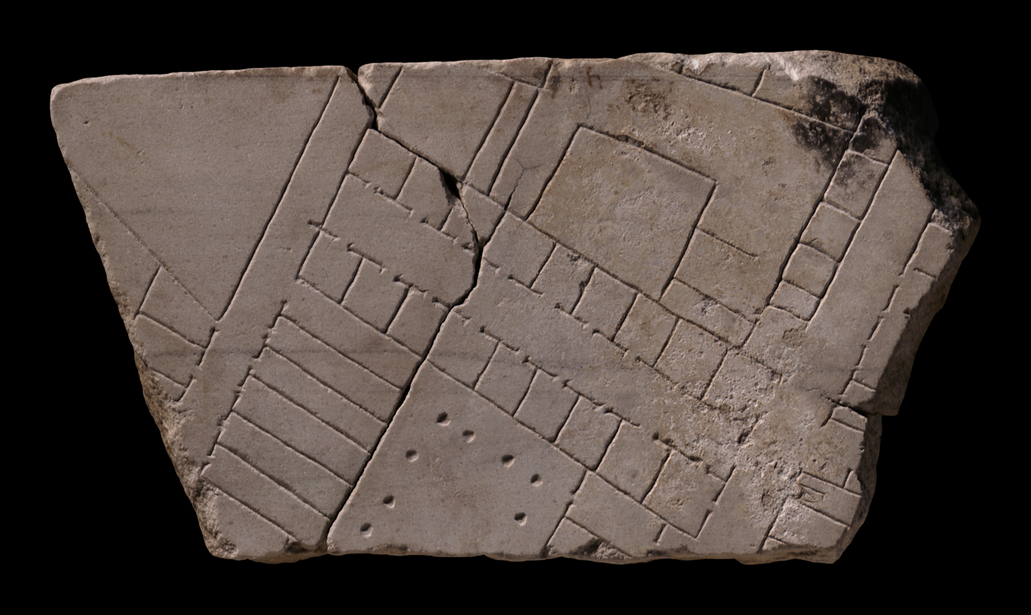
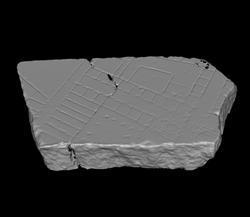
Description Two fragments with a slab edge at the top side and clamphole in the middle. A tassello (?) is located on the right side. Fragment 421a is on the left and 421b on the left. The breakage of the fragments along the line of the incisions is possibly the result of a sledge impact from the back side, as experimented by the Stanford Forma Urbis team (see
photo essay).
Two parallel streets run diagonal top right to bottom left on the left and right side of the fragments. The cluster on the left corner has a large open area on the top and three rooms flanking the street below. This cluster possibly continues into fragment 421c. The middle of the fragments has three different structures located between the two streets. The top structure has several large rectangular spaces, a row of small rooms (no openings) on the right side and a row of larger rooms on the top. The structure in the middle consists of two rows of rooms opening up to a middle corridor. The lower structure has a row of long and narrow rooms opening up to the street on the left. Behind these is an open space with a colonnade on the three visible sides. Two rooms are located to the right of this open space.
On the other side of the street to the right several spaces can be identified.
Identification: possible connection with 421c
-visible on Almeida drawing?
Identification: possible connection with 475 A combination of wall feature matching procedure and boundary incision matching at Stanford has proposed a match with fragment 475 (Koller-Levoy 2005, 9-10). The boundary incision matching algorithm identified a possible match between frs. 421and 475 (fig. 24). In this hypothetical join, three pairs of incisions align across the slab boundary between the two fragments, and the ductus is not dissimilar. Examination of the actual marble fragments confirmed the plausibility of this match (fig. 25).
When the wall feature matching procedure was executed on the combined frs. 421 and 475, the algorithm output two suggested locations on the wall (fig. 26), with one of the proposed locations ranked significantly higher in score than the other. The highest probability position for fragments 421 and 475 suggested by the wall feature matching process corresponds to a placement on the Aventine, with fr. 421 along the top center to the right of the Circus Maximus on slab VIII-6 and fr. 475 in the bottom right corner of slab IX-6 (fig. 27).
The clamp holes on frs. 475 and frs. 421ab correspond with Cozzas clamp holes B7-3 and B7-5, respectively. There are a number of additional factors which can be considered to support such a positioning. Since fr. 475 would be located in the same slab as frs. 7 (IX-6), it would be expected to share similar characteristics. Although the marble veining direction between fragments 7 and 475 appears reasonably compatible, the thickness of frs. 7e and 475 differ by almost a centimeter. However, the fragments would be positioned approximately 0.80 meters apart, and this variation in thickness is not unprecedented for areas so far apart within the same slab. One compelling similarity between frs 7e and 475 is the condition of the marble on the bottom slab edge surface; both fragments have a smooth textured band of the same width (ca. 45 mm) along this edge, and also exhibit a very similar curved pattern of sawing marks.
Because the suggested position of fr. 421 is in a previously unoccupied slab, there are no like comparisons that be made to evaluate its suitability here. It is worth noting, however, that the predominate angle of the dense architecture and streets on frs. 421ab is the same (28-30 degrees from vertical) as that on nearby fr. 21 (slab VII-14), and of excavated structures along the Clivus Publicius. Fragment 422
has strong similarities with fr. 421 in thickness, ductus, angle between architecture and veining direction (fig. 28).
Cozza (1968, p. 22) joins this fragment with fr. 423ab. Read article for reasons.
Significance
|
 Prev
Prev