ID AND LOCATION
| Stanford #
| 43a |
| AG1980 #
| 43a |
| PM1960 #
| 43 a |
| Slab #
| unknown |
| Adjoins
| none |
CONDITION
| Located
| false |
| Incised
| true |
| Surviving
| false |
| Slab Edges
| 0 |
| Clamp Holes
| 0 |
| Tassello
| no | |
|
|
|
|
|
|
|
|
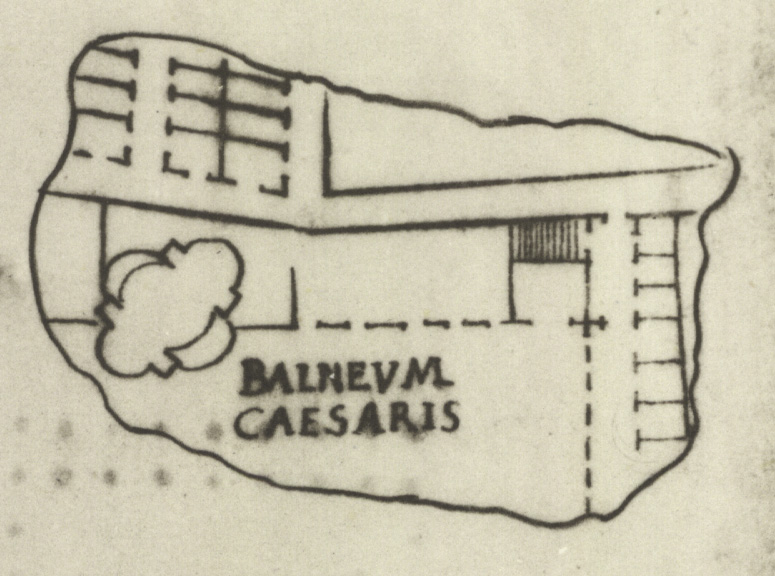
Detail from Cod. Vat. Lat. 3439 - Fo 22r,
reproduced from PM 1960, pl. 13 | |
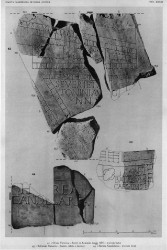
PM 1960 Plates: 13 33
AG 1980 Plates: 34
|
|
| IDENTIFICATION |
| Renaissance drawing: Baths of Caesar (balneum Caesaris)
|
|
| INSCRIPTION
Epigraphic conventions used |
| Transcription |
| None; the fragment itself is lost
|
| Renaissance Transcription |
| BALNEVM CAESARIS
|
| Reconstruction |
| BALNEVM CAESARIS (AG 1980; PM 1980) |
|
|
|
|
|
| ANALYSIS
|
| Description The fragment is now lost, but Renaissance drawing Cod. Vat. Lat. 3439 - Fo 22r shows it as it looked before it was separated from section b (see detailed photo above or PM 1960, pl. 13, no. 31). At top left were two vertical rows of rooms or tabernae, the row to the right being back to back. Top right was a large, rectangular enclosure. Below the rooms or shops and the enclosure ran a horizontal passageway or corridor. Only visible in fr. 43b is an opening and a staircase that connected this passageway to the area in the bottom of frs. 43a and b. This area or building was labeled BALNEUM CAESARIS. Most of this building is visible in fr. 43b. This lost piece only depicted an oval feature with arched ends and sides and four small protruding antae.
Identification: Balneum Caesaris The inscription in this fragment and in 43b conveniently identifies the structure depicted at the bottom as a bath (PM 1960, p. 111; Staccioli 1961, p. 96). The rooms at top may have formed one unit with the structure at the bottom (PM 1960, p. 111). The elaborate oval feature in the bottom of this missing fragment, unique on the Plan, defies identification (Staccioli 1961, p. 96). Its unusual shape and the fact that it does not seem to be part of a continuous row of hot, warm, and cold rooms typically found in a Roman bath may indicate it was a laconicum, a dry sweat bath. The imperial name of this bath has led to the assumption that it is to be associated with a Domitianic bathing complex on the Palatine, incorporated into the later Severan structure and completely transformed by Maxentius (PM 1960, p. 111; LTUR I, p. 156).
Significance There are many unidentified baths on the Plan. Some represent small neighborhood baths, balnea, others the large imperial thermae like those of Titus and Trajan. This fragment seems to depict a medium-sized bath complex, perhaps similar to that of Agrippa in fr. 38. Locating and identifying with certainty the bath in this lost fragment and its surviving companion 43b would allow us to assess the development of Roman neighborhood baths within Roman society and urban landscape. |
|
| HISTORY OF FRAGMENT |
| Originally part of a much larger piece, this fragment was discovered in 1562 in a garden behind the Church of Saints Cosmas and Damian. From here, it was transferred to the Palazzo Farnese and stored there. Renaissance engravers reproduced the complete fragment in 16th-c. drawings that are now kept in the Vatican (for more information about the creation and accuracy of these drawings, see Cod. Vat. Lat. 3439), and Giovanni Pietro Bellori included it in his 1673 publication. Some time thereafter, the piece broke in two, and while section b still survives, section a is now lost. A cast of the missing fragment was created in which section b was inserted (see fr. 43ab).(This fragments history corresponds to Iter D as summarized in PM 1960, p. 56.)
Text by Tina Najbjerg
|
|
| KEYWORDS
|
| bath, dry sweat bath, shops, passageway |
|
 Prev
Prev