ID AND LOCATION
| Stanford #
| 44a |
| AG1980 #
| 44a |
| PM1960 #
| 44 a |
| Slab #
| unknown |
| Adjoins
| 44abcde |
CONDITION
| Located
| false |
| Incised
| true |
| Surviving
| false |
| Slab Edges
| 0 |
| Clamp Holes
| 0 |
| Tassello
| no | |
|
|
|
|
|
|
|
|
Detail from Cod. Vat. Lat. 3439 - Fo 19r,
reproduced from PM 1960, pl. 9 | |
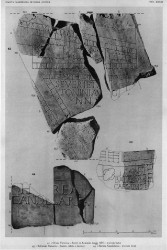
PM 1960 Plates: 9 33
AG 1980 Plates: 34
|
|
| IDENTIFICATION |
| Renaissance drawing: Lighting warehouse (horrea Candelaria)
|
|
| INSCRIPTION
Epigraphic conventions used |
| Transcription |
| None; the fragment is missing
|
| Renaissance Transcription |
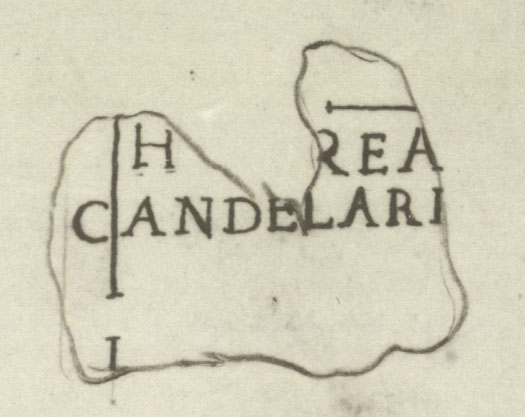
| H[..]REA/CANDELARI[.]
|
| Reconstruction |
| H[OR]REA/CANDELARI[A] (with frs. 44d and e: PM 1960; AG 1980) |
|
|
|
|
|
| ANALYSIS
|
| Description The fragment is missing but Renaissance drawing Cat. Vat. Lat. 3439 - Fo 19r shows it as it looked before it was separated from fr. 44bc (see detailed photo above or PM 1960, pl. 9, no. 4). It merely depicted part of the letter H, the first letter in the inscription H[OR]REA/CANDELARIA. The building thus designated was rendered in fr. 44bcde as three walls surrounding a rectangular space with a small opening at top and on the left side. Section 44b was part of a slab edge and had a clamp hole along the side.
Identification: Horrea Candelaria The inscription in this and in the once joining fr. 44bcde identifies the rectangular space as horrea Candelaria, warehouses for candles or all types of lighting material (PM 1960, p. 112). Unlike other horrea on the Plan, which consist of at least three rows of rooms surrounding and facing a central space, this warehouse seems to have consisted of a large open space, free of construction and simply flanked by four walls with narrow openings. E. Rodríguez-Almeida has suggested that the space within the walls was left free of permanent construction because of the fire danger from the particular materials kept here. The goods may have been kept under simple wooden roofs (Rodríguez-Almeida1970-71, p. 123; AG 1980, p. 152). The horrea Candelaria are not known from any other source and their location in Rome is unknown (LTUR III, p. 39). The similarity between the marble of this fragment group (44abcde) and the horrea Graminaria fragments 42a and 42b indicates that they were situated close together on the Map. The marble of these groups is also similar to that of slab IX-5, which may then locate them in the area of the clivus Victoriae, at the top of the Plan (AG 1980, p. 152; Rodríguez-Almeida 1970-71, p. 123).
Significance Together with fr. 44bcde, this missing fragment is our only source for the horrea Candelaria. |
|
| HISTORY OF FRAGMENT |
| The history of this missing fragment is not recorded in PM 1960, p. 112. However, since it was included in the 16th-c. drawings that are now kept in the Vatican (for more information about the creation and accuracy of these drawings, see Cod. Vat. Lat. 3439), it was probably discovered in 1562 behind the Church of Saints Cosmas and Damian, like the majority of FUR fragments. From the church, it was transferred to the Palazzo Farnese and stored there. When included in the Renaissance drawings, the fragment was still part of a larger piece. Some time thereafter, however, it broke off from the still surviving section 44bc and has been missing ever since. For the 1903 reconstruction of the Map in the Capitoline Museums, a plaster copy of this missing piece was made and joined to frs. 44bcde (see fr. 44abcde).
Text by Tina Najbjerg
|
|
| KEYWORDS
|
| ware house, lighting, open space, |
|
 Prev
Prev