ID AND LOCATION
| Stanford #
| 45a |
| AG1980 #
| 45a |
| PM1960 #
| 45 a |
| Slab #
| unknown |
| Adjoins
| 45bc |
CONDITION
| Located
| false |
| Incised
| true |
| Surviving
| false |
| Slab Edges
| 0 |
| Clamp Holes
| 0 |
| Tassello
| no | |
|
|
|
|
|
|
|
|
Detail from Cod. Vat. Lat. 3439 - Fo 19r,
reproduced from PM 1960, pl. 9 | |
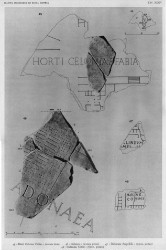
PM 1960 Plates: 9 34
AG 1980 Plates: 34
|
|
| IDENTIFICATION |
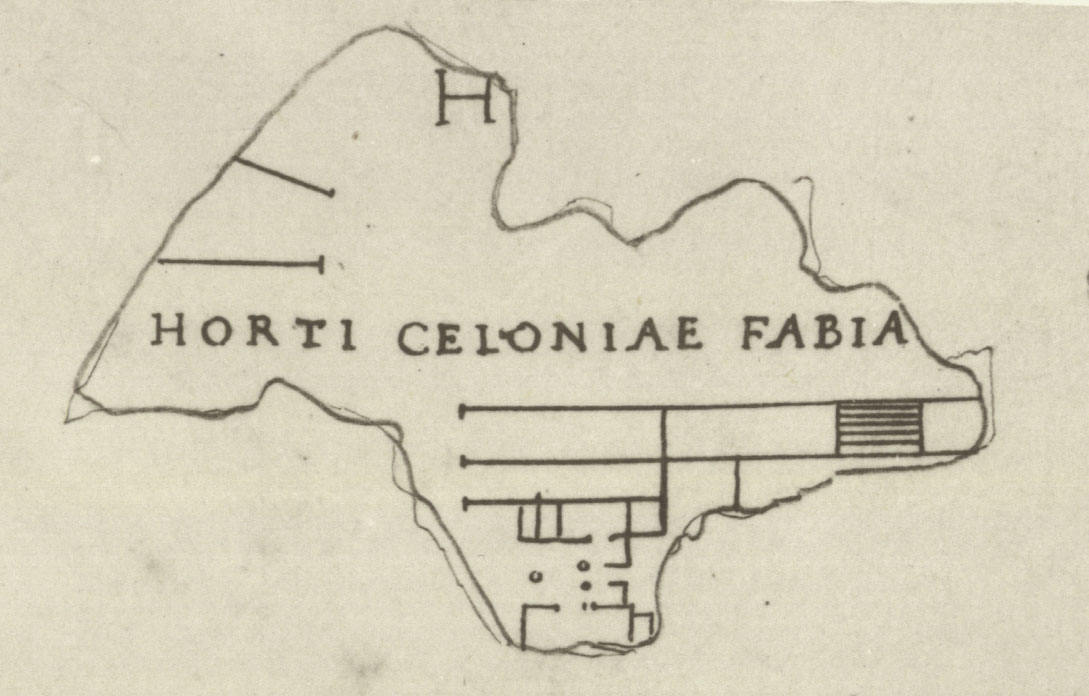
| Renaissance drawing: The Gardens of Celonia (Ceionia) Fabia (horti Celoniae [Ceioniae] Fabiae)
|
|
| INSCRIPTION
Epigraphic conventions used |
| Transcription |
| None; the fragment is missing
|
| Renaissance Transcription |
| H[---]/HORTI CEL*ONIAE FABIA[---]
|
| Reconstruction |
H[---]/HORTI CELONIAE FABIA[E] (AG 1980)
HORTI CEI*ONIAE FABIA[E] (PM 1960)
|
|
|
|
|
|
| ANALYSIS
|
| Description The fragment is largely missing, but Renaissance drawing Cod. Vat. Lat. 3439 - Fo 19r shows it as it looked in the 16th century (see detailed photo or PM 1960, pl. 9, no. 1). Two horizontal inscriptions traversed the fragment: At top right, the letter H was visible; across the center ran the almost complete inscription HORTI CEL*ONIAE FABIA[---]. The central portion of the latter inscription is visible in the still surviving fr. 45bc. Two straight lines, one horizontal, another at an oblique angle, appeared immediately above the HORTI section of the inscription and ran beyond the left edge of the fragment. In the bottom right corner of the piece, a large building was visible. It consisted of two horizontal lines, both terminating on the left underneath the letters CE. A wide staircase connected these walls and seemed to have given access to a large, open, rectangular space in the lower right corner. This area was also accessed from the left via a colonnaded opening, flanked on both sides by a series of rooms.
Identification: Horti Celoniae (Ceioniae) Fabiae The bottom inscription in this missing fragment identifies the large open space and the building below as the gardens of Celonia or Ceionia Fabia. Building upon an earlier theory that Celonia Fabia was the wife of Fabius Cilo, E. Rodríguez-Almeida has proposed to locate this fragment in the lower right corner of slab X-6, immediately to the left of the also lost fr. 3A in slab X-7, which may have labeled the property of L. Fabius Cilo, urban prefect under Septimius Severus (AG 1980, pp. 57-62, figs. 14-15). In this case, the horti in this fragment would have been situated on the Aventine hill. Despite the difference in scale between frs. 45a and 3A, according to the Renaissance drawings, Rodríguez-Almeida suggests that the inscriptions in these two fragments combine to read: [L. FABI C]ILONIS/H[ORTI ET DOMUS]/HORTI CELONIAE FABIA[E] (AG 1980, p. 61, fig. 15). It has also been proposed that the gardens belonged to Ceionia Fabia, the sister of Lucius Verus, and that they probably were situated in an area where there were many such gardens, such as the right river bank between Trastevere and the Vatican, the high areas of the Esquiline hill, or the Pinciano-Salaria area (LTUR III, p. 57).
Significance The great private and public gardens of imperial Rome are notoriously difficult to locate, as they left few archaeological traces behind. Inevitably, as Rome grew, they were parcelled out and built upon by later generations. The only key to their appearence, size, and location is provided by the Marble Plan and fragments such as this one.
|
|
| HISTORY OF FRAGMENT |
| This fragment was discovered in 1562 in a garden behind the Church of Saints Cosmas and Damian. From here, it was transferred to the Palazzo Farnese and stored there. Renaissance engravers reproduced the fragment in 16th-c. drawings that are now kept in the Vatican (for more information about the creation and accuracy of these drawings, see Cod. Vat. Lat. 3439), and Giovanni Pietro Bellori included it in his 1673 publication. At some point there after, the fragment broke and only two small sections survive today (fr. 45bc). The whereabouts of the larger section, a, are unknown. (This fragments history corresponds to Iter D as summarized in PM 1960, p. 56.)
Text by Tina Najbjerg
|
|
| KEYWORDS
|
| horti, gardens, columns, steps |
|
 Prev
Prev