ID AND LOCATION
| Stanford #
| 471 |
| AG1980 #
| 471 |
| PM1960 #
| 471 |
| Slab #
| unknown |
| Adjoins
| none |
CONDITION
| Located
| false |
| Incised
| true |
| Surviving
| true |
| Subfragments
| 1 |
| Plaster Parts
| 0 |
| Back Surface
| smooth |
| Slab Edges
| 1 |
| Clamp Holes
| 2 |
| Tassello
| no |
TECHNICAL INFO
|
|
|
|
|
|
|
|
|
|
|
| ANALYSIS
|
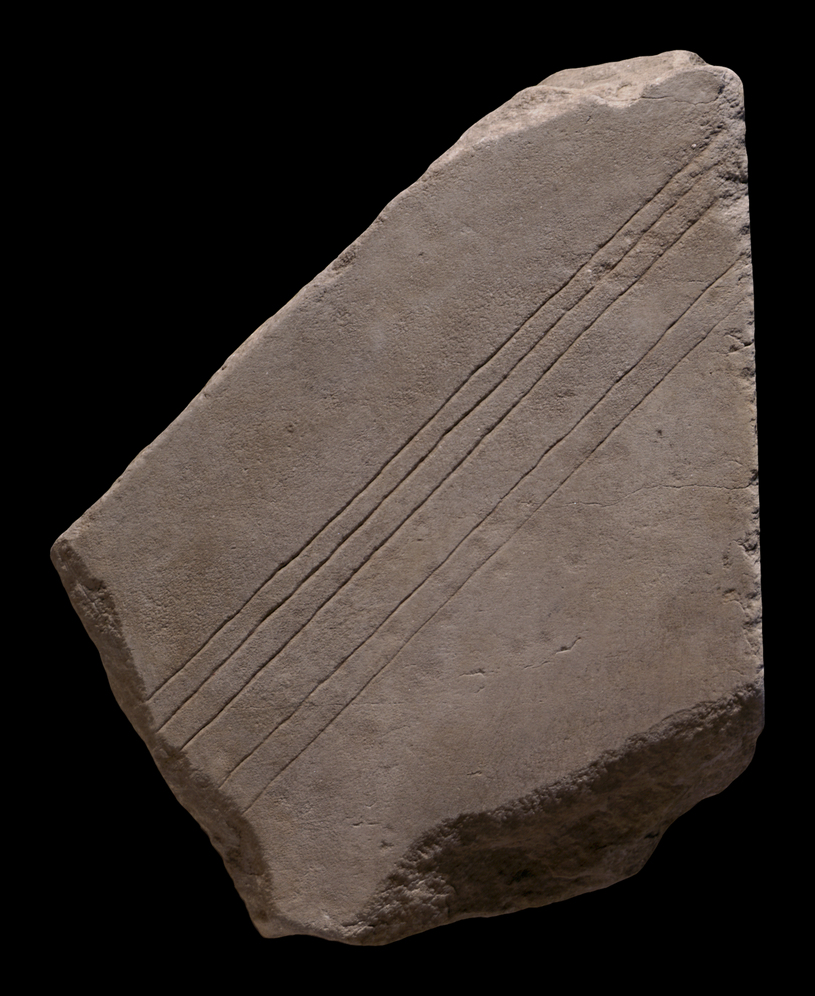
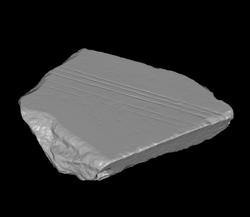
| Description A slab edge with two clamp holes lies along the right side of the fragment. A blank area was cut off from the upper-left edge during the Capitoline reconstruction of the Plan in 1742 to fit the fragment into a frame. Five long parallel incised lines cross the entirety of the fragment's top surface at a 44 degree angle to the slab edge. A slightly larger gap (24 mm) between two of the lines seemingly separates them into two groups.
Identification Early reconstructions identified this fragment with the Circus Flaminius, positioning the fragment along the long sides of the Circus area (PM 1960, pp. 90, 222, 225, pl. Agg. F fig. 19). However, by 1960, scholars had withdrawn this attribution as lacking foundation (PM 1960, pp. 143). R. Taylor suggested an identification for the fragment's parallel lines as banked seating for spectators at the Naumachia Augusti, and tentatively located the fragment along the lower right side of slab V-17 (Taylor 1997). However, this placement is not consistent with the expected marble veining direction as determined by other fragments positioned in this slab.
Significance The set of long lines incised on this fragment, surrounded by large blank spaces, suggests a distinct, dominant architectural structure, such as a circus or stadium. (Note that the angles of the lines relative to the slab edge may be appropriate for the Stadium of Domitian, for example).
|
|
| HISTORY OF FRAGMENT |
| Blank section of fragment was cut off during Capitoline Reconstruction in 1742 to fit it into the wooden frames (PM 1960, p. 27).
Like the majority of FUR fragments, this piece was discovered in 1562 in a garden behind the Church of Saints Cosmas and Damian. From here, it was transferred to the Palazzo Farnese and stored there. It was not among the fragments that were reproduced in the Renaissance drawings that are now kept in the Vatican, but Giovanni Pietro Bellori included it in his 1673 publication. In 1742, it was moved to the Capitoline Museums and exhibited with some of the other known fragments in wooden frames along the main staircase. During this reconstruction, a blank area was cut off from the fragment (PM 1960, p. 27). In 1903, museum curators included the fragment in a reconstruction of the FUR mounted on a wall behind the Palazzo dei Conservatori (1903-1924). Since then, the fragment has been stored with the other known FUR fragments in various places: the storerooms of the Antiquarium Comunale (1924-1939), the Capitoline Museums again (1939-1955), the Palazzo Braschi (1955-1998), and since 1998 in the Museo della Civiltà Romana in EUR under the auspices of the Sovraintendenza ai Beni Culturali del Comune di Roma. (This fragment's history corresponds to Iter E as summarized in PM 1960, p. 56.)
Text by David Koller and Tina Najbjerg.
|
|
 Prev
Prev