ID AND LOCATION
| Stanford #
| 48 |
| AG1980 #
| 48 |
| PM1960 #
| 48 |
| Slab #
| unknown |
| Adjoins
| none |
CONDITION
| Located
| false |
| Incised
| true |
| Surviving
| false |
| Slab Edges
| 0 |
| Clamp Holes
| 0 |
| Tassello
| no | |
|
|
|
|
|
|
|
|
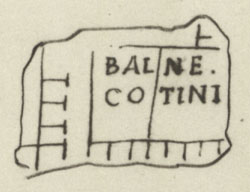
Detail from Cod. Vat. Lat. 3439 - Fo 22r,
reproduced from PM 1960, pl. 13 | |
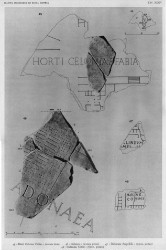
PM 1960 Plates: 13 34
AG 1980 Plates: 34
|
|
| IDENTIFICATION |
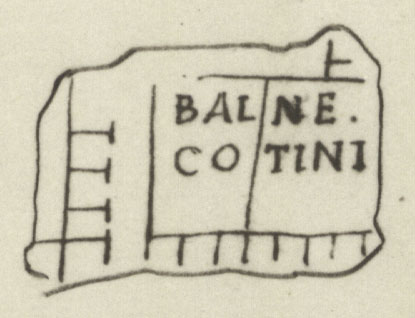
| Renaissance drawing: Baths of Cotinus (balneum Cotini)
|
|
| INSCRIPTION
Epigraphic conventions used |
| Transcription |
| None; the fragment is missing
|
| Renaissance Transcription |
| BALNE[..]/COTINI
|
| Reconstruction |
| BALNE[UM]/COTINI (PM 1960; AG 1980) |
|
|
|
|
|
| ANALYSIS
|
| Description The fragment is lost but Renaissance drawing Cod. Vat. Lat. 3439 - Fo 22r shows what it depicted (see detailed photo above or PM 1960, pl. 13, no. 11). On the right, a large rectangular open space was divided in two by a vertical line. The inscription was placed in this space. A row of rooms or shops backed onto the bottom of this rectangular area. On the left, a narrow passageway separated the rectangular space from a vertical row of shops that faced it.
Identification: Balneum Cotini The inscription conveniently identifies the rectangular structure as part of a bath complex, the balneum Cotini. This bath is not known from any other source (PM 1960, p. 114). Its irregular layout is characteristic of smaller neighborhood baths (Staccioli 1961, p. 93). E. Rodríguez-Almeida has suggested that the vertical line in the rectangular space perhaps separated the bath into women's and men's sections (LTUR I, p. 159).
Significance There are many unidentified baths on the Plan. Some represent small neighborhood baths, balnea, others the large imperial thermae like those of Titus and Trajan. This fragment seems to depict a small or medium-sized bath complex. Locating this lost fragment would allow us to assess the development of Roman neighborhood baths in the urban landscape. |
|
| HISTORY OF FRAGMENT |
| Like the majority of FUR fragments, this piece was discovered in 1562 in a garden behind the Church of Saints Cosmas and Damian. From here, it was transferred to the Palazzo Farnese and stored there. Renaissance engravers reproduced the fragment in 16th-c. drawings that are now kept in the Vatican (for more information about the creation and accuracy of these drawings, see Cod. Vat. Lat. 3439), and Giovanni Pietro Bellori included it in his 1673 publication. The whereabouts of the piece after this date are unknown. (This fragments history corresponds to Iter D as summarized in PM 1960, p. 56.)
Text by Tina Najbjerg
|
|
| KEYWORDS
|
| bath, tabernae |
|
 Prev
Prev