ID AND LOCATION
| Stanford #
| 492(*) |
| AG1980 #
| 492 |
| PM1960 #
| 492 |
| Slab #
| unknown |
| Adjoins
| none |
CONDITION
| Located
| false |
| Incised
| true |
| Surviving
| true |
| Subfragments
| 1 |
| Plaster Parts
| 0 |
| Back Surface
| smooth |
| Slab Edges
| 0 |
| Clamp Holes
| 0 |
| Tassello
| no |
TECHNICAL INFO
|
|
|
|
|
|
|
|
|
|
|
| ANALYSIS
|
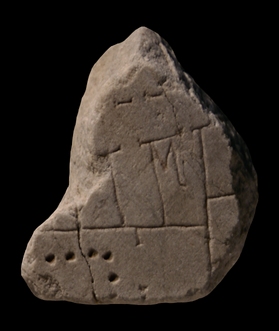
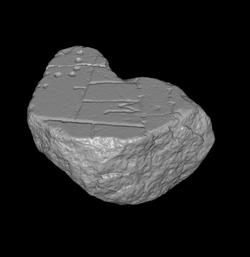
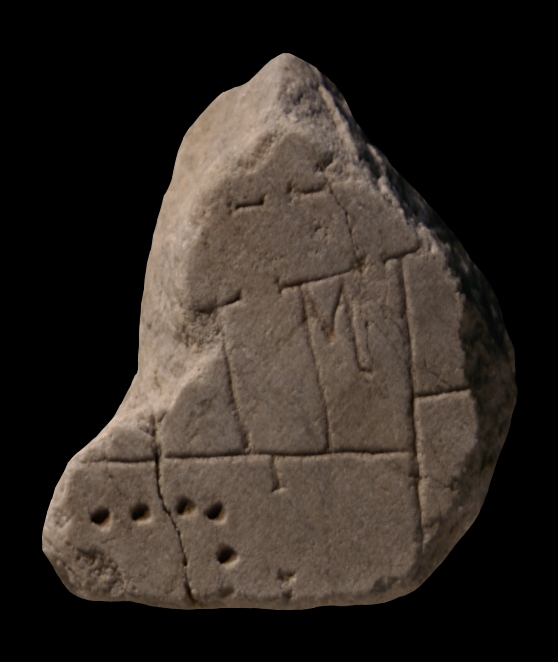
| Description At the top of this small fragment, a dashed horizontal line depicts a covered arcade separating a street just above it from a covered sidewalk just below. At least three tabernae open onto the sidewalk and street. These tabernae become elongated toward the right side of the fragment; the longest, at center right, has a staircase in it. These shops back onto the outer wall of an enclosed portico. The portico consists of an open central space, a rectangular colonnade around it (here represented by a line of dots), a covered walkway between the colonnade and the outside wall, and a large room at right that opens onto the walkway. Along the right edge of the fragment, a second building begins; visible are a taberna opening onto the sidewalk and street, and a larger space behind.
Identification This fragment depicts a common type of architectural grouping on the Plan: a row of tabernae with an open court behind. The Plan does not show any access from the tabernae to the open space, but D. Reynolds (1996, pp. 163-164, figs. 3.14 and 3.15) has argued that such connections were common and desirable in the crowded city because they allowed open space to be shared. The many courtyards on the Plan must have had a variety of residential, commercial, industrial and monumental uses. The colonnade made this one relatively luxurious.
Significance This piece is typical of the many unidentified fragments of the Plan. No monumental buildings are represented; instead, this fragment depicts the mix of spaces, functions and activities that made up the urban fabric of Rome. |
|
| HISTORY OF FRAGMENT |
| Like the majority of FUR fragments, this piece was discovered in 1562 in a garden behind the Church of Saints Cosmas and Damian. From here, it was transferred to the Palazzo Farnese and stored there. It was not among the fragments that were reproduced in the Renaissance drawings that are now kept in the Vatican, but Giovanni Pietro Bellori included it in his 1673 publication. In 1742, the fragment was moved to the Capitoline Museums and exhibited with some of the other known fragments in wooden frames along the main staircase. Since then, it has been stored with the other FUR fragments in various places: the storerooms of the Capitoline Museums (1903-1924), the Antiquarium Comunale (1924-1939), the Capitoline Museums again (1939-1955), the Palazzo Braschi (1955-1998), and since 1998 in the Museo della Civiltà Romana in EUR under the auspices of the Sovraintendenza ai Beni Culturali del Comune di Roma. (This fragments history corresponds to Iter E as summarized in PM 1960, p. 56.)
Text by Tina Najbjerg and Jennifer Trimble |
|
| KEYWORDS
|
| tabernae, colonnade, portico, arcade |
|
 Prev
Prev