ID AND LOCATION
| Stanford #
| 500 |
| AG1980 #
| 500 |
| PM1960 #
| 500 |
| Slab #
| unknown |
| Adjoins
| none |
CONDITION
| Located
| false |
| Incised
| true |
| Surviving
| true |
| Subfragments
| 1 |
| Plaster Parts
| 0 |
| Back Surface
| smooth |
| Slab Edges
| 0 |
| Clamp Holes
| 0 |
| Tassello
| no |
TECHNICAL INFO
|
|
|
|
|
|
|
|
|
|
|
| ANALYSIS
|
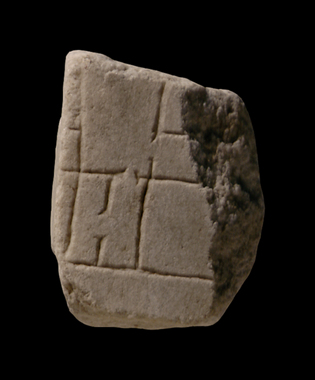
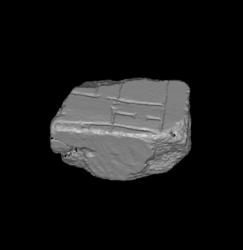
| Description The small fragment was from the edge of a slab. On the back, a raised ridge runs along the edge; according to PM 1960, pl. 51 and AG 1980, pl. 52, the veining of the marble runs parallel to it. The architecture engraved on the front consists of large rooms clustering around what might be an open square in the top left corner. Two of them open onto the square.
Identification Due to the small size of the piece, it is difficult to ascertain what type of architecture is engraved here. However, the relatively large size of the rooms may indicate that these are apartments, as opposed to shops.
Significance Past scholarship on the Plan has not paid much attention to small, unidentified fragments like this one. Digital 3D matching may now allow us to locate such pieces on the Plan and enrich our knowledge of non-monumental architecture in Rome. |
|
| HISTORY OF FRAGMENT |
| Together with the majority of the fragments, this piece was discovered in 1562 behind the Church of Saints Cosmas and Damian. It was rediscovered in 1888 or 1899 in a wall that framed the Secret Garden between the Farnese palace and the Tiber (PM 1960, p. 145).
Text by Tina Najbjerg and Jennifer Trimble. |
|
 Prev
Prev