ID AND LOCATION
| Stanford #
| 552a |
| AG1980 #
| 552a |
| PM1960 #
| 552 a |
| Slab #
| unknown |
| Adjoins
| 552b |
CONDITION
| Located
| false |
| Incised
| true |
| Surviving
| true |
| Subfragments
| 1 |
| Plaster Parts
| 0 |
| Back Surface
| smooth |
| Slab Edges
| 1 |
| Clamp Holes
| 0 |
| Tassello
| yes |
TECHNICAL INFO
|
|
|
|
|
|
|
|
|
|
|
| ANALYSIS
|
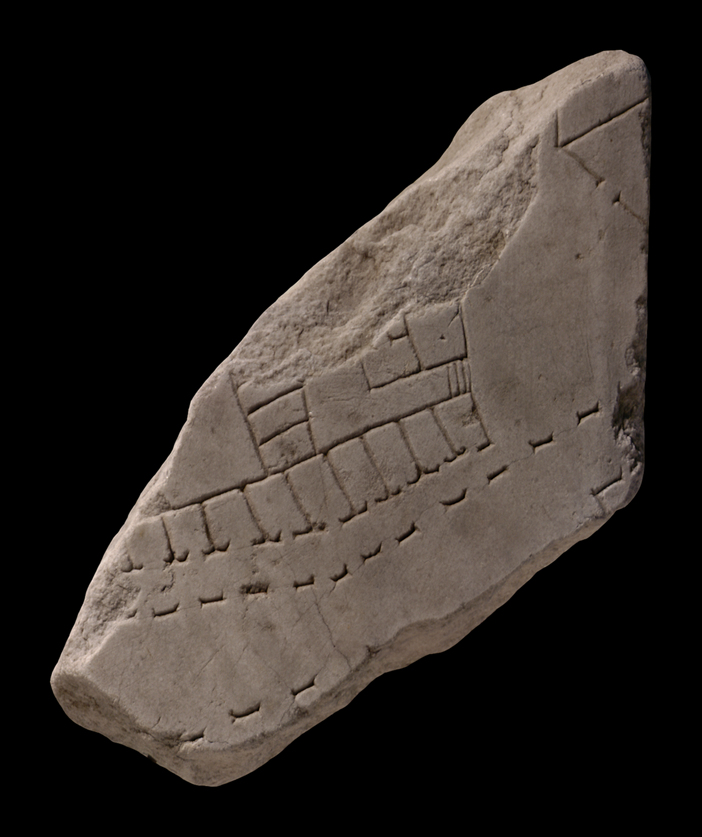
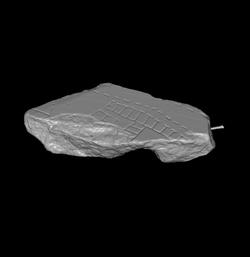
| Description The fragment was part of a slab edge. A wedge hole (tassello) is visible on the back (AG 1980, pl. 55). A slightly curved street winds its way from the bottom left of the fragment towards the top right where it becomes a seemingly triangular piazza. The street is lined with an arcade all along its course on the left side - the arcade even continues across the piazza - and on its right side at least part of the way. On the left, behind the portico , a row of tabernae follows the shape of the street. The row stops at the left side of the piazza. Around the corner from the last shop, steps or a ramp lead to a narrow alley that runs behind the shops, then make a right turn. It frames two rooms on the right, and on the left lies another row of rooms, perpendicular to the first row of shops. None of these rooms shows any openings, which may be an engraver's mistake, or they are accessed from above. The joining fr. 552b
shows that large tabernae flanked the porticoed street also on the right side. At top right, behind the piazza, parts of two large rooms are visible. One of them has a small opening towards the piazza.
Identification Rows of tabernae are ubiquitous on the Plan, and the type depicted here are of the most common type seen on the FUR. Each shop consisted of a single room with a wide opening towards the street that could be screened off at night. The owners might have resided with their families on a wooden platform in the back of the shop. The luxury of having a covered sidewalk in front of a row of shops was apparently not restricted to such grandiose areas as the slopes of the Palatine, facing the Circus Maximus (see fr. 8bde). Frs. 33abc, 34a, 34b and 34c depict a large, predominantly commercial area by the Tiber which abounds with rows of tabernae and arcades. This fragment might belong to either such areas. These covered arcades or porticos signify that there was a second storey or a mezzanine level above the shops, which would have provided the shop owners with additional living room (Reynolds 1996, p. 158). The slight curve of the street and the stepped ramp indicate that the fragment depicts a somewhat hilly section of the city. The width of the street and the fact that it was lined on both sides suggest that it was one of Rome's major thoroughfares.
Significance This fragment is a classic example of non-identified fragments of the Plan. No monumental buildings are depicted, and the fragment instead provides a view of the equally important, but lesser known commercial and residential structures. |
|
| HISTORY OF FRAGMENT |
| Like the majority of FUR fragments, this piece was discovered in 1562 in a garden behind the Church of Saints Cosmas and Damian. From here, it was transferred to the Palazzo Farnese and stored there. It was not among the fragments that were reproduced in the Renaissance drawings that are now kept in the Vatican, but Giovanni Pietro Bellori included it in his 1673 publication. In 1742, the fragment was moved to the Capitoline Museums and exhibited with some of the other known fragments in wooden frames along the main staircase. Since then, it has been stored with the other FUR fragments in various places: the storerooms of the Capitoline Museums (1903-1924), the Antiquarium Comunale (1924-1939), the Capitoline Museums again (1939-1955), the Palazzo Braschi (1955-1998), and since 1998 in the Museo della Civiltà Romana in EUR under the auspices of the Sovraintendenza ai Beni Culturali del Comune di Roma. (This fragments history corresponds to Iter E as summarized in PM 1960, p. 56.)
Text by Tina Najbjerg |
|
| KEYWORDS
|
| street, ramp, arcade, portico, tabernae, piazza |
|
 Prev
Prev