ID AND LOCATION
| Stanford #
| 554 |
| AG1980 #
| 554 |
| PM1960 #
| 554 |
| Slab #
| unknown |
| Adjoins
| none |
CONDITION
| Located
| false |
| Incised
| true |
| Surviving
| true |
| Subfragments
| 1 |
| Plaster Parts
| 0 |
| Back Surface
| smooth |
| Slab Edges
| 0 |
| Clamp Holes
| 0 |
| Tassello
| no |
TECHNICAL INFO
|
|
|
|
|
|
|
|
|
|
|
| ANALYSIS
|
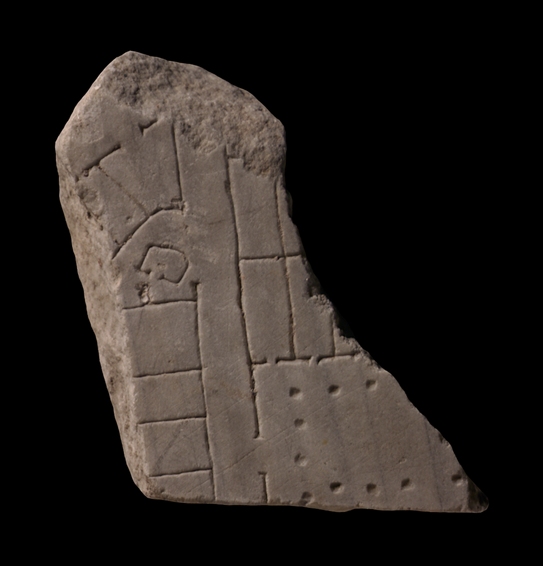
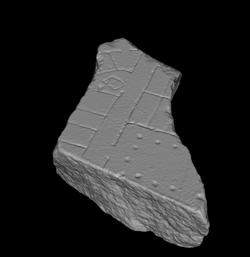
| Description A straight, vertical street traverses the fragment in the center. On the right, at the bottom, lies a rectangular, colonnaded courtyard, or peristyle, which is accessed from the vertical street via a small, central opening. A row of elongated rooms opens onto the peristyle from above. They seem to back onto another row of similar rooms at top right. On the left side, four rooms of equal size back onto the lower part of the vertical street. At top left, the vertical street becomes a small, irregular piazza with a small enclosure centered in it. Above, a row of tabernae curve around the piazza toward the left. They face away from the piazza.
Identification The peristyle in this fragment is accessed from the street and is probably of public use. The entry is narrow, however, which perhaps indicates that limited public access was desired. The large rooms that flank the peristyle look like shops, and the whole complex may have been a local market, a macellum. Another option is that the rooms are apartments, made luxurious by the addition of the peristyle - always a desirable feature in the crowded neighborhoods of Rome. The rooms that curve around the little piazza are probably regular tabernae, however, of the type so commonly seen on the FUR. Each shop consisted of a single room with a wide opening towards the street that could be screened off at night. The owners may have resided with their families on a wooden platform in the back of the shop. The enclosure in the small piazza may have been a neighborhood shrine (Sartorio 1988, p. 32).
Significance This fragment shows what is probably a typical neighborhood of Rome, with residential and commercial structures side by side with small altars or fountains of communal use. |
|
| HISTORY OF FRAGMENT |
| The fragment was discovered between 1867 and 1899, when the aula of the Forum Pacis was excavated (PM 1960, p. 149) Since then, it has presumalby been stored with the other known FUR fragments in various places: the storerooms of the Commissione Archeologica (until 1903), the Capitoline Museums (1903-1924), the Antiquarium Comunale (1924-1939), the Capitoline Museums again (1939-1955), the Palazzo Braschi (1955-1998), and since 1998 in the Museo della Civiltà Romana in EUR under the auspices of the Sovraintendenza ai Beni Culturali del Comune di Roma. (This fragments history corresponds to Iter G as summarized in PM 1960, p. 56.)
Text by Tina Najbjerg |
|
| KEYWORDS
|
| tabernae, street, peristyle, colonnade, shrine, |
|
 Prev
Prev