ID AND LOCATION
| Stanford #
| 558 |
| AG1980 #
| 558 |
| PM1960 #
| 558 |
| Slab #
| unknown |
| Adjoins
| none |
CONDITION
| Located
| false |
| Incised
| true |
| Surviving
| true |
| Subfragments
| 1 |
| Plaster Parts
| 0 |
| Back Surface
| smooth |
| Slab Edges
| 0 |
| Clamp Holes
| 0 |
| Tassello
| no |
TECHNICAL INFO
|
|
|
|
|
|
|
|
|
|
|
| ANALYSIS
|
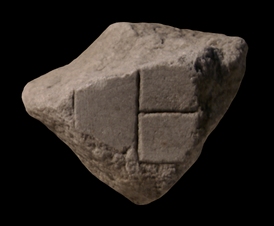
| Description Two small rooms of exact same size, side by side, are visible on the right. On the left, a line runs parallel to the common back/front of the rooms.
Identification The fragment is too small to warrant an identification of its architecture.
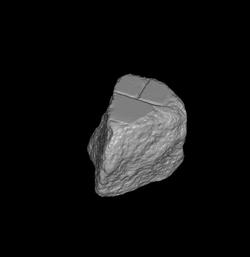
Significance 3D digital matching may allow us to join this fragment to already identified and located areas on the Plan.
|
|
| HISTORY OF FRAGMENT |
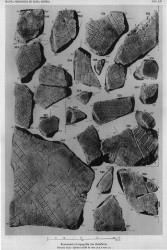
| The fragment was possibly discovered between 1867 and 1899, when the aula of the Forum Pacis was excavated (PM 1960, p. 149). Since then, it has probably been stored with the other known FUR fragments in various places: the storerooms of the Commissione Archeologica (until 1903), the Capitoline Museums (1903-1924), the Antiquarium Comunale (1924-1939), the Capitoline Museums again (1939-1955), the Palazzo Braschi (1955-1998), and since 1998 in the Museo della Civiltà Romana in EUR under the auspices of the Sovraintendenza ai Beni Culturali del Comune di Roma. (This fragments history may correspond to Iter G as summarized in PM 1960, p. 56.)
Text by Tina Najbjerg |
|
| KEYWORDS
|
| rooms |
|
 Prev
Prev