ID AND LOCATION
| Stanford #
| 563b |
| AG1980 #
| 563b |
| PM1960 #
| 547 |
| Slab #
| unknown |
| Adjoins
| 563a |
CONDITION
| Located
| false |
| Incised
| true |
| Surviving
| true |
| Subfragments
| 1 |
| Plaster Parts
| 0 |
| Back Surface
| smooth |
| Slab Edges
| 1 |
| Clamp Holes
| 0 |
| Tassello
| no |
TECHNICAL INFO
|
|
|
|
|
|
|
|
|
|
|
| ANALYSIS
|
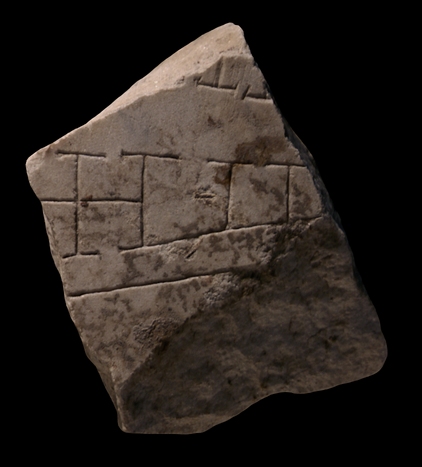
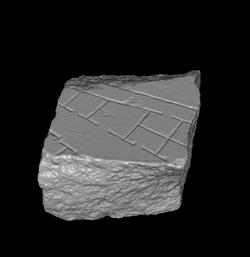
| Description The fragment was part of a slab edge. A street traverses the piece from center left to top right. It continues along the bottom of the joining fr. 563a. The street is flanked at top by what seems to be a row of tabernae. Also below it is framed by a row of shops, those on the left being back-to-back tabernae. A straight line runs parallel to the back wall of this bottom row of shops. It might represent the edge of a sidewalk.
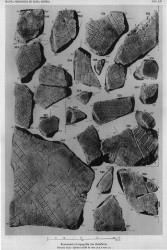
Identification Rows of tabernae are ubiquitous on the Plan, and the type depicted here are of the most common type seen on the FUR. Each shop consisted of a single room with a wide opening towards the street that could be screened off a night. The owners may have resided with their families on a wooden platform in the back of the shop. In 1970, E. Rodríguez-Almeida joined this small piece with the large fr. 563a (Rodríguez-Almeida 1970-71, p. 133), thus demonstrating that the fragment formed part of a large commercial and residential section of Rome. The lack of staircases or ramps and the relatively rectilinear layout of the architecture in the larger fragment further suggest that the group was located in a flat area of Rome.
Significance This fragment is typical of non-identified fragments of the Plan. No monumental buildings are represented, and the fragment instead provides a view of the lesser known structures that made up the urban fabric of Rome: the residential and commercial buildings.
|
|
| HISTORY OF FRAGMENT |
| The fragment was discovered during excavations along the Via dei Fori Imperiali (PM 1960, p. 148, does not specify a date). Since its publication in PM 1960, the fragment has been stored with the other known FUR fragments in various places: the Palazzo Braschi (1955-1998), and since 1998 in the Museo della Civiltà Romana in EUR under the auspices of the Sovraintendenza ai Beni Culturali del Comune di Roma.
Text by Tina Najbjerg
|
|
| KEYWORDS
|
| tabernae |
|
 Prev
Prev