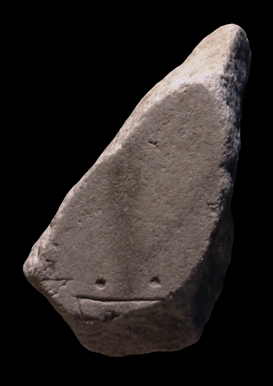
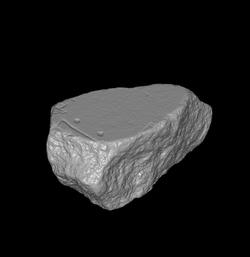
| Description At the bottom, the fragment depicts the corner of a structure with two columns of a colonnade placed alongside its wall. The corner of another feature is visible in the right edge, a little above the colonnaded feature.
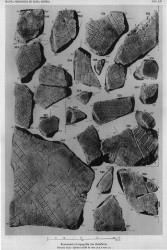
Identification: Thermae Traiani In 1994, E. Rodríguez-Almeida joined this fragment with fr. 10wxy from the Baths of Trajan in slab VIII-3 (Rodríguez-Almeida 1994b). The two fragments fit together with a "lock" of the marble. The angle created between a faint guideline and the marble veining helped place the fragment. Comparison with the caldarium group from the Baths of Trajan (10wxy) shows the same angle between the veining and the guideline, an orthogonal guideline dividing the space into symmetrical halves, the same architectonic structure, and the same thickness. The fragment perhaps depicts the tepidarium, elaborated architecturally as a passageway between the caldarium and the frigidarium. It shows that this room had, at both ends, a double passageway with central body, elaborated on the 'outside' of the room and flat on the 'inside'. On the caldarium end, the caldarium side was niched/apsidal, and the side facing the intervening room was flat. At the far end, on the frigidarium side, the interior was again flat, and the far side was elaborated with two columns and flanking antae with columns at the end.
This enormous bath complex was built between 104 and 109 CE by the architect Apollodorus of Damascus (Cassius Dio 69.4.1) on a great platform at the top of the Oppian Hill in Regio III (LTUR V, p. 67). Standing and excavated remains, combined with drawings of the Baths made in the Renaissance and the fragments of the FUR tell us of their internal design (see LTUR V, figs. 42-43 for Piranesi's drawing of the remains and for a reconstruction that includes the actual remains). Like all the imperial thermae of Rome from at least the Baths of Titus onward (fr. 110), these were designed as a central bathing block within a large open space (ca. 300 x 216 m) surrounded by a precinct wall that included additional rooms and architectural features. The bathing block proper was placed against the center of the NE precinct wall to give maximum sun exposure to the hot rooms, which were situated in a row along the SW side of the building (partly visible on fr. 10wxy)(LTUR V, p. 68). The bathing rooms were symmetrically duplicated on either side of a central axis, the line of which is faintly visible in the guideline on this fragment and on fr. 10lm. This central axis began at the monumental entrance in the NE wall and led directly into the natatio, depicted as a large, colonnaded square at the bottom right of fr. 10i. From there, this axis extended through a great central cruciform hall, not visible on the surviving fragments of the Plan, and finally into the tepidarium and the caldarium. Visitors could move off this central axis into suites of small rooms near the entrance, perhaps dressing rooms (see fr. 10i). Two elaborately built rotundae with curving walls that were interrupted at each corner by triple niches, probably filled with statuary (frs. 10i and 10z), may have been frigidaria. There were rectangular palaestrae as well, not visible on the surviving Plan fragments, and numerous smaller rooms throughout. Along the SW side of the bathing block, on either side of the caldarium, is a row of sunrooms, placed to take maximum advantage of the sun. The visitor might also turn left or right from the monumental entrance along a colonnaded passageway which led to a suite of rooms within the NE precinct wall and ultimately to the great hemicycles at the far ends. The northernmost hemicycle is depicted in frs.
10r,
10s, and
12.
Fr. 10i depicts the southern hemicycle. These hemicycles are thought to have been monumental display fountains; they looked out onto the large open area that enclosed the bathing block on three sides. In these gardens were meeting rooms and libraries, the latter perhaps in the semicircular exedrae near the S and W corners of the outer wall, one of which survives to this day with two storeys of niches (LTUR V, p. 68). At the far end of this open area, at the center of the SW wall of the precinct, a vast hemicycle opened outward (frs. 13q and 13r). Seats around its curve suggest that this was a space for performances or athletic contests (Richardson 1992, p. 397). Staircases along the SW precinct wall and other minor entrances gave access to the Baths from multiple directions.
The Baths of Trajan were built on a massive platform supported by a series of vaulted tunnels; they covered much of the filled-in Esquiline wing of Nero's Golden House (domus Aurea), damaged in a fire in 104 CE and no longer in use. Some later sources refer to the emperor Domitian as the builder, but this is contradicted by the Trajanic brickstamps found in the complex, the building's unified design, and the epigraphic and textual evidence of the Baths' dedication in 109 CE (LTUR V, p. 67). The immense water supply needed was provided in part if not entirely by the aqua Traiana and distributed to the Baths from the huge nearby cistern divided into nine long chambers and known as the Sette Sale (LTUR V, pp. 68-69; this is not depicted on the surviving fragments of the Plan). The Baths remained in use into the 4th and 5th c. CE; they may have been experiencing gradual abandonment even before their decisive ending in 537 CE when the aqueducts were cut by Vitigis' Ostrogothic army. In the 16th c. and later, the surviving remains on the Oppian were referred to indiscriminately as the Baths of Trajan and the Baths of Titus until R. Lanciani (BullCom 1895, pp. 110-115) disentangled this conflation (LTUR V, p. 67). Only one fragment of the Plan, fr. 110, has been associated thus far with the adjacent Baths of Titus.
Significance Along with the other fragments that depict the Baths of Trajan, this group is key to our knowledge of the architecture of this monument of which little remains; in addition, it gives us insight into the work of their architect, Apollodorus of Damascus (Cassius Dio 69.4.1) who also designed Trajan's Forum. Comparison to other imperial thermae on the Marble Plan (Baths of Agrippa in fr. 38 and Baths of Titus in fr. 110) shows great consistency in the rendering of the architecture of such buildings: Rooms are symmetrically arranged around the center axis; great hemicycles add variety to the otherwise rectilinear design, and the walls of the central bathing building proper are rendered with thick, recessed lines on the FUR. Whether these thick lines represent the thickness of the actual walls, or are merely symbolic renderings, is uncertain. The symmetrical and rectilinear architecture of these thermae forms a stark contrast to the small, irregular neighborhood baths, the balnea, usually hidden in crowded insulae. The difference is probably caused by the organic growth of small baths within already existing neighborhoods, and the free development of the large thermae in blank spaces where preexisting buildings had been removed to give the imperial architects free reigns.
The Baths of Trajan fragments are also invaluable in clarifying the role complexes such as these played in the social life of Rome. Women as well as men used these Baths (LTUR V, p. 67 with reference), and the complex included not only the great central bathing block, but also gardens, probably libraries, a large semi-circular area with seating that would have provided room to watch sports or performances, clubrooms and informal meeting rooms.
|
 Prev
Prev