ID AND LOCATION
| Stanford #
| 57d |
| AG1980 #
| 57d |
| PM1960 #
| 57 d |
| Slab #
| unknown |
| Adjoins
| 57abc |
CONDITION
| Located
| false |
| Incised
| true |
| Surviving
| false |
| Slab Edges
| 0 |
| Clamp Holes
| 0 |
| Tassello
| no | |
|
|
|
|
|
|
|
|

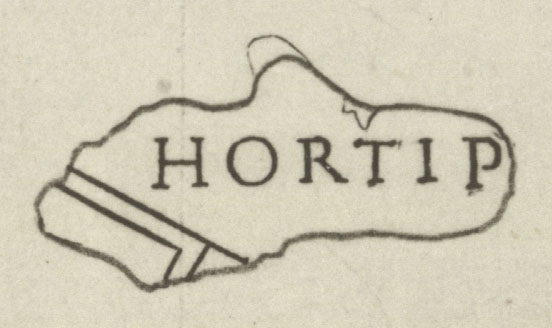
Detail from Cod. Vat. Lat. 3439 - Fo 19r,
reproduced from PM 1960, pl. 9 | |
PM 1960 Plates: 9 35
AG 1980 Plates: 36
|
|
| IDENTIFICATION |
| Renaissance drawing: Gardens of Pallas (horti Pallantiani) or of Pompey (horti Pompeiani)?
|
|
| INSCRIPTION
Epigraphic conventions used |
| Transcription |
| None; the fragment itself is missing
|
| Renaissance Transcription |
| HORTI P[---]
|
| Reconstruction |
| HORTI P[---] (with fr. 57abc: PM 1960; AG 1980) |
|
|
|
|
|
| ANALYSIS
|
| Description The fragment is missing but Renaissance drawing Cod. Vat. Lat. 3439 - Fo 19r shows it as it looked when still in one piece with frs. 57abc (see detailed photo above or PM 1960, pl. 9, no. 2). The letters HORTIP[---] traversed the entire fragment. In the lower left, the corner of a building appeared (visible in the surviving fr. 57abc). It consisted of a rectangular space flanked on the long side by at least four columns. A long wall separated this building from the open space in which the letters were inscribed.
Identification: Horti Pallantiani? The incomplete label in this and fr. 57abc has tentatively been reconstructed as horti Pallantiani, thus referring to the Gardens of Pallas, the emperor Claudius' powerful freedman (PM 1960, p. 117; LTUR III, p. 77). Three passages by Frontinus (aq 69) locate the gardens, known to have been situated in Regio V, to an area between the fourth tower of the Aurelian Walls, south of the porta Tiburtina, the final tower of the aqua Claudia, near the so-called Temple to Minerva Medici, and a point near the Porta Maggiore (LTUR III, p. 77). If correctly identified, fragments 57 should be located in the extreme upper left of the Severan Marble Plan.
Identification: Horti Pompeiani? The horti P[---] in this fragment may have also been associated with the horti Pompeiani, the gardens of Pompey the Great. After his death, the gardens were appropriated by Marc Antony, and they later seemed to have been parcelled out, with at least one part belonging to the Statilius family (LTUR III, p. 78). The exact location of Pompey's gardens is uncertain. Scholars have situated them on the W slope of the Pincian Hill, on the S slope of the Quirinal, and in the Campus Martius (LTUR III, pp. 78-79 with references).
Significance Although this fragment is missing, the joining fr. 57abc demonstrates that it came from a rough-backed slab. E. Rodríguez-Almeida has proven that there were few rough-backed slabs on the Marble Plan (Rodríguez-Almeida 1992, fig. 17); if the distribution of rough-backed slabs in the upper left corner and in the area of the Campus Martius could be determined, it might be possible to locate the exact position of this fragment. |
|
| HISTORY OF FRAGMENT |
| Originally part of a larger fragment, this piece was discovered in 1562 in a garden behind the Church of Saints Cosmas and Damian. From here, it was transferred to the Palazzo Farnese and stored there. Renaissance engravers reproduced the fragment in its entirety in 16th-c. drawings that are now kept in the Vatican (for more information about the creation and accuracy of these drawings, see Cod. Vat. Lat. 3439), and Giovanni Pietro Bellori included it in his 1673 publication. At some point after that, the fragment broke in four pieces of which only sections 57a, b, and c survive. Section d was lost.
Text by Tina Najbjerg
|
|
| KEYWORDS
|
| gardens, horti, Pompey, Pallas, colonnade, porticus |
|
 Prev
Prev