ID AND LOCATION
| Stanford #
| 633 |
| AG1980 #
| 633 |
| PM1960 #
| 633 |
| Slab #
| unknown |
| Adjoins
| none |
CONDITION
| Located
| false |
| Incised
| true |
| Surviving
| true |
| Subfragments
| 1 |
| Plaster Parts
| 0 |
| Back Surface
| smooth |
| Slab Edges
| 0 |
| Clamp Holes
| 0 |
| Tassello
| no |
TECHNICAL INFO
|
|
|
|
|
|
|
|
|
|
|
| ANALYSIS
|
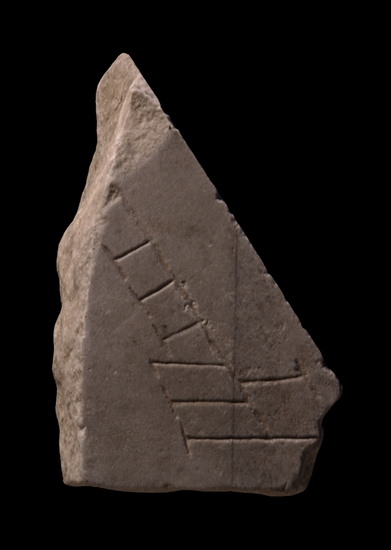
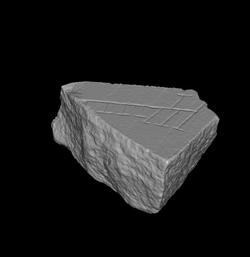
| Description A diagonal row of tabernae, facing left, frame an open space on the right. The right side of the fragment was cut off during the Capitoline reconstruction of the Plan in 1742 to fit the fragment into a frame, suggesting that the open space to the right of the shops was substantial. The top part of the row consists of five small, regular shops; the last two rooms in the row are longer and they are skewed in relation to the upper shops. These two shops back onto a single room.
Identification Rows of tabernae are ubiquitous on the Plan, and the type depicted here are of the most common type seen on the FUR. Each shop consisted of a single room with a wide opening towards the street that could be screened off at night. The owners may have resided with their families on a wooden platform in the back of the shop, although the small size of these particular tabernae may indicate they were strictly for commercial use. There were many blank areas on the Marble Plan. These included the spaces occupied by the Tiber River, by gardens, arenas, temple precincts, courtyards, or from the edges of the Map, basically any space devoid of architecture or human construction. This fragment could have belonged to any of those areas, with the row of shops defining a structure that imposes upon the open space. The thickness and smooth back of the fragment, however, place it with a group of fragments which E. Rodríguez-Almeida has shown belonged to the Tiber (for example 621abcd, e, and f, 625, and 630). The blank area of this fragment, removed in modern times, may then represent a part of the river.
Significance This fragment is typical of non-identified fragments of the Plan. No monumental buildings are represented, and the fragment instead provides a view of the lesser known residential and commercial buildings. It also provides an intersting view of how Roman surveys worked: The fact that the bottom shops are skewed in relationship to the ones at top may represent the surveyors' difficulty in matching up information from two different survey areas (PM 1960, p. 69, n. 3; Reynolds 1996, pp. 98-99). |
|
| HISTORY OF FRAGMENT |
| Like the majority of FUR fragments, this piece was discovered in 1562 in a garden behind the Church of Saints Cosmas and Damian. From here, it was transferred to the Palazzo Farnese and stored there. It was not among the fragments that were reproduced in the Renaissance drawings that are now kept in the Vatican, but Giovanni Pietro Bellori included it in his 1673 publication. In 1742, the fragment was moved to the Capitoline Museums and exhibited with some of the other known fragments in wooden frames along the main staircase. During this reconstruction, a blank area was cut off from the fragment (PM 1960, p. 153). Since then, it has been stored with the other FUR fragments in various places: the storerooms of the Capitoline Museums (1903-1924), the Antiquarium Comunale (1924-1939), the Capitoline Museums again (1939-1955), the Palazzo Braschi (1955-1998), and since 1998 in the Museo della Civiltà Romana in EUR under the auspices of the Sovraintendenza ai Beni Culturali del Comune di Roma. (This fragments history corresponds to Iter E as summarized in PM 1960, p. 56.)
Text by Tina Najbjerg
|
|
| KEYWORDS
|
| tabernae, Tiber |
|
 Prev
Prev