ID AND LOCATION
| Stanford #
| 636 |
| AG1980 #
| 636 |
| PM1960 #
| 636 |
| Slab #
| unknown |
| Adjoins
| none |
CONDITION
| Located
| false |
| Incised
| true |
| Surviving
| true |
| Subfragments
| 1 |
| Plaster Parts
| 0 |
| Back Surface
| not preserved |
| Slab Edges
| 0 |
| Clamp Holes
| 0 |
| Tassello
| no |
TECHNICAL INFO
|
|
|
|
|
|
|
|
|
|
|
| ANALYSIS
|
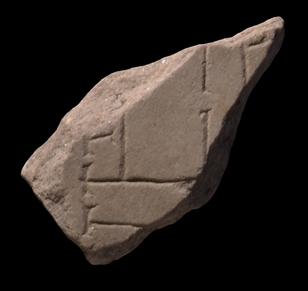
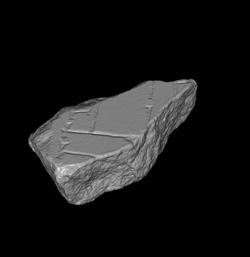
| Description The fragment depicts a section of a building. Part of the edge of the structure is visible on the left. Here, a series of rooms faces left, away from the building, the two upper, interconnected rooms being smaller and shorter than the two bottom rooms. Top center, a larger, rectangular space gives access to smaller rooms on the right.
Identification The two bottom rooms that front the building could represent tabernae. The rest of the rooms, however, may be of residential use, especially those in the interior of the building.
Significance This fragment is typical of non-identified fragments of the Plan. No monumental buildings are represented, and the fragment instead provides a view of the lesser residential and commercial buildings. 3D digital matching may allow us to join this fragment to already identified and located areas on the Plan.
|
|
| HISTORY OF FRAGMENT |
| The provenance of this fragment is unknown (PM 1960, p. 154). Presumably, it has been stored since its publication in PM 1960 with other known FUR fragments in the Palazzo Braschi (1955-1998), and since 1998 in the Museo della Civiltà Romana in EUR under the auspices of the Sovraintendenza ai Beni Culturali del Comune di Roma.
Text by Tina Najbjerg
|
|
 Prev
Prev