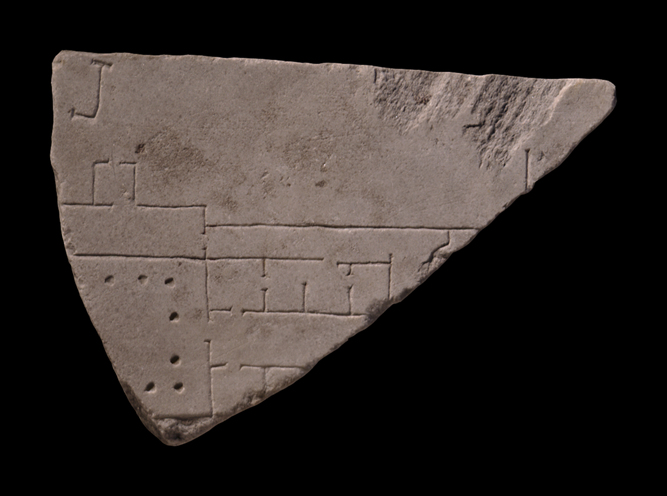
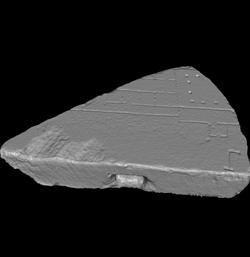
| Description The large fragment was part of a slab edge; a clamp hole is visible on the side. At the bottom of the fragment, horizontal with the slab edge, one sees a section of a large structure. It consists of a large peristyle on the left which has access to a long and wide horizontal corridor. This corridor is flanked, probably on both sides, by a row of four rooms that only connect to each other. Only the first room in the row has access from the central corridor. Flanking the peristyle and the corridor section at top are two long and narrow rooms that span the length of each of these sections. A small enclosure with an opening to the open space at top is attached to the elongated room above the peristyle. The elongated room that flanks the corridor rooms at top makes a right turn at their end and continues its course down the right end of the corridor section. In the top left corner of the fragment, outside the large building at the bottom, a bent wall section is visible.
Identification: Bath complex In 1961, R.A. Staccioli grouped the building in this fragment with small baths, balnea, on the Plan (Staccioli 1961, p. 100, pl. 44). All the characteristics of a small neighborhood bath complex are here: The peristyle functioned as the palaestra where people exercised or socialized in the shade of the covered porticos; the first room in the row of rooms flanking the corridor was probably the changing room (apodyterium), which led to a series of interconnected hot, warm or cold rooms (the caldarium, the tepidarium, and the frigidarium). The attached enclosure at top left may have been one of the entrances to the baths. It has also been identified as a small neighborhood shrine (Sartorio 1988, p. 32).
According to the Regionary Catalogues, 4th-c. Rome had 11 large imperial baths (thermae) and 856 small baths (balnea). Staccioli interpreted the difference between large imperial baths (thermae) and small baths (balnea) as follows: thermae were large, imperial bath complexes where rooms, some being non-essential for bathing, were arranged symmetrically around a central axis and within a single building. Balnea, on the other hand, were smaller neighborhood bath houses, generally of Republican origin. Their insertion into larger structures means that their architecture is irregular, that they mainly consist of rooms essential for bathing, and that they often lack a proper palaestra (good examples of such balnea are seen in frs. 10g,
25a,
330, and
377ab). This bath complex seems to fall between these two categories: It is not as large as the Baths of Agrippa, of Titus, or of Trajan. But it is contained within one building, it seems, and is symmetrically laid out, with the corridor being the central axis. Is this an example of a late Republican or early Imperial bath complex, one that shows the transition between the two?
Significance Only a fraction of the number of baths in Rome has been identified on the Plan thus far, and it is extremely likely that this fragment depicts one of them. Its divergence from the characteristics proposed for balnea and for thermae on the Plan makes it an especially interesting example.
|
| The fragment was discovered in the 1867 during excavations in the aula of the Forum Pacis (PM 1960, p. 154), and it was exhibited with other FUR fragments along the main staircase of the Capitoline Museums until 1883. In 1903, the museum curators included the piece in a reconstruction of the FUR mounted on a wall behind the Palazzo dei Conservatori (1903-1924). Since then, the fragment has been stored with the other known FUR fragments in various places: the storerooms of the Antiquarium Comunale (1924-1939), the Capitoline Museums again (1939-1955), the Palazzo Braschi (1955-1998), and since 1998 in the Museo della Civiltà Romana in EUR under the auspices of the Sovraintendenza ai Beni Culturali del Comune di Roma. (This fragments history corresponds to Iter F as summarized in PM 1960, p. 56.)
Text by Tina Najbjerg |
 Prev
Prev