ID AND LOCATION
| Stanford #
| 650 |
| AG1980 #
| 650 |
| PM1960 #
| 650 |
| Slab #
| unknown |
| Adjoins
| none |
CONDITION
| Located
| false |
| Incised
| true |
| Surviving
| true |
| Subfragments
| 1 |
| Plaster Parts
| 0 |
| Back Surface
| not preserved |
| Slab Edges
| 0 |
| Clamp Holes
| 0 |
| Tassello
| no |
TECHNICAL INFO
|
|
|
|
|
|
|
|
|
|
|
| ANALYSIS
|
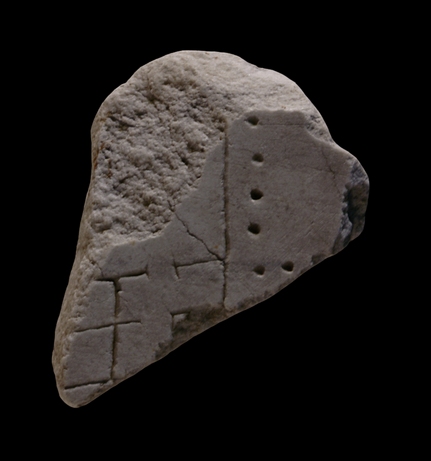
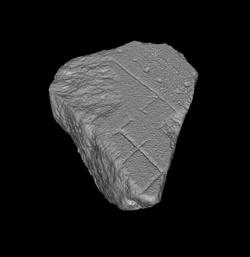
| Description The top right half of the pear-shaped fragment is occupied by a section of a colonnaded court, a peristyle. Seven columns are visible. Connected to the outside of the peristyle on the left are a few rooms that look like tabernae with back rooms.
Identification Courtyards were desirable features in the crowded city, and the addition of a covered colonnade like in this fragment was especially luxurious. Courtyards could be shared by a group of neighbors and shopowners and used as work spaces or simply extra living space. They might function as meeting grounds for one of Rome's many guilds or priesthoods. On occasion, when attached to bath complexes, they served a more specific function as a palaestra for exercise. The rooms to the left are probably tabernae although not enough remains to be certain. If they are shops with back rooms, the latter would have provide living quarters for the shop owner and his family. This back space could be blocked off from the front part of the shop by a wooden partition.
Significance This fragment seems to represent a view of the lesser known structures that made up the urban fabric of Rome: the residential and commercial buildings.
|
|
| HISTORY OF FRAGMENT |
| The provenance of this fragment is unknown (PM 1960, p. 154). Presumably, it has been stored since its publication in PM 1960 with other known FUR fragments in the Palazzo Braschi (1955-1998), and since 1998 in the Museo della Civiltà Romana in EUR under the auspices of the Sovraintendenza ai Beni Culturali del Comune di Roma.
Text by Tina Najbjerg |
|
| KEYWORDS
|
| tabernae, courtyard, colonnade |
|
 Prev
Prev