ID AND LOCATION
| Stanford #
| 674b |
| AG1980 #
| 674b |
| PM1960 #
| 674 b |
| Slab #
| unknown |
| Adjoins
| 674ac |
CONDITION
| Located
| false |
| Incised
| true |
| Surviving
| true |
| Subfragments
| 1 |
| Plaster Parts
| 0 |
| Back Surface
| sawn off |
| Slab Edges
| 0 |
| Clamp Holes
| 0 |
| Tassello
| no |
TECHNICAL INFO
|
|
|
|
|
|
|
|
|
Photograph (81 KB)
Note about photographs | |
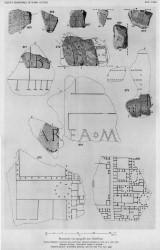
PM 1960 Plates: 9 58
AG 1980 Plates: 59
|
|
| IDENTIFICATION |
| Ar(e)a Matidiae on the Oppian Hill or Area Martis on the Caelian Hill?
|
|
| INSCRIPTION
Epigraphic conventions used |
| Transcription |
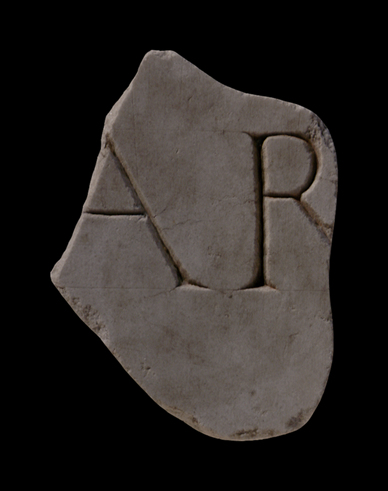
| [---]AR[---]
|
| Renaissance Transcription |
[---]AREA (leaf/star??) M[---]
(Cod. Vat. Lat. 3439 -- Fo 19 r, reproduced at PM 1960, pl. 9, no.3)
|
| Reconstruction |
AREA M[ATIDIAE] (with fr. 674ac; AG 1980)
AREA M[ARTI]S (with frs. 674ac and 200b; Ferrea 2002) |
|
|
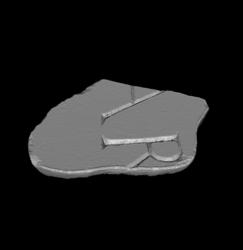
3D Model Full model
Download the viewer | Note about 3D models |
|
|
| ANALYSIS
|
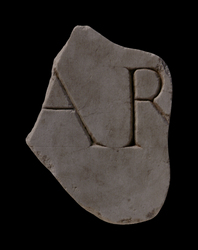
| Description The edges of this fragment have been sawed off and smoothed out. Two large letters, AR, traverse the piece.
Identification: Area Matidiae E. Rodríguez-Almeida has briefly suggested that this and the missing fr. 674ac label the hitherto unidentified ar(e)a Matidiae, mentioned in a late edict by Tarracius Bassus (CIL 6, 31.893b)(AG 1980, p. 168). Since the other monuments and areas mentioned in the edict are concentrated in Regions 1 to 5, this particular area or district was probably located on the Oppian Hill (AG 1980, p. 169, n.3).
Identification: Area Martis L. Ferrea has proposed that the letters AREA M[---] in this fragment and in the missing fr. 674ac be combined with the letters [---]IS in fr. 200b to read AREA M[ART]IS (Ferrea 2002, p. 65). The similar style and ductus of the letters in these fragments, as well as a visible guide line in both, seems to confirm this thesis. She suggests the fragments labeled an area on the Caelian Hill, the campus Martialis, which was known to have served as a place for military exercises when the Campus Martius was flooded. Imprecise rendering of fr. 674ac by the Renaissance engravers probably accounts for the slight misalignment of the lines in the fragments. Ferrea locates frs. 200a and b along the top edge of slab XI-6 and frs. 674ac and b in the upper right corner of slab X-5 (Ferrea 2002, fig. 66). They thus occupy the area just south of the Temple of Claudius on the Caelian Hill.
Significance If Ferrea's identification of this fragment and frs. 674ac, 200a, and 200b, is correct, it would present a significant gain for our knowledge of the topography of the Caelian Hill. |
|
| HISTORY OF FRAGMENT |
| Like the majority of FUR fragments, this piece was discovered in 1562 in a garden behind the Church of Saints Cosmas and Damian. From here, it was transferred to the Palazzo Farnese and stored there. Renaissance engravers reproduced the fragment in 16th-c. drawings that are now kept in the Vatican (for more information about the creation and accuracy of these drawings, see Cod. Vat. Lat. 3439), and Giovanni Pietro Bellori included it in his 1673 publication. Some time after that, the fragment broke into three pieces (674a, b, and c) of which only this fragment survives. In 1742, it was moved to the Capitoline Museums and exhibited with some of the other fragments in wooden frames along the main staircase. It was probably at this time that the edges of the piece were rounded off and smoothed out. Since then, the fragment has been stored with the other known FUR fragments in various places: the storerooms of the Capitoline Museums (1903-1924), in the Antiquarium Comunale (1924-1939), the Capitoline Museums again (1939-1955), the Palazzo Braschi (1955-1998), and since 1998 in the Museo della Civiltà Romana in EUR under the auspices of the Sovraintendenza ai Beni Culturali del Comune di Roma. (This fragments history corresponds to Iter B as summarized in PM 1960, p. 56.)
Text by Tina Najbjerg
|
|
 Prev
Prev