ID AND LOCATION
| Stanford #
| 675 |
| AG1980 #
| 675 |
| PM1960 #
| 675 |
| Slab #
| unknown |
| Adjoins
| none |
CONDITION
| Located
| false |
| Incised
| true |
| Surviving
| false |
| Slab Edges
| 0 |
| Clamp Holes
| 0 |
| Tassello
| no | |
|
|
|
|
|
|
|
|
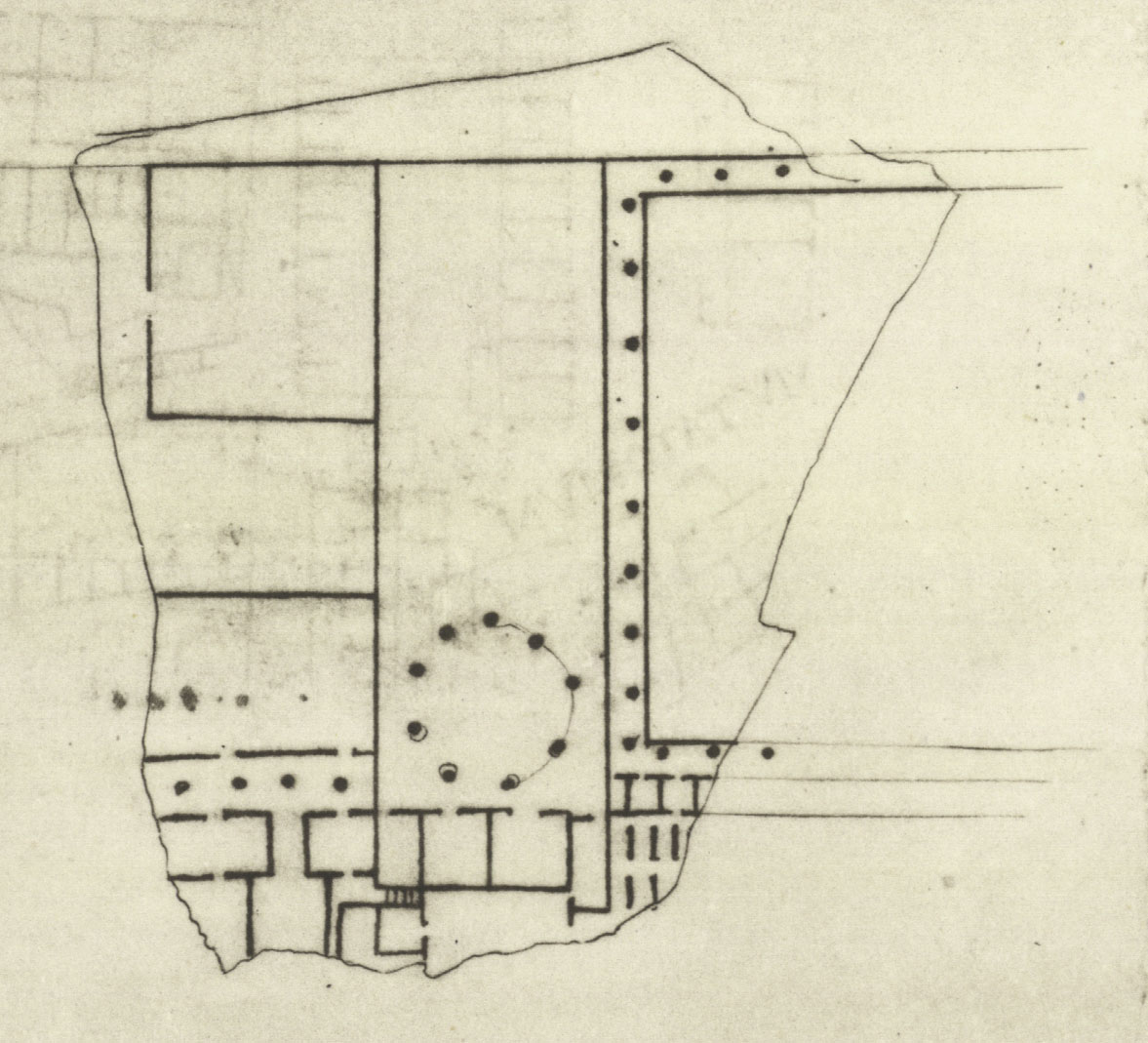
Detail from Cod. Vat. Lat. 3439 - Fo 15v,
reproduced from PM 1960, pl. 5 | |
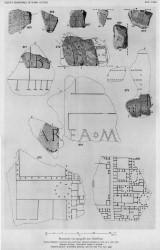
PM 1960 Plates: 5 58
AG 1980 Plates: 59
|
|
| IDENTIFICATION |
| Renaissance drawing: Unidentified architecture including a large colonnaded courtyard and a small, circular building (tholos?)
|
|
| INSCRIPTION |
| None |
|
|
|
|
|
| ANALYSIS
|
| Description The fragment itself is lost, but Renaissance drawing Cod. Vat. Lat. 3439 - Fo 15v shows it as it looked in the 16th century (see detail above or PM 1960, pl. 5, no. 2). On the far right, it depicted part of a colonnaded courtyard. A horizontal row of rooms opened onto the bottom edge of the portico. Below this row were two more rows of rooms, which open at both ends. Abutting the left side of the colonnaded courtyard was a large, open, elongated structure. It seems to have been accessed via a staircase and a series of small rooms at the bottom. Inside this space lay a circular building, consisting entirely of columns (a tholos?). The space immediately to the left of this structure was divided by a horizontal wall. Above it lay a rectangular structure with a central opening in the left wall. Below, an elongated space was fronted by a colonnade and a series of smaller rooms. E. Rodríguez-Almeida has suggested it was part of a slab corner (AG 1980, p. 168, pl. 59).
Identification The function of the three separate structures in this fragment is uncertain. Colonnaded courtyards are common on the Plan and they seem to have served many different purposes. Generally, small or medium-sized, colonnaded courtyards are incorporated into bath complexes, serve as garden spaces or vegetable plots in private houses, function as pleasant, open-air areas or work spaces behind rows of tabernae, or as common gardens in apartment complexes. In all these cases, access from the street to the courtyard is limited. The peristyle in this fragment, however, is extremely large and seems to have been accessed directly from the street which may indicate that it served a more public function than those mentioned above, perhaps as a large market.
The circular structure in the center is an enigma. Its shape is reminiscent of circular temples such as those to Vesta, Hercules, and Temple C in the Largo Argentina. However, it would be unusual for a temple to be enclosed within such a small space as here in this fragment. The circular structure could, however, have served as a small, private shrine for a priesthood or a collegium. The scholae or headquarters of such collegia tended to be small buildings with restricted access, as is the case in this fragment.
Significance The Renaissance drawing is the only existing evidence for this lost fragment.
|
|
| HISTORY OF FRAGMENT |
| Like the majority of FUR fragments, this piece was discovered in 1562 in a garden behind the Church of Saints Cosmas and Damian. From here, it was transferred to the Palazzo Farnese and stored there. Renaissance engravers reproduced the fragment in 16th-c. drawings that are now kept in the Vatican (for more information about the creation and accuracy of these drawings, see Cod. Vat. Lat. 3439), and Giovanni Pietro Bellori included it in his 1673 publication. The whereabouts of the piece after this date are unknown. (This fragments history corresponds to Iter D as summarized in PM 1960, p. 56.)
Text by Tina Najbjerg
|
|
| KEYWORDS
|
| tholos, circular, colonnade, courtyard, portico, tabernae, stairs |
|
 Prev
Prev