ID AND LOCATION
| Stanford #
| 678 |
| AG1980 #
| 678 |
| PM1960 #
| 678 |
| Slab #
| unknown |
| Adjoins
| none |
CONDITION
| Located
| false |
| Incised
| true |
| Surviving
| false |
| Slab Edges
| 0 |
| Clamp Holes
| 0 |
| Tassello
| no | |
|
|
|
|
|
|
|
|
Detail from Cod. Vat. Lat. 3439 - Fo 19r,
reproduced from PM 1960, pl. 9 | |
PM 1960 Plates: 9 59
AG 1980 Plates: 60
|
|
| IDENTIFICATION |
| Renaissance drawing: Unidentified architecture consisting mainly of large, rectilinear porticos
|
|
| INSCRIPTION |
| None |
|
|
|
|
|
| ANALYSIS
|
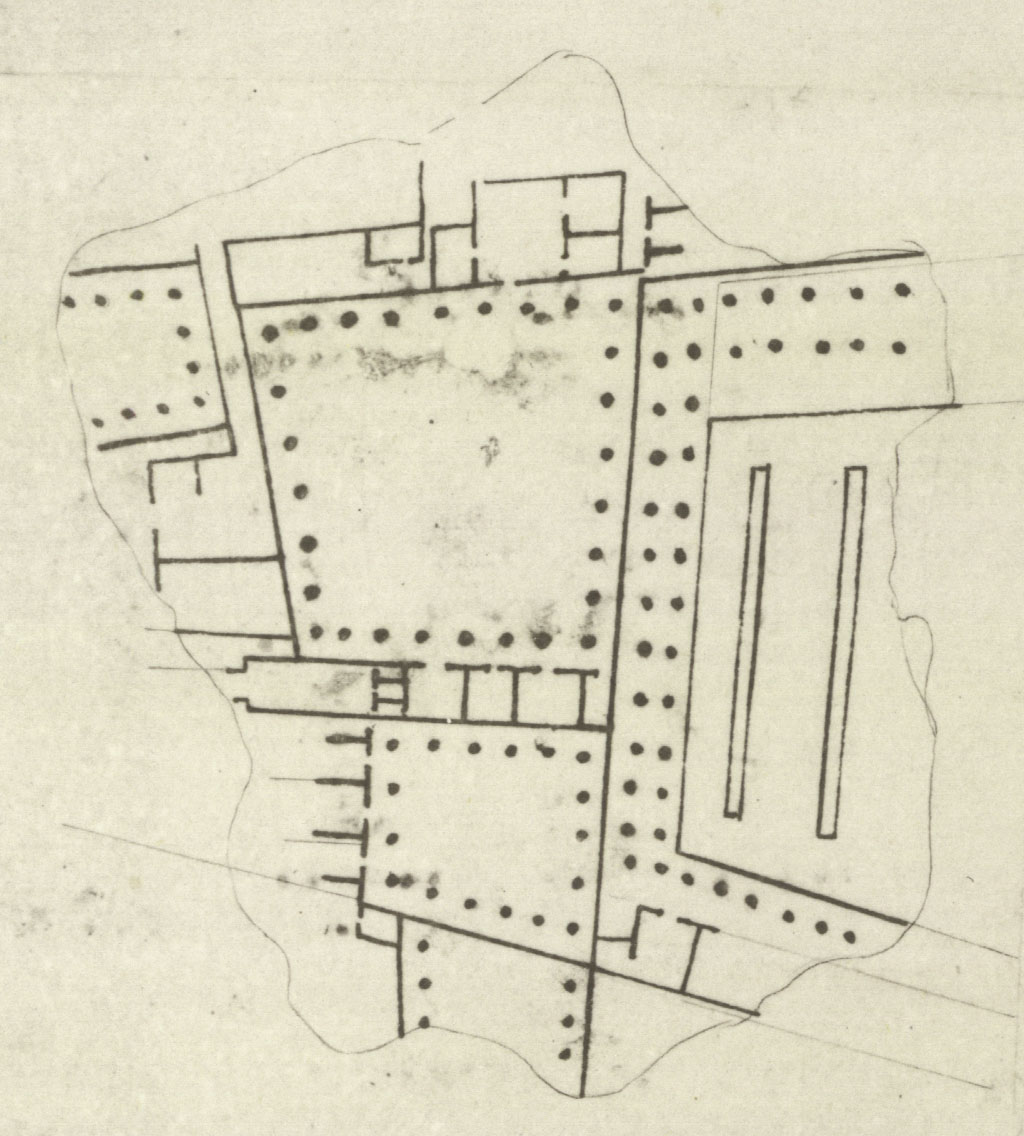
| Description The large fragment is lost but Renaissance drawing Cod. Vat. Lat. 3439 - Fo 19r shows it as it looked in the 16th century (see photo above or PM 1960, pl. 9, no. 12). It depicted a series of large, colonnaded spaces. On the right, double colonnades flanked an open space at top and on the left, while a single row of columns defined its edge at the bottom. In the lower left corner of this building was a small room. Two long, narrow features traversed its central courtyard vertically. Top center of the fragment was another large four-sided portico. It was faced at the bottom by three rooms. The only access to this large structure seems to have been through a small hall at top to which were attached three small rooms. The narrow openings in the leftmost of the small rooms at the bottom and in the top right corner of the portico may simply be sloppily closed lines on part of the Renaissance engraver. A medium-sized, four-sided portico abutted the back rooms of the larger portico above. It was closed on three sides and accessed from a large open space on the left via four small rooms. Below it was yet another medium-sized portico. A narrow, vertical corridor separated the portico top center from another colonnaded space in the top left corner of the fragment. No access was shown. The corridor led to two large rooms.
Identification Colonnaded courtyards like those depicted here are common on the Plan. They seem to have served a variety of purposes. Generally, small or medium-sized, colonnaded courtyards are incorporated into bath complexes, serve as garden spaces or vegetable plots in private houses, function as pleasant, open-air areas or work spaces behind rows of tabernae, or as common gardens in apartment complexes. In all these cases, access from the street to the courtyard is limited. The two peristyles situated at center top in this fragment, rendered in their entirety, fit into this category. The only access to the portico at top center was through an easily guarded room at top, which suggests it was a semi-private space. The small rooms attached at top and bottom may indicate it was a private, one-family house, a domus, in which case the portico would have served as a vegetable plot or simply a pleasant retreat from the crowded city. The small rooms would have served as bedrooms, and seasonal dining rooms. The private nature of the building and the large size of the peristyle may also indicate that it functioned as the headquarters (schola) for one of Rome's many guilds or priesthoods (collegia). In this case, the peristyle would have been the space in which the members met and ate their communal meals. The wide room at the bottom with two openings facing the colonnaded courtyard may have been a small shrine for the deity worshipped by the collegium.
The smaller peristyle below was easily accessed from the open space on the left. It may therefore have served a more public function. It was either attached to a large, open space behind shops, in which case it was a communal area used by the shop owners and their families for recreation, or it was part of an apartment complex and therefore used by the tenants as a pleasant outdoor space.
Although the large peristyle to the right is not shown in its entirety, it was obviously a substantial structure. The long, narrow features in its center are similar to those in the center of the Forum of Vespasian, around the Temple of Divine Claudius, and in the unidentified building in fr. 11fgh. They may have represented hedges or other types of plantings in beds. No openings are shown in the part of the building that is represented in this drawing, and it is therefore not possible to know if it was easily accessible or not. The large size of the structure, however, may indicate that it served a more public function than those mentioned above, perhaps as a large market.
Significance The Renaissance drawing is the only existing evidence for this lost fragment.
|
|
| HISTORY OF FRAGMENT |
| Like the majority of FUR fragments, this piece was discovered in 1562 in a garden behind the Church of Saints Cosmas and Damian. From here, it was transferred to the Palazzo Farnese and stored there. Renaissance engravers reproduced the fragment in 16th-c. drawings that are now kept in the Vatican (for more information about the creation and accuracy of these drawings, see Cod. Vat. Lat. 3439), and Giovanni Pietro Bellori included it in his 1673 publication. The whereabouts of the piece after this date are unknown. (This fragments history corresponds to Iter D as summarized in PM 1960, p. 56.)
Text by Tina Najbjerg
|
|
| KEYWORDS
|
| portico, hedges, colonnades, domus, collegium, guild, priesthood, bedrooms, dining rooms |
|
 Prev
Prev