ID AND LOCATION
| Stanford #
| 679 |
| AG1980 #
| 679 |
| PM1960 #
| 679 |
| Slab #
| unknown |
| Adjoins
| none |
CONDITION
| Located
| false |
| Incised
| true |
| Surviving
| false |
| Slab Edges
| 0 |
| Clamp Holes
| 0 |
| Tassello
| no | |
|
|
|
|
|
|
|
|
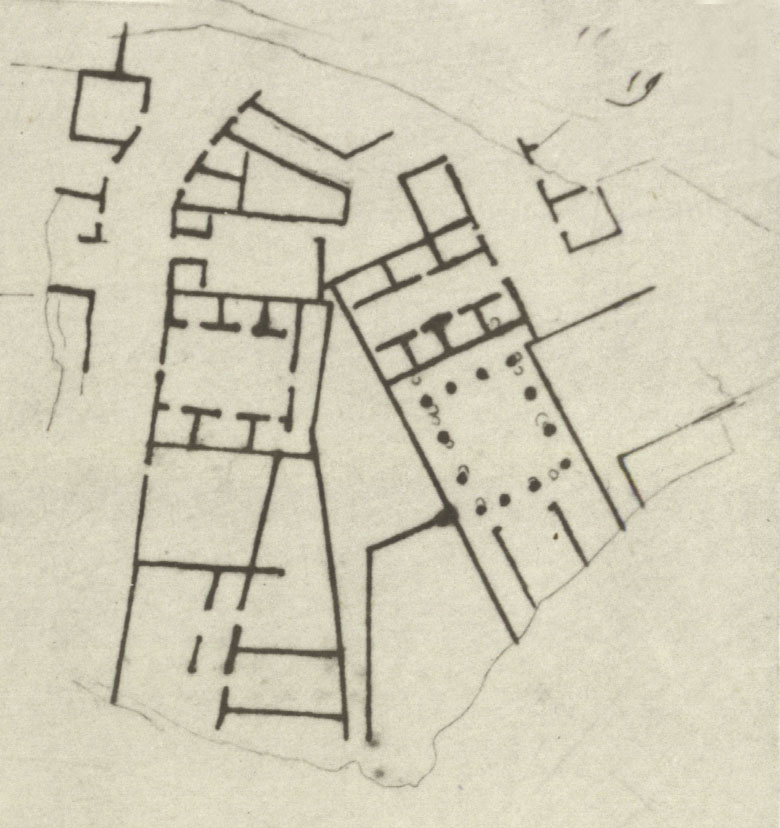
Detail from Cod. Vat. Lat. 3439 - Fo 19r,
reproduced from PM 1960, pl. 9 | |
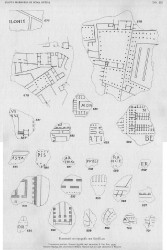
PM 1960 Plates: 9 59
AG 1980 Plates: 60
|
|
| IDENTIFICATION |
| Renaissance drawing: Unidentified architecture including possible apartment units and a peristyle
|
|
| INSCRIPTION |
| None |
|
|
|
|
|
| ANALYSIS
|
| Description The fragment is missing but Renaissance drawing Cod. Vat. Lat. 3439 - Fo 19r shows what it depicted (see detailed photo above or PM 1960, pl. 9, no. 10). A vertical street traversed the fragment on the left side. A few rooms were visible to the left of this street. On its right were five adjoining buildings, four of which opened onto the street. The building at the bottom did not face the street. It consisted of a row of shops with an arcade in front and what seemed to be a closed corridor. Could it, however, be a wide sidewalk? Abutting the top of this structure was a large, square room that opened onto the street via a tiny opening. Adjoining this room at top was a square building that consisted of a central space surrounded by six rooms, all facing the center. The room in the back spanned the width of the entire building. Above it was a rectangular room with two small shops flanking the central entrance. In the rear, an opening led to a back alley that branched off to the right and to the vertical street on the left. A small structure, consisting of a back room and two front rooms, was wedged between the rectangular building and the left branch of the back alley. Behind this series of buildings were two large open spaces of irregular shape and yet another series of buildings. The building at top, a large room surrounded by seven smaller, inward-facing rooms, opened onto a small street on the far right. Across the street, a row of left-facing shops was cut off by the right turn of the street. In the bottom right corner of the fragment, a large peristyle building abutted the building above. The peristyle was closed on three sides; on the fourth side, it opened towards three elongated rooms. Another large, open structure was visible to the right of the peristyle building.
Identification The two buildings that consist of small rooms surrounding a larger hall may be corridor flats (see Reynolds 1996, pp. 166-67). Other examples of such flats on the Marble Plan are frs. 33a, 111ab, and 165abd (Reynolds 1996, fig. 3.24A). The small openings in front suggest these buildings are residences as opposed to commercial structures with interior shops. The function of the peristyle is uncertain. Not enough remains of the building to ascertain whether it was part of a single-family residence (a domus) or a larger, more public structure. Most of the remaining architecture in the missing fragment seems to have been commercial in nature.
Significance The fragment depicted a section of the non-monumental and therefore lesser-known architecture of Rome: the mixed commercial and residential neighborhoods. |
|
| HISTORY OF FRAGMENT |
| Like the majority of FUR fragments, this piece was discovered in 1562 in a garden behind the Church of Saints Cosmas and Damian. From here, it was transferred to the Palazzo Farnese and stored there. Renaissance engravers reproduced the fragment in 16th-c. drawings that are now kept in the Vatican (for more information about the creation and accuracy of these drawings, see Cod. Vat. Lat. 3439), and Giovanni Pietro Bellori included it in his 1673-publication. The whereabouts of the piece after this date are unknown. (This fragments history corresponds to Iter D as summarized in PM1960, p. 56.)
Text by Tina Najbjerg
|
|
| KEYWORDS
|
| peristyle, street, corridor |
|
 Prev
Prev