ID AND LOCATION
| Stanford #
| 683 |
| AG1980 #
| 683 |
| PM1960 #
| 683 |
| Slab #
| unknown |
| Adjoins
| none |
CONDITION
| Located
| false |
| Incised
| true |
| Surviving
| false |
| Slab Edges
| 0 |
| Clamp Holes
| 0 |
| Tassello
| no | |
|
|
|
|
|
|
|
|
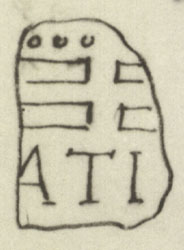
Detail from Cod. Vat. Lat. 3439 - Fo 22r,
reproduced from PM 1960, pl. 13 | |
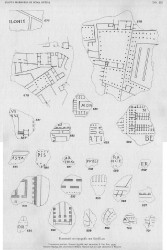
PM 1960 Plates: 13 59
AG 1980 Plates: 60
|
|
| IDENTIFICATION |
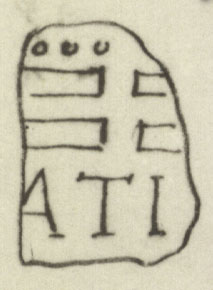
| Renaissance drawing: Hedges(?) between colonnade and partial inscription [---]ATI[---]
|
|
| INSCRIPTION
Epigraphic conventions used |
| Transcription |
| None; the fragment itself is missing
|
| Renaissance Transcription |
| [---]ATI[---]
|
| Reconstruction |
| [---]ATI[---] (PM 1960) |
|
|
|
|
|
| ANALYSIS
|
| Description The fragment itself is lost but Renaissance drawing Cod. Vat. Lat. 3439 - Fo 22r shows what it depicted (see photo detail above or PM 1960, pl. 13, no. 18). At top, three columns from a horizontal colonnade were visible. Below the colonnade and parallel to it were four elongated features, divided into two vertical and horizontal rows. Below these, the letters [---]ATI[---] appeared.
Identification The authors of PM 1960 suggested that the elongated features represented hedges or planters, similar to those seen in the Temple to the Deified Claudius fragments, in the porticoed structure in fr. 11fgh, and in fr. 678. Like the examples in frs. 11fgh and 678, the hedges in this fragment were surrounded by a colonnade. The partial inscription labeled the structure which may have functioned as a park or recreational area.
Significance Non-architectural structures were generally not depicted on the Marble Plan, and if the elongated features here indeed represent hedges or planters, this fragment provides one of the few examples of such garden structures. |
|
| HISTORY OF FRAGMENT |
| Like the majority of FUR fragments, this piece was discovered in 1562 in a garden behind the Church of Saints Cosmas and Damian. From here, it was transferred to the Palazzo Farnese and stored there. Renaissance engravers reproduced the fragment in 16th-c. drawings that are now kept in the Vatican (for more information about the creation and accuracy of these drawings, see Cod. Vat. Lat. 3439), and Giovanni Pietro Bellori included it in his 1673-publication. The whereabouts of the piece after this date are unknown. (This fragments history corresponds to Iter D as summarized in PM 1960, p. 56.)
Text by Tina Najbjerg
|
|
| KEYWORDS
|
| hedges, garden, colonnade |
|
 Prev
Prev