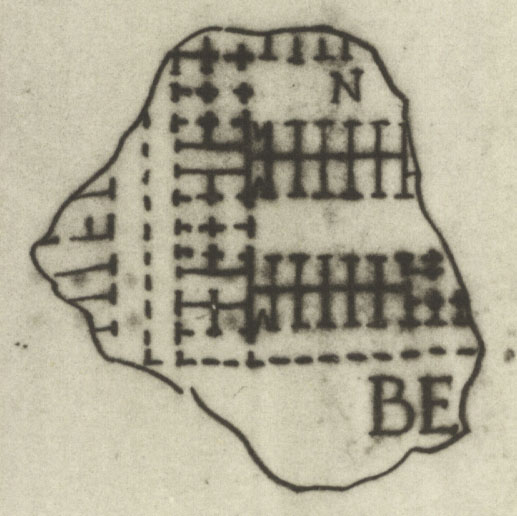
ID AND LOCATION
| Stanford #
| 684 |
| AG1980 #
| 684 |
| PM1960 #
| 684 |
| Slab #
| unknown |
| Adjoins
| none |
CONDITION
| Located
| false |
| Incised
| true |
| Surviving
| false |
| Slab Edges
| 0 |
| Clamp Holes
| 0 |
| Tassello
| no | |
|
|
|
|
|
|
|
|
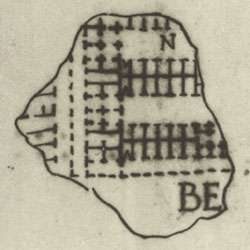
Detail from Cod. Vat. Lat. 3439 - Fo 22r,
reproduced from PM 1960, pl. 13 | |
PM 1960 Plates: 13 59
AG 1980 Plates: 60
|
|
| IDENTIFICATION |
| Renaissance drawing: Rooms arranged around two courtyards, possibly representing either warehouses (horrea), living quarters for special groups [ergastula?], or shopping bazaars (tabernae)
|
|
| INSCRIPTION
Epigraphic conventions used |
| Transcription |
| None; the fragment itself is lost.
|
| Renaissance Transcription |
| N[---]/BE[---]
|
| Reconstruction |
| [PRASI]NA/BE[NETA] (AG 1980) |
|
|
|
|
|
| ANALYSIS
|
| Description The fragment itself is lost but Renaissance drawing Cod. Vat. Lat. 3439 - Fo 22r shows what it depicted (see photo detail above or PM 1960, pl. 13, no. 30). A large building, consisting of two rectangular courtyards surrounded by small inward- and outward-facing rooms, occupied most of the fragment. Narrow double entrances on the left side and in the bottom rows of rooms allowed access to the two courtyards. Within the entrances on the left were staircases to upper floors. The entire building was fronted by an arcade. To the left, a row of shops(?) faced the courtyard building. The letter N was visible in the space of the upper courtyard; larger letters BE appeared below the building.
Identification E. Rodríguez-Almeida has tentatively suggested that the fragment was the corner of a slab (AG 1980, p. 171, pl. 60). As to the function of the double courtyard building, he muses that it looks like a warehouse (horreum) but concludes that the double entrances to the courtyards make it more likely that the building served as living quarters for specific groups, perhaps workers. Despite the difference in the size of the letters and the great distance between them, Rodríguez-Almeida merges the two lines and reconstructs the inscription that labeled the building as [PRASI]NA/BE[NETA](AG 1980, p. 171). Another possibility is to identify the structures as shopping bazaars, characterized by D. Reynolds as tabernae facing in on court spaces (for examples of such on the Plan, see Reynolds 1996, fig. 3.21). The prominent inscriptions like the two in this fragment render this interpretation unlikely, however. While large warehouse structures generally are labeled on the Plan, the only group of shops deemed worthy of a label is the macellum in fr. 157. The rectilinear layout and seemingly utilitarian nature of the building in this fragment place the piece in the S corner of the Plan, in an area of Rome that was flat, close to the Tiber, and occupied by similar buildings (see for example the architecture in fragment groups 24, 25, 28, 33, and 34).
Significance The fragment is important in that it depicts a type of commercial or combined commercial and residential structures that made up a large part of Rome's non-monumental cityscape. |
|
| HISTORY OF FRAGMENT |
| Like the majority of FUR fragments, this piece was discovered in 1562 in a garden behind the Church of Saints Cosmas and Damian. From here, it was transferred to the Palazzo Farnese and stored there. Renaissance engravers reproduced the fragment in 16th-c. drawings that are now kept in the Vatican (for more information about the creation and accuracy of these drawings, see Cod. Vat. Lat. 3439), and Giovanni Pietro Bellori included it in his 1673-publication. The whereabouts of the piece after this date are unknown. (This fragments history corresponds to Iter D as summarized in PM 1960, p. 56.)
Text by Tina Najbjerg
|
|
| KEYWORDS
|
| warehouse, living quarters, courtyard, shops, stairs, bazaar |
|
 Prev
Prev