ID AND LOCATION
| Stanford #
| 686 |
| AG1980 #
| 686 |
| PM1960 #
| 686 |
| Slab #
| unknown |
| Adjoins
| none |
CONDITION
| Located
| false |
| Incised
| true |
| Surviving
| false |
| Slab Edges
| 0 |
| Clamp Holes
| 0 |
| Tassello
| no | |
|
|
|
|
|
BIBLIOGRAPHY
- AG 1980, pl. 60
- LTUR II: Forum Pistorum (D. Palombi), p. 313
- LTUR IV: Serapis, aedes, templum (R. Santangeli Valenzani), pp. 302-303
- PM 1960, p. 158, pls. 13, 59
- Richardson 1992, p. 169 (Forum Pistorum); p. 361 (Serapis, Aedes)
|
|
|
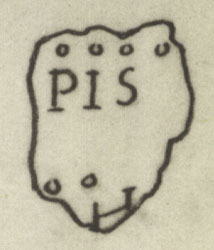
Detail from Cod. Vat. Lat. 3439 - Fo 22r,
reproduced from PM 1960, pl. 13 | |
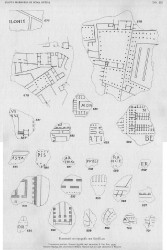
PM 1960 Plates: 13 59
AG 1980 Plates: 60
|
|
| IDENTIFICATION |
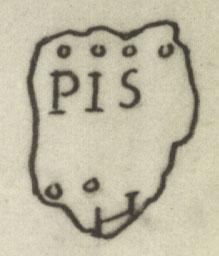
Renaissance drawing: Two parallel colonnades and a partial inscription
[---]PIS[---]
|
|
| INSCRIPTION
Epigraphic conventions used |
| Transcription |
| None; the fragment itself is lost
|
| Renaissance Transcription |
| [---]PIS[---]
|
| Reconstruction |
[AEDES SERA]PIS (Hülsen and Jordan, see reference in PM 1960, p. 158)
[TEMPLUM A]PIS (Bellori, Piranesi; see reference in PM 1960, p. 158)
[FORUM] PIS[TORIUM] (Jordan; see reference in PM 1960, p. 158) |
|
|
|
|
|
| ANALYSIS
|
| Description The small fragment is lost but Renaissance drawing Cod. Vat. Lat. 3439 - Fo 22r shows what it depicted (see photo detail above or PM 1960, pl. 13, no. 15). At top, a colonnade traversed the fragment. Below, the incomplete inscription [---]PIS[---] was inscribed. Another horizontal colonnade appeared at the bottom of the fragment; it seems to have been met by a vertical row of small rooms. Curiously, the individual columns were rendered as circles as opposed to dots, which is the norm on the Plan. Rather than distinguishing them as something different than columns, this may simply have been a convention used by the engraver of Renaissance drawing Cod. Vat. Lat. 3439.
Identification No recent attempt to identify this lost fragment has been made. Previous suggestions include the aedes Serapis, the templum Apis (not known), and the forum Pistor[i]um (PM 1960, p. 158). The temple to Serapis was built by Caracalla in Region VI. Archaeological finds relating to Serapis suggest it was located on the S part of the Quirinal, behind the church of S. Silvester (LTUR IV, p. 303). The 4th-century Regionary catalogues list the Forum of the Bakers/Millers, Forum Pistor[i]um, as being in the 13th region. It must have played an important role in the bread distribution program organized by Aurelian and was probably located in the large warehouse district along the S side of the Aventine, near the Tiber (LTUR II, p. 313). If the building existed in the beginning of the 3rd century, when the Map was carved, this would place the fragment in the upper right corner of the Map, between slabs VII-15 and VII-20.
Significance This missing fragment is our only knowledge about either of the two suggested buildings, the forum Pistarum and the aedes Serapis. Locating the fragment on the Map would be a huge gain. |
|
| HISTORY OF FRAGMENT |
| Like the majority of FUR fragments, this piece was discovered in 1562 in a garden behind the Church of Saints Cosmas and Damian. From here, it was transferred to the Palazzo Farnese and stored there. Renaissance engravers reproduced the fragment in 16th-c. drawings that are now kept in the Vatican (for more information about the creation and accuracy of these drawings, see Cod. Vat. Lat. 3439), and Giovanni Pietro Bellori included it in his 1673 publication. The whereabouts of the piece after this date are unknown. (This fragments history corresponds to Iter D as summarized in PM 1960, p. 56.)
Text by Tina Najbjerg
|
|
| KEYWORDS
|
| columns, forum, shops, bakers, millers, Aedes Serapis, Forum Pistor[i]um |
|
 Prev
Prev