ID AND LOCATION
| Stanford #
| 68ab |
| AG1980 #
| 68a-b |
| PM1960 #
| 68 a b |
| Slab #
| unknown |
| Adjoins
| none |
CONDITION
| Located
| false |
| Incised
| true |
| Surviving
| true |
| Subfragments
| 2 |
| Plaster Parts
| 0 |
| Back Surface
| rough |
| Slab Edges
| 0 |
| Clamp Holes
| 0 |
| Tassello
| no |
TECHNICAL INFO
|
|
|
|
|
|
|
|
|
|
|
| ANALYSIS
|
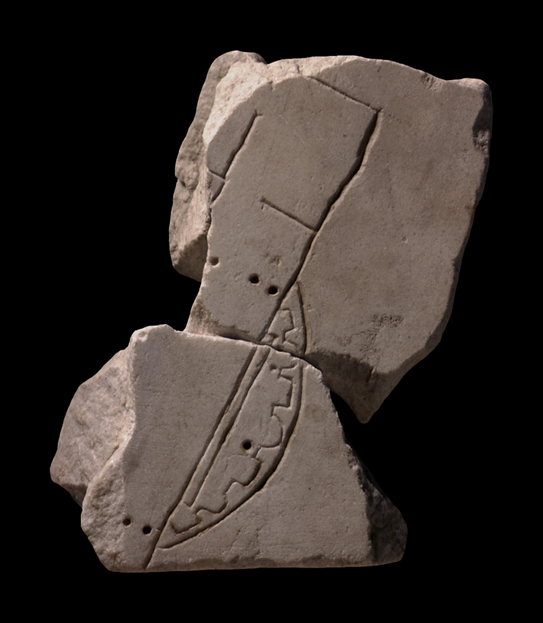
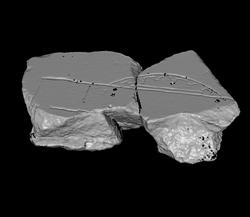
| Cozza 1990 (quoted from our bibliography): FUR fr. 68ab must belong with frs. 46acd and 46b (the Adonaea) for the following reasons: a) they have similar type of rough backs, b) they are of same thickness (52-62 mm), c) the ductus is by the same engraver, d) the veining of the Proconnesian marble falls in the same direction (NB. the veining direction of fr. 68ab in PM 1960, pl. 35 is not exact - see fig. 1 for the correct veining line), e) both are from a slab edge (and both have a clamp hole). The architectural corner visible in fr. 68a is thus opposite the corner of the Adonaea in fr. 46d and the center of the semi-circular exedra in 68ab coincides with the principal axis of the Adonaea in fr. 46 which falls along the center of the euripus (fig. 1). The direction of the inscription in fr. 46, ADONAEA, indicates that these fragments were either positioned along the top or the left edge of the slab. The addition of fr. 68ab to the structure of the Adonaea in frs. 46 confirms that the latter cannot be identified with the Hall of Adonis in Domitian's palace on the Palatine, mentioned by the Severan writer Philostratus (Apoll. 7.32). Neither of the possible orientations of frs. 46 and 68 allows for the semi-circular exedra to be incorporated into the existing architecture in the Vigna Barberini on the Palatine, as has been proposed. Philostratus' "Hall of Adonis" should perhaps be interpreted as smaller, mobile gardens in planters as opposed to a large, architecturally fixed structure. The Adonaea on the FUR is probably located somewhere in the Campus Martius, as has been proposed. |
|
| HISTORY OF FRAGMENT |
| None |
|
 Prev
Prev