ID AND LOCATION
| Stanford #
| 6a |
| AG1980 #
| 6a |
| PM1960 #
| 6 a |
| Slab #
| IX-4 |
| Adjoins
| none |
CONDITION
| Located
| true |
| Incised
| true |
| Surviving
| false |
| Slab Edges
| 0 |
| Clamp Holes
| 0 |
| Tassello
| no | |
|
|
|
|
|
BIBLIOGRAPHY
- AG 1980, pp. 70-72, fig. 19, pl. 4
- LTUR I: Armamentaria (E. Rodríguez Almeida), p. 126; Castra Misenatium (D. Palombi), pp. 248-249
- PM 1960, p. 65, pls. 5, 10, 17
- Richardson 1992, pp. 77-78 (Castra Misenatium)
- Rodríguez-Almeida 1977
|
|
|
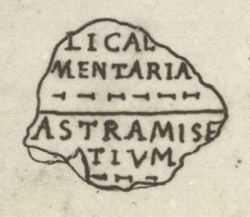
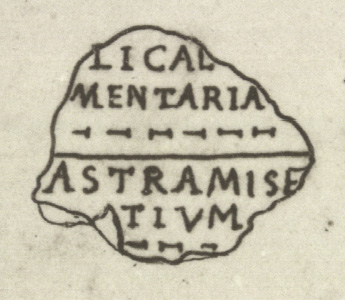
Detail from Cod. Vat. Lat. 3439 - Fo 20r,
reproduced from PM 1960, pl. 10 | |
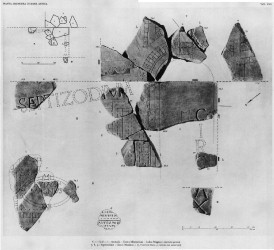
PM 1960 Plates: 10 17
AG 1980 Plates: 4
|
|
| IDENTIFICATION |
Renaissance drawing: Barracks of the Misenum sailors (castra Misenatium)
Armories (Armamentaria)?
|
|
| INSCRIPTION
Epigraphic conventions used |
| Transcription |
| None; the fragment itself is lost.
|
| Renaissance Transcription |
1. [---]LICAL[---]/[---]MENTARIA[---]
2. [---]ASTRAMISE[---]/[---]TIVM[---]
|
| Reconstruction |
1. [ARMA]MENTARIA? (PM 1960; AG 1980)
2. [C]ASTRA MISE/[NA]TIVM (PM 1960; AG 1980) |
|
|
|
|
|
| ANALYSIS
|
| Description The fragment is missing but is reproduced in Renaissance drawing Cod. Vat. Lat. 3439 - Fo 20r (see photo detail above or PM 1960, pl. 5, no. 1). Four lines of text were separated by a solid horizontal line. Below the second and the fourth were dashed lines that may indicate a portico or arcade on each side of the solid wall, the upper one the width of a covered walkway, and the lower one the width of a street. This suggests that the top two lines are part of the same phrase, describing the upper building, and the lower two lines are part of a label for another building. In the drawing, the fragment is outlined in haematite; the outline does not, however, correspond well to the pencil outline underneath.
Identification: Castra Misenatium The bottom inscription has been reconstructed as castra Misenatium (PM 1960, p. 65). It thus seemed to have labeled the barracks that housed a detachment of sailors from the fleet at Misenum who manned the velarium of the Flavian Amphitheater (the Colosseum) and perhaps also participated in staged naval battles, the naumachiae. The Regionary Catalogues reveal that the barracks were located in Regio III, presumably near the Amphitheater in a neighborhood with several other buildings functionally related to the games, including the gladiatorial training schools (LTUR I, pp. 248-249). The Castra, and this fragment, are probably to be located east of the Amphitheater along the ancient street underlying the modern Via Labicana, just beyond the Ludus Magnus. This would place the Castra on the outer slopes of the Oppian Hill between the Baths of Trajan and the Via Labicana - in the very area where an inscription (CIL 6.1091) was discovered that recorded a later expansion of the Castra (LTUR I, p. 249). If this is correct, the letters Castra Misenatium were carved into the space of the street, and the barracks were preceded by a covered arcade (see AG 1980, fig. 19 and pl. 4).
Identification: Armamentaria? The complete reconstruction of the top inscription in this fragment is still disputed. The general consensus, however, is that the [---]MENTARIA be reconstructed as the plural of armamentarium, ARMA[MENTARIA], and thus referred to storage facilities for armor and weapons for one or more of the four gladiatorial training schools near the Flavian Amphitheater: the Ludus Magnus, the Ludus Dacicus, the Ludus Gallicus, and the Ludus Matutinus (LTUR I, 126). An early proposal by E. Lundström that the complete inscription read as follows: ...[ET LU]DI GAL[ICI ARMAMEN]TARIA is rejected by both A.M. Colini (PM 1960, p. 65) and by E. Rodríguez-Almeida (Rodríguez-Almeida 1977; AG 1980, p. 70).
Significance Along this street were two and perhaps three encampments of armed men: the Castra Misenatium, the Ludus Magnus, and perhaps also the Ludus Dacicus, if it opened onto this street. The Armamentaria, if the identification is right, was an additional structure related to weapons and battle along the same stretch. It may not be coincidental that it stood directly across the street from the Castra Misenatium; the sailors stationed there may have provided a useful protective watch over the armoury. These installations must have shaped the character and use of this street, potentially making it a rough neighborhood, which may have affected who traveled on this street and in what way, and who chose a different route through this part of town. |
|
| HISTORY OF FRAGMENT |
| Like the majority of FUR fragments, this piece was discovered in 1562 in a garden behind the Church of Saints Cosmas and Damian. From here, it was transferred to the Palazzo Farnese and stored there. Renaissance engravers reproduced the fragment in 16th-c. drawings that are now kept in the Vatican (for more information about the creation and accuracy of these drawings, see Cod. Vat. Lat. 3439), and Giovanni Pietro Bellori included it in his 1673 publication. The whereabouts of the piece after this date are unknown. (This fragments history corresponds to Iter D as summarized in PM 1960, p. 56.)
Text by Tina Najbjerg and
Jennifer Trimble
|
|
| KEYWORDS
|
| barracks, street, arcade, camp, |
|
 Prev
Prev