ID AND LOCATION
| Stanford #
| 6g |
| AG1980 #
| 6g |
| PM1960 #
| 161 |
| Slab #
| IX-4 |
| Adjoins
| 13p |
CONDITION
| Located
| true |
| Incised
| true |
| Surviving
| true |
| Subfragments
| 1 |
| Plaster Parts
| 0 |
| Back Surface
| rough |
| Slab Edges
| 1 |
| Clamp Holes
| 0 |
| Tassello
| no |
TECHNICAL INFO
|
|
|
|
|
|
|
|
|
|
|
| ANALYSIS
|
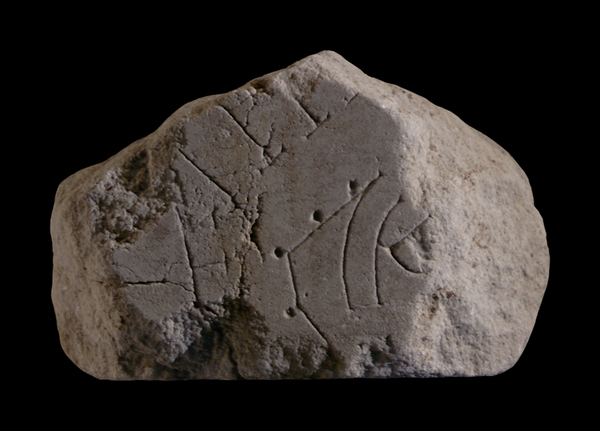
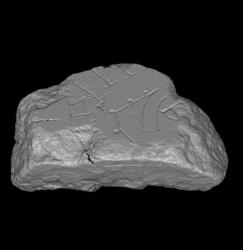
| Description The fragment was part of a slab edge. It shows the corner of a porticoed structure in the center of which lies an elliptically shaped feature. The corner of the porticus is cut off, as if there was not enough room to complete the rectangle. Two openings in the walls of the ellipse - rendered with wide-spaced double lines - are visible, and the letter D appears inside. Rows of retangular rooms frame the portico on the left side and in the corner.
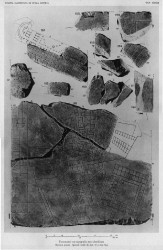
Identification: Ludus Dacicus The building in the fragment was tentatively identified as the ludus Dacicus and joined to fr. 142 (now 13p) by the authors of PM 1960 (p. 124). E. Rodríguez-Almeida confirmed the identification and the join, and convincingly placed the fragments across the horizontal edges of slabs IX-4 and VIII-4 (Rodríguez-Almeida 1970-71, fig. 7; AG 1980, fig. 19). He did so based on the following: a) the fragment depicted one of the four gladiatorial training schools built by Domitian near the Flavian Amphitheater; b) the rough backs of both fragments, 6g and 13p, limited their position on the map to slabs IX-4 and VIII-4 which were some of the few rough-backed slabs on the map; c) the direction of the inscription indicated that the building draped across a horizontal slab edge; and d) the Ludus Dacicus were recorded in the Regionary Catalogues to be located in either Regio II or III (AG 1980, p. 72). These constraints located the building exactly between the Baths of Trajan and the Ludus Magnus, aligned exactly with the latter (AG 1980, fig. 19). (Rodríguez-Almeida further noted that on the map, the Ludus Dacicus and the Ludus Magnus were shifted 8 degrees left of their actual position on the ground.) L. Richardson points out that this situates the ludus Dacicus firmly in Regio III but does not explain why one literary source, the Curiosum, lists the building as being in Regio II (Richardson 1992, p. 236). A similar error in the listing for the ludus Matutinus might indicate, Richardson suggests, that those two ludi were confused in the literary tradition of the 4th century.
The fragment demonstrates that the architecture of the ludus Dacicus was similar to that of the ludus Magnus, just on a smaller scale: an elliptically shaped cavea surrounded the arena. A rectangular portico and rows of inward-facing rooms, that would have served as lodgings for the gladiators, framed the cavea on all sides. This fragment shows, however, that the cavea of the Dacicus had two small openings in its N side in addition to those at the ends of the long axis. The Ludus Magnus, on the other hand, had ceremonial accesses at each end of the long axis but box seats in the center of the flat sides of the ellipse. The smaller size of the Ludus Dacicus and the lack of box seats indicate that it was of lesser importance than the Magnus and perhaps did not receive as high-ranking spectators as the latter.
Significance Together with fr. 13p, this fragment provides our only evidence for the architecture and location of the ludus Dacicus.
|
|
| HISTORY OF FRAGMENT |
| The fragment was discovered in the 1860s or 70s during excavations in the aula of the Forum Pacis (see PM 1960, p. 28), and it was exhibited with other FUR fragments along the main staircase of the Capitoline Museums until 1883. Since 1903, it has been stored with the other known fragments in various places: the storerooms of the Capitoline Museums (1903-1924), the Antiquarium Comunale (1924-1939), the Capitoline Museums again (1939-1955), the Palazzo Braschi (1955-1998), and since 1998 in the Museo della Civiltà Romana in EUR under the auspices of the Sovraintendenza ai Beni Culturali del Comune di Roma. (This fragments history corresponds to Iter F as summarized in PM 1960, p. 56.) N.B. PM 1960 does not indicate the whereabouts of the fragment between 1883 and 1903.
Text by Tina Najbjerg
|
|
| KEYWORDS
|
| ludus, gladiatorial training school, cavea, portico, porticus, colonnade, columns, rooms, arena |
|
 Prev
Prev