ID AND LOCATION
CONDITION
| Located
| true |
| Incised
| true |
| Surviving
| true |
| Subfragments
| 1 |
| Plaster Parts
| 0 |
| Back Surface
| rough |
| Slab Edges
| 0 |
| Clamp Holes
| 0 |
| Tassello
| no |
TECHNICAL INFO
|
|
|
|
|
|
|
|
|
|
|
| ANALYSIS
|
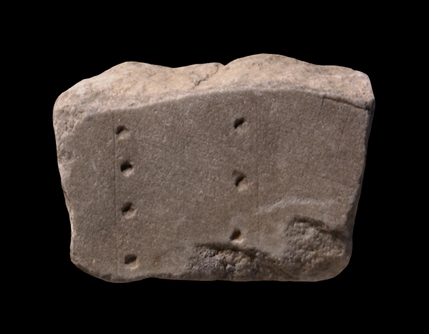
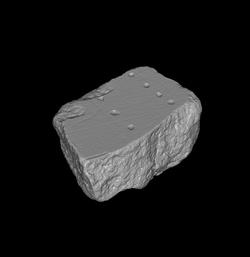
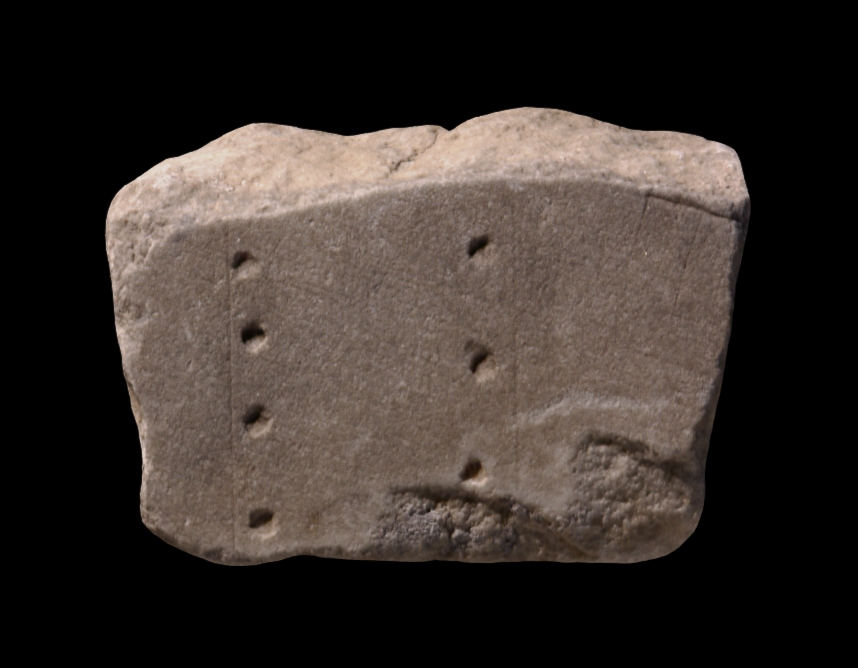
| Description This fragment depicts two parallel lines of columns; there are guide lines along both lines to help the engraver. N.B. The marble vein direction on PM 1960, pl. 35, is represented correctly for fragments 70a and 70b, but incorrectly for fragment 70c; this was fixed in AG 1980, pl. 36.
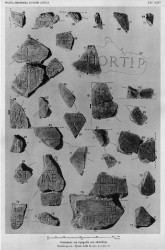
Identification: Aedes Faustinae This fragment, together with frs. 70a, 70c and 103, has recently been identified as part of the Temple of the Deified Faustina on the Palatine, rededicated in 221 CE to Elagabalus (Cecamore 1999; on the Temple of Elagabalus, see LTUR III, pp. 10-11). The identification is supported by the inscription on 70a and 70c, comparison with the second century CE structures excavated in the Vigna Barberini on the Palatine, close study of the original location on the wall of the dowel hole (tassello) on the back of 70a and 70c, and the similarity between these fragments and known parts of slab VII-11 of the Plan, to which this location corresponds. The temple stood within a large porticus that had a double colonnade on three sides (Cecamore 1999, p. 320, fig. 5). This fragment depicts part of the colonnade at the S corner of the complex.
Significance Together with frs. 70a, c, and 103, this fragment was key to identifying the excavated remains on the Palatine as belonging to the Temple of Faustina.
|
|
| HISTORY OF FRAGMENT |
| Like the majority of FUR fragments, this piece was discovered in 1562 in a garden behind the Church of Saints Cosmas and Damian. From here, it was transferred to the Palazzo Farnese and stored there. It was not among the fragments that were reproduced in the Renaissance drawings that are now kept in the Vatican, but Giovanni Pietro Bellori included it in his 1673 publication. In 1742, it was moved to the Capitoline Museums and exhibited with some of the other known fragments in wooden frames along the main staircase. In 1903, museum curators included the fragment in a reconstruction of the FUR mounted on a wall behind the Palazzo dei Conservatori (1903-1924). Since then, the fragment has been stored with the other known FUR fragments in various places: the storerooms of the Antiquarium Comunale (1924-1939), the Capitoline Museums again (1939-1955), the Palazzo Braschi (1955-1998), and since 1998 in the Museo della Civiltà Romana in EUR under the auspices of the Sovraintendenza ai Beni Culturali del Comune di Roma. (This fragments history corresponds to Iter E as summarized in PM 1960, p. 56.)
Text by Tina Najbjerg and Jennifer Trimble
|
|
| KEYWORDS
|
| temple, palatine, columns, guide lines, colonnade, porticus |
|
 Prev
Prev