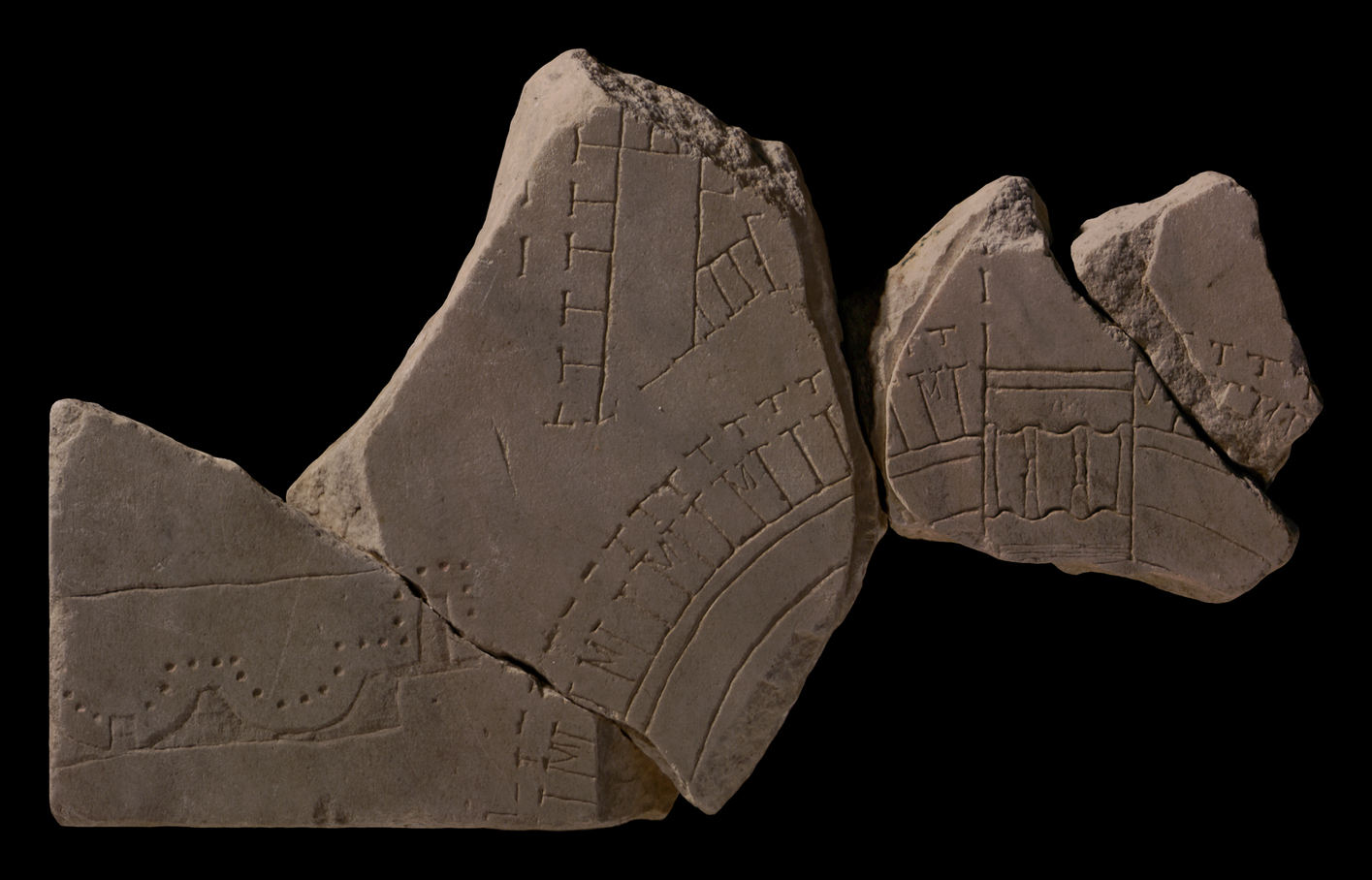
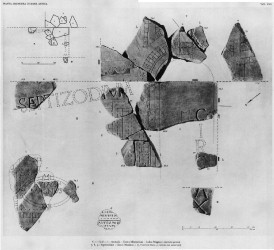
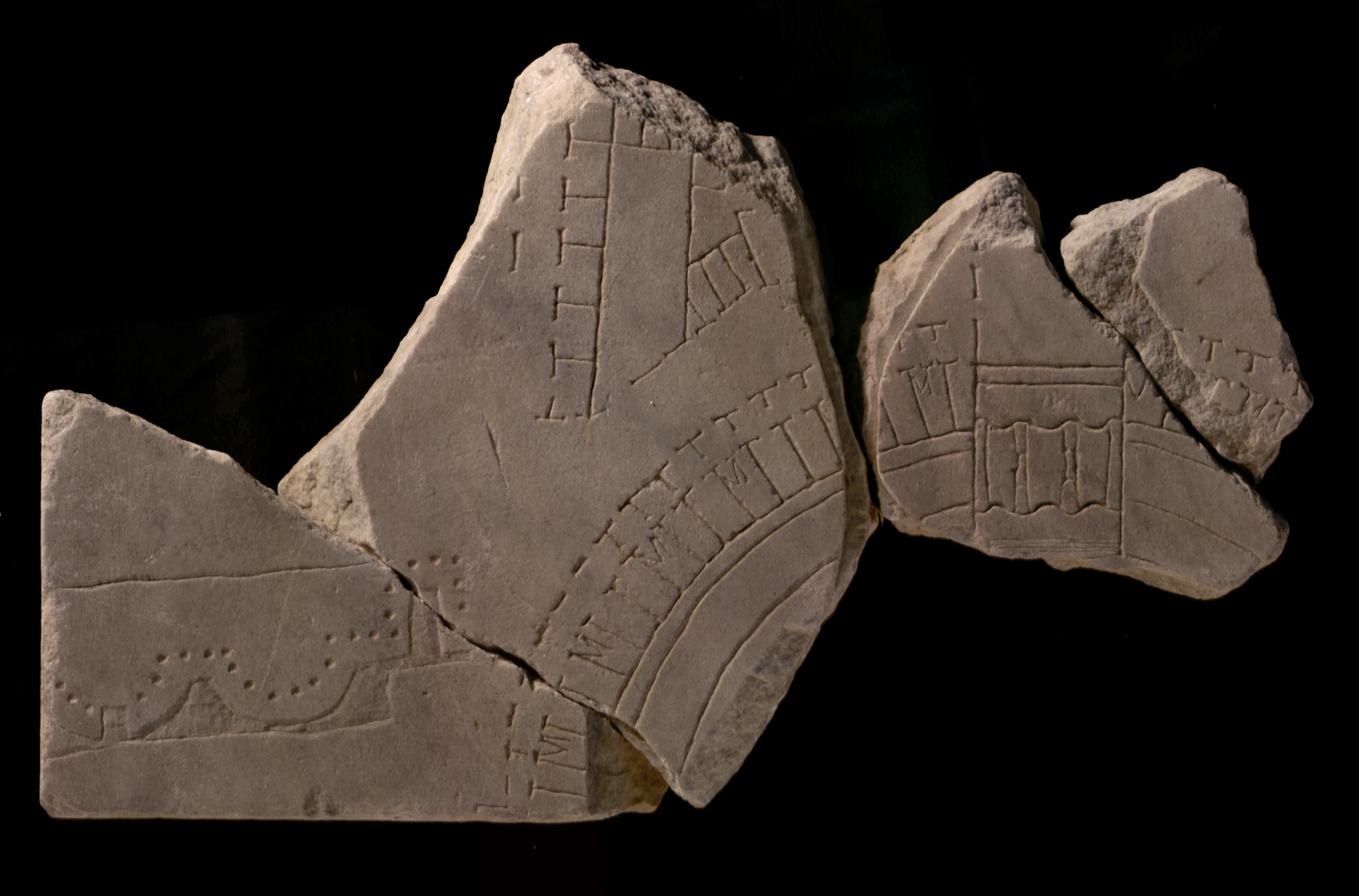
Description Fragment 7a, at left, is the lower left corner of the slab. There is a clamp hole along the left edge. This fragment's surface is almost entirely taken up by a single monument that continues beyond the fragment's left edge onto the adjacent slab (now lost). The surviving part of the structure consists of two semi-circular bays with a flat rear wall and an L-shaped anta, at the right end. Unusually, this entire outline is recessed and would have been filled with highly visible red paint. A line of dots representing columns follows the outline of the curves and the anta. Inside the left semi-circle is a small square, also recessed, perhaps a statue pedestal. Some distance in front is a horizontal line.
Covering the majority of the rightmost area of the joined fragments is the curved outline of a major structure. Four concentric arcs form the interior edge of the building. Backing onto the fourth arc is a row of rooms, every third of which contains a staircase. In front of these rooms, forming the exterior of the building, lies an arcaded passageway which at the bottom is rendered with dashes, at top with T-shaped piers. These suggest that the arcaded passageway is here interrupted by cross walls with doorways in them. These cross walls may have been built to strengthen the outer wall here (PM 1960, p. 66), or they may have been designed to slow down pedestrian traffic moving through the passageway along the curve. In the center of fr. 7c, the arcaded passageway and line of rooms with staircases are interrupted by a wide opening. At the top, it is crossed by two parallel lines, probably steps; at the bottom edge are five lightly incised lines, also steps. In the middle, two wavy lines are linked by four vertical bars. On the Plan, this is the standard way to represent an arch with three barrel vaults separated by piers. Passages perforate the central piers. The left wall of the arch continues upward into the street outside the curved arcade, where it shows two openings.
At the top of fr. 7b, a rectangular space extends from the top of the fragment toward the curved arcade. Two doors at the bottom of this space provide access to it; they open onto a street that curves around the arcaded building described above. Small rooms with external doorways, probably shops, flank the left and top sides of this rectangular space. Along the left side, two dashes suggest an arcaded passageway in front of some of the shops, perhaps left unfinished. Several small, narrow rooms open onto the curving street on the right side of this building.
Identification: Septizodium The monument that occupies most of the leftmost fragment, 7a, is conveniently named by an inscription in frs. 8a and 8b. This is the Septizodium, built by Septimius Severus in 203 CE (CIL 6.1032) at the SE corner of the Palatine Hill where it faced visitors entering Rome from the Via Appia (LTUR IV, p. 269. See also map in LTUR III, fig. 190). Excavations in 1985-88 and Renaissance drawings confirm what these fragments of the Plan depict: this was a tall, elongated monument whose facade resembled a
great nymphaeum and the scenae frons of a Roman theater. Antae framed three semi-circular bays and a row of columns; extending across the front was a pool (LTUR IV, p. 270 and fig. 124). On the statue base in the central niche, visible in 7a, perhaps stood a statue of Septimius Severus himself (LTUR IV, p. 269).
Identification: Circus Maximus The curved architecture in the right section of these fragments is the sphendone or semicircular E end of the Circus Maximus (PM 1960, pp. 66-67). The rest of the Circus is depicted in 7e,
8bde,
8c,
8fg,
8h, and 9. Situated in the valley between the Palatine and the Aventine Hills, the circus Maximus played a central role in Rome's earliest history. Sources attribute its conception to the Etruscan kings and relate it to the rise of the ludi Romani (LTUR I, p. 272). For centuries, the Circus was nothing but an open space with wooden partitions and seating; more permanent walls were not constructed until the 2nd c. BCE. Julius Caesar is credited with giving the Circus the shape and size it was to retain for centuries: According to Dionysius of Halicarnassus (3.68.1-4), the Circus had a length of 421 m. and a width of 118 m., and the cavea of the Circus held 150,000 spectators (LTUR I, p. 273). The structure was destroyed by fire several times and it collapsed occasionally, but it underwent several reconstructions by various emperors and remained in use until the 6th c. In Medieval times, the area was mainly used for agriculture, and in the following centuries it was gradually encroached upon by various forms of construction. Not until the beginning of the 20th c. was the area of the Circus cleared (LTUR I, pp. 274-75).
Evidence gathered from excavations, written sources, coins, and standing remains reveals the architecture of the Circus in the imperial period: Raised above the surrounding area, the building measured 600 m. in length and 140 m. in width. The long sides of the structure were not precisely parallel; one side, facing the Aventine, was slightly inclined, as is usual for Roman circuses (LTUR I, pp. 275-76). The exterior facade was divided into three sections, the bottom section being as tall as the two above combined. The walls of the two upper sections were solid but decorated with pilasters and windows. The bottom section was perforated by arches that led to a covered arcade that surrounded the entire building. Behind the covered passageway, radial walls created a series of rooms, every third of which served a different purpose: One room led directly to the lowest seating area; the next room contained stairs that gave access to the corridors and seating areas above; and the third room functioned as a shop (LTUR I, p. 275). The seating area, the cavea, was divided into three sections: the ima, media, and summa cavea. The start gates, the carceres, occupied the N end of the Circus; these were placed on a curve and on a slightly oblique angle in relation to the central axis of the building. The arena itself was divided along the central axis by a spina or a euripus (LTUR I, p. 276, with references and reconstruction in fig. 158). Nothing remains of this divider, but numerous representations on coins and other sources suggest it was decorated with a variety of features: Tricuspid metae marked the two ends of the divider and flanked an array of statues, columns, altars, and small temples. Here was also placed the device, consisting of sculpted dolphins, that counted the completed rounds.
This group of FUR fragments illustrates a peculiar convention employed by the carvers. The outer half of the cavea is illustrated in ground plan; it shows the outer arcade and the row of compartments inside it. The inner half, however, shows an aerial view of the seating arrangement. The two inner lines of the curve illustrate the praecinctiones, or division by rank, between the primary seating in front (the ima cavea) and in the middle (the media cavea) (PM 1960, p. 66).
Identification: Arcus Titi The arched gate that cuts through the hemicycle of the Circus Maximus on the central axis in these fragments probably represents the Arch of Titus (LTUR I, p. 274). This arch, decreed in 70 CE after the victory over the Jews and the destruction of Jerusalem, was a delayed dedication to Titus in 81 CE by the Roman senate and people (LTUR I, p. 108). Excavations (LTUR I, fig. 159), representations in mosaic and relief (references in LTUR I, p. 109), and these FUR fragments combine to present a picture of this monument: Approached by steps, the structure consisted of three barrel vaults, the central vault being taller than the two flanking it. It was completely revetted with Luna marble and decorated with pilasters, columns, and carved reliefs. A bronze quadriga, alluding to the victory, topped the arch (LTUR I, p. 109).
Significance The presence of the Septizodium in these fragments provides crucial dating evidence for the Plan. The Septizodium's construction date of 203 CE is a terminus post quem for the Plan's construction, since the urban survey and the carving of the slabs must have occurred with this building already in place (PM 1960, p. 213). The Circus Maximus group is equally significant for our understanding of the Plan, for excavations in the area of the sphendone confirm the accuracy of much of the information it contains, for example the depiction of the Arch of Titus, the outer arcade, and even the distribution of staircases in every third compartment (LTUR I, p. 275, fig. 159). This suggests that the Plan is largely accurate in its depictions of these kinds of details.
|
 Prev
Prev