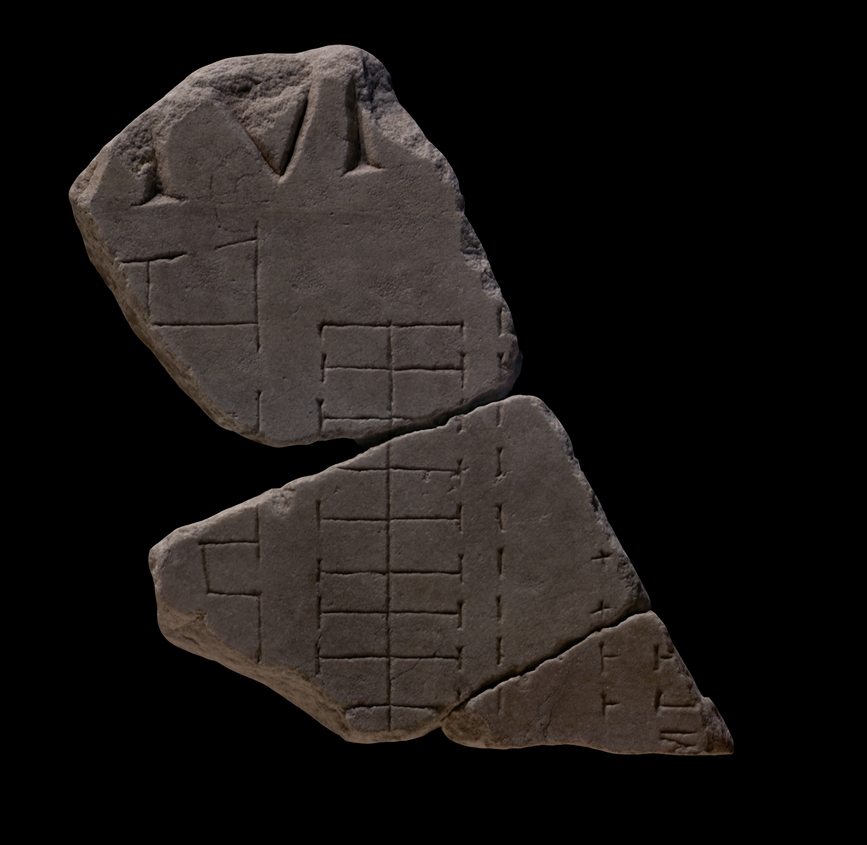
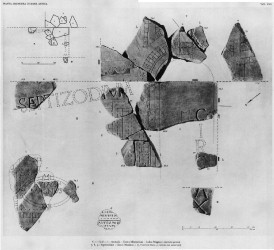
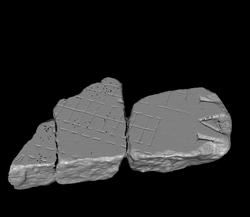
| Description This group consists of three fragments from the same slab, from top to bottom: 8b, d, and 8e. The bottom of three letters, IVM, from a horizontal inscription appears at top. Just below the letters, a very thin vein traverses the marble. This vein is the continuation of the one visible in fr. 8a and 8c. Below the inscription, three vertical groups of buildings are separated by two streets. On the left, large rooms open onto the space above and the adjacent street on the right. Across the street lies a parallel row of back-to-back tabernae. They are fronted on the right side by a covered arcade, denoted by a dashed line. Beyond that, a wide street separates the back-to-back tabernae from a barely visible structure at the right edge of these fragments. The facade of this structure consists of an arcade (the T-shapes suggest it was vaulted) behind which lay another row of small rooms.
Identification: Circus Maximus The vaulted arcade at right is part of the outer ambulatory of the Circus Maximus (PM 1960, p. 66). The rest of the Circus is depicted in 7e,
7abcd,
8c,
8fg,
8h, and 9. Situated in the valley between the Palatine and the Aventine Hills, the circus Maximus played a central role in Rome's earliest history. Sources attribute its conception to the Etruscan kings and relate it to the rise of the ludi Romani (LTUR I, p. 272). For centuries, the Circus was nothing but an open space with wooden partitions and seating; more permanent walls were not constructed until the 2nd c. BCE. Julius Caesar is credited with giving the Circus the shape and enormous size it was to retain for centuries: According to Dionysius of Halicarnassus (3.68.1-4), the Circus was 421 m. long and 118 m. wide, and the cavea of the Circus held 150,000 spectators (LTUR I, p. 273). The Circus was destroyed by fire several times and it collapsed occasionally, but it underwent several reconstructions by various emperors and remained in use until the 6th c. In Medieval times, the area was mainly used for agriculture, and in the following centuries it was gradually encroached upon by various forms of construction until it was cleared at the beginning of the 20th c. (LTUR I, pp. 274-75).
Evidence gathered from excavations, written sources, coins, and standing remains reveals the architecture of the Circus in the imperial period: Raised above the surrounding area, the building measured 600 m. in length and 140 m. in width. The long sides of the structure were not precisely parallel; one side, facing the Aventine, was slightly inclined, as is usual for Roman circuses (LTUR I, pp. 275-76). The exterior facade was divided into three sections, the bottom section being as tall as the two above combined. The walls of the two upper sections were solid but decorated with pilasters and windows. The bottom section was perforated by arches that led to a covered walkway that surrounded the entire building. Behind the covered passageway, radial walls created a series of rooms, every third of which served a different purpose: One room led directly to the lowest seating area, the next room contained stairs that gave access to the corridors and seating areas above, and the third room functioned as a shop (LTUR I, p. 275). The seating area, the cavea, was divided into three sections: the ima, media, and summa cavea. The start gates, the carceres, occupied the N end of the Circus; these were placed on a curve and on a slightly oblique angle in relation to the central axis of the building. The arena itself was divided along the central axis by a spina or a euripus (LTUR I, p. 276, with references and reconstruction in fig. 158). Nothing remains of this divider, but numerous representations on coins and other sources suggest it was decorated with a variety of features: Tricuspid metae marked the two ends of the divider and flanked an array of statues, columns, altars, and small temples. Here was also placed the device, consisting of sculpted dolphins, that counted the completed rounds.
This fragment group shows a section of the arcaded facade of the NE side of the Circus, as well as some of the ground floor compartments behind the covered walkway. It is not clear why the T's denoting the vaulted outer arcade of the Circus are replaced by crosses in two places, usually the sign of a cross vault. This implies that the structure extends into the street, but there is no corresponding architectural mark opposite these crosses. This may be a mistake by the engraver or it may have some architectural significance we do not understand. The back-to-back tabernae on the left are situated between the Circus and the Palatine Hill, parallel to the long side of the Circus. These shops would have taken advantage of the great crowds that visited the Circus. The rooms on the far left must have been set in the foundation of the imperial palaces on the Palatine.
Identification: Septizodium Together with fragment 8a, the letters IVM at top of this piece named an important Severan monument, the Septizodium, built by Septimius Severus in 203 CE (CIL 6.1032) at the SE corner of the Palatine Hill where it faced visitors entering Rome from the Via Appia (LTUR IV, p. 269. See also map in LTUR III, fig. 190). Part of the structure is visible in fr. 7abcd. Excavations in 1985-88 and Renaissance drawings confirm what these fragments of the Plan depict: The Septizodium was a tall, elongated monument whose facade resembled a
great nymphaeum and the scenae frons of a Roman theater. Antae framed three semicircular bays and a row of columns; a pool extended across the front (LTUR IV, p. 270 and fig. 124). On the statue base in the central niche, visible in 7a, perhaps stood a statue of Septimius Severus himself (LTUR IV, p. 269).
Significance The Septizodium was built in 203 CE (CIL 6.1032); its depiction here provides a terminus post quem for the construction of the Plan, since the urban survey and the carving of the Plan must have occurred with the Septizodium already in place (PM 1960, p. 213). This particular fragment might also shed light on whether there was any meaningful difference between the two spellings of the monument found in the ancient sources, "Septizodium" or "Septizonium" (PM 1960, p. 67; LTUR I, p. 271). The lower curve of a D before the I is clearly visible on the color photograph above, showing that "Septizodium" was the version used on the Plan.
|
 Prev
Prev