ID AND LOCATION
| Stanford #
| 8i |
| AG1980 #
| 8i |
| PM1960 #
| 480 |
| Slab #
| VIII-5 |
| Adjoins
| none |
CONDITION
| Located
| true |
| Incised
| true |
| Surviving
| true |
| Subfragments
| 1 |
| Plaster Parts
| 0 |
| Back Surface
| smooth |
| Slab Edges
| 0 |
| Clamp Holes
| 0 |
| Tassello
| no |
TECHNICAL INFO
|
|
|
|
|
|
|
|
|
|
|
| ANALYSIS
|
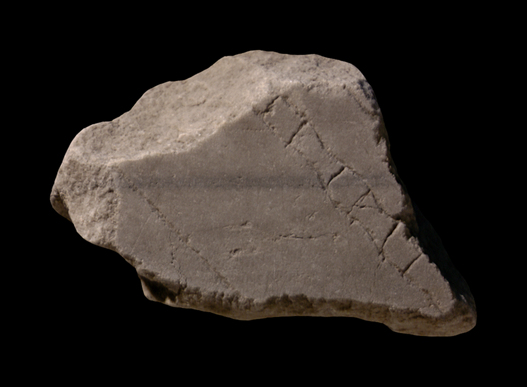
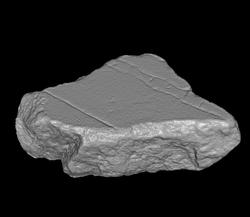
| Description An aqueduct traverses the fragment from top center to bottom right. It is rendered as a string of alternating concave and convex sections. On either side, a straight line runs parallel to the aqueduct; the line on the right is closer to the water channel than the one on the left. A dark blue veining line crosses the fragment at a 45 degree angle to the aqueduct.
Identification: Aqua Claudia The smooth back and distinct blue veining line of this fragment, which match similar features in fragment groups 8l-o and 8a-h, allowed E. Rodríguez-Almeida to locate it in slab VIII-5, between the Septizodium and the Flavian Amphitheater. The thickness of the slab (gradually decreasing towards the right) and the angle of the veining line placed the fragment precisely 17 cm to the right of group 8l-o (Rodríguez-Almeida 1970-71, fig. 13). This position identified the depicted aqueduct as the Neronian extension of the aqua Claudia that descended from the templum Divi Claudi along the clivus Scauri before crossing the Via S. Gregorio towards the Palatine Hill (Rodríguez-Almeida 1970-71; AG 1980, p. 76). Five double arcades of this aqueduct are still visible today at the base of the Palatine. Nero extended the channel from the Caelian Hill to the Palatine in 64 CE; Domitian repaired it ca. 90 CE, and Septimius Severus reinforced its arches around 200 CE (Claridge 1998, p. 144). How to interpret the straight lines that run parallel to the aqueduct in this fragment is uncertain. It is interesting to note the difference in the representation of aqueducts on the map: this Neronian branch of the Aqua Claudia is rendered as a series of short, alternating convex and concave sections. In fr. 4a, the same aqueduct is represented in a similar way but with one straight side. The two aqueducts in fr. 517abcdef are shown as recessed squares between hourglass-shaped features. Finally, the aqua Alsietina is rendered as arched symbols along a straight line (see for example fr. 37Cabc). R. Taylor suggested that the arched symbols of the Alsietina represent millwheels, as the water channels may have accomodated millraces to serve the flour mills on the Janiculum (Taylor 1997). The frequency of these arched motifs, however, speak against this interpretation. They probably do not depict actual features but are simply symbolic representations of the different aqueducts.
Significance Rodríguez-Almeida's discovery of the characteristics of slab VIII-5 might help locate other fragments in this slab. Ascertaining the use of different designs for different aqueducts would help us understand the symbolic language of the map.
|
|
| HISTORY OF FRAGMENT |
| Like the majority of FUR fragments, this piece was discovered in 1562 in a garden behind the Church of Saints Cosmas and Damian. From here, it was transferred to the Palazzo Farnese and stored there. The fragment was later used as building material in the 17th-c. construction of the Farnese familys "Giardino Segreto" (Secret Garden) near the Via Giulia, and it was rediscovered in 1888 or 1898 when the walls of the garden were demolished. Since then, it has been stored with the other known FUR fragments in various places: the storerooms of the Commissione Archeologica (1888/1898-1903), the Antiquarium Comunale (1924-1939), the Capitoline Museums (1939-1955), the Palazzo Braschi (1955-1998), and since 1998 in the Museo della Civiltà Romana in EUR under the auspices of the Sovraintendenza ai Beni Culturali del Comune di Roma. (This fragments history corresponds to Iter E as summarized in PM 1960, p. 56.) N.B. PM 1960 does not reveal the whereabouts of the fragment between 1903 and 1924.
Text by Tina Najbjerg
|
|
| KEYWORDS
|
| aqueduct, aqua Claudia, water channel |
|
 Prev
Prev