ID AND LOCATION
| Stanford #
| 92(*) |
| AG1980 #
| 92 |
| PM1960 #
| 92 |
| Slab #
| VI-8 |
| Adjoins
| none |
CONDITION
| Located
| true |
| Incised
| true |
| Surviving
| true |
| Subfragments
| 1 |
| Plaster Parts
| 0 |
| Back Surface
| rough |
| Slab Edges
| 1 |
| Clamp Holes
| 1 |
| Tassello
| no |
TECHNICAL INFO
|
|
|
|
|
|
|
|
|
|
|
| ANALYSIS
|
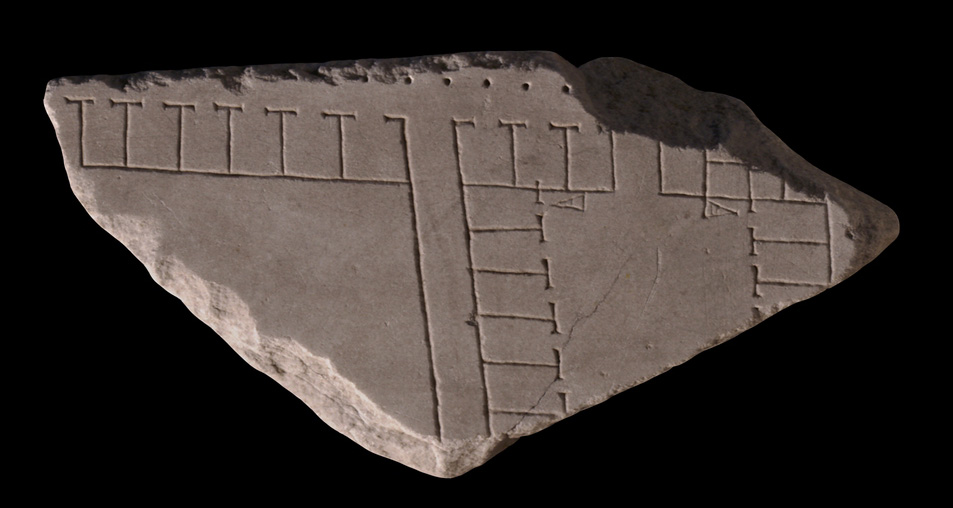
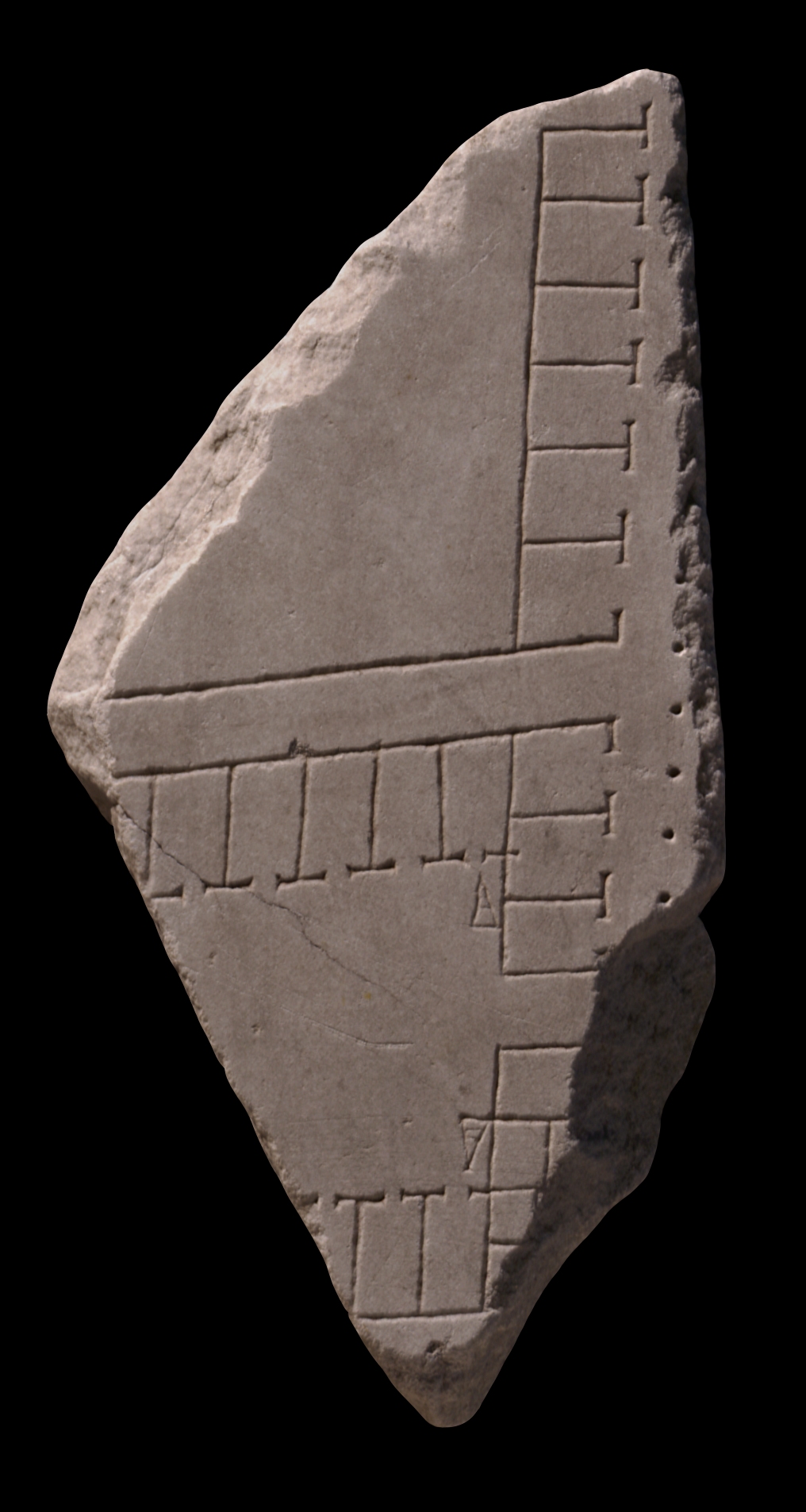
| Description The top edge of this fragment is a slab border with a clamp hole. Two buildings lie side by side, separated by a vertical street. A continuous, covered portico runs along the top side. The structure on the left consists of a large courtyard fronted by a row of outward-facing tabernae. Close examination of the incisions shows that the back wall of the row of tabernae stops short of the left fragment edge, indicating an entrance to the courtyard. Interior rooms frame the left and right edges of the central space on the right half of the fragment. Like the open structure to the left, this building is fronted on the top by outward-facing tabernae. Two stairways, rendered as triangles, flank the wide, central entrance to the interior.
Identification: Riverfront structures, including a warehouse, in Trastevere
D. Koller proposed a position for this fragment along the upper edge of slab VI-8 near frs. 138a and 138bcde, corresponding to a location on the bank of the Tiber in Trastevere (Koller-Levoy 2005). Fr. 92 shares the rough back surface of other fragments located in this slab, and its thickness ranges from 63mm along the slab edge up to 67mm at the bottom tip, a gradient which is consistent with that of fr. 138 nearby.
The incised architectural features on frs. 92 and 138 also align well: the street that separates the two buildings on fr. 92 is exactly in line with a street on fr. 138b, and the relative orientation is that expected given their slab edges. Furthermore, the line that forms the right wall of the structure on the right of fr. 92 continues on fr. 138, where it forms the edge of a second street, parallel to the first. The angle of the riverfront tabernae on fr. 92, relative to the slab edge, is the same as the large street that traverses fr. 138bcde. Also, the entrance to the courtyard in the left structure of fr. 92 is directly opposite the stairway entrance to the corresponding space on fr. 138b.
The ductus of fragment 92 is similar to that on fr. 138, further supporting this placement. Finally, the clamp hole on the top edge matches the position of a clamp hole observed in the aula wall by L. Cozza (clamp hole C8-16 in PM 1960, pl. 61b).
As seen in the adjoining slabs, courtyard structures and warehouses, similar to those depicted here, occupied a long stretch of land between the river and the Via Campana-Portuensis. Note for example the similarity between the architecture shown in fr. 92 and the riverfront structures seen in slabs VI-7 (frs.
27a,
27b,
27c,
27de,
27f),
slab VI-9 (frs.
28a,
28b,
28c), and slab VII-18
(frs. 24c, 24d). A portico similar to the one in fr. 92, rendered as a dotted line, is visible in fr. 27f. In both fragments the portico runs in front of a row of tabernae that faces the river. The combination in fr. 92 of double stairways flanking an entrance that opens onto the river is repeated in the large courtyard structure in fr. 28a. Both structures may be courtyard warehouses with internal stairs to a second floor (Staccioli 1962; Rickman 1971, p. 120; Reynolds 1996, pp. 179-181, fig. 3.36 and compare figs. 3.14 and 3.15). Such warehouses would have been a vital part of the daily commerce and loading/unloading of goods from/to Rome via the Tiber. It is interesting to note the change in scale between the large warehouses and other commercial structures farther downstream (frs. 28) and the smaller-scale architecture just upstream (frs. 27). Positioned between these groups, fr. 92 may represent a transitional area, thus reflecting the shifting activities and changing use of space along the riverbank. Warehouses and courtyard buildings such as those shown in this fragment would have played an important role in the commercial activities along the Tiber.
Significance The locations of frs. 92 and 138 provide us with important new knowledge about Transtiberim, the commercial activities along the riverfront, and the changing use of space along the Tiber's course through the city. Interestingly, D. Koller's positioning of fr. 92 in slab VI-8 requires the Tiber to be at an angle several degrees from horizontal, a slightly different course than that depicted in PM 1960, pl. 62b, and AG 1980, large fold-out plan. |
|
| HISTORY OF FRAGMENT |
| Like the majority of FUR fragments, this piece was discovered in the garden behind the Church of Saints Cosmas and Damian in 1562. From here, it was transferred to and stored in the Palazzo Farnese. It was not reproduced in the Renaissance drawings that are now kept in the Vatican, but Giovanni Pietro Bellori included it in his publication of the Plan in 1673. In 1742, the fragment was moved to the Capitoline museums and exhibited in wooden frames along the main staircase. Since then, it has been stored with the other FUR fragments in various places: In the storerooms of the Capitoline museums (1903-1924), in the Antiquarium Comunale (1924-1939), in the Capitoline museums (1939-1955), in the Braschi palace (1955-1998), and since 1998 in the Museo della Civiltà Romana in EUR under the auspices of the Sovraintendenza ai Beni Culturali del Comune di Roma(PM 1960, p. 119 [Iter E']).
Text by David Koller, Tina Najbjerg, and Jennifer Trimble
|
|
| KEYWORDS
|
| horreum, courtyard, tabernae, shops, stairs, colonnade, Tiber, riverfront, Transtiberim |
|
 Prev
Prev