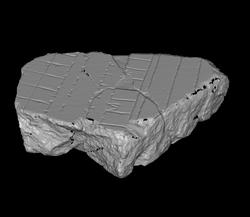
| [FRAGMENT ANALYSIS IN PROGRESS]
Description The surface of the fragment is damaged. A row of back-to-back tabernae is visible on the left side of the fragment. The tabernae on the right open up to a possible covered walkway bordered on the right by an arcade. To the right of this arcade a street is visible with the original red paint still visible. This street runs top-bottom and is flanked on the right by T-shaped piers running parallel to the road. These piers perhaps indicate another covered walkway in front of the single row of tabernae visible to the right. Two of the tabernae have an internal staircase.
Four straight, parallel lines traverse the piece to the left of these shops.
Identification: alongside the Circus Maximus The fragment was matched with fr. 351
by the Stanford team. Four vertical rows of distinct parallel incised features on fragments fn9 and 351 caused the boundary incision matching algorithm to assign a very high score for the correspondence between these two fragments (Koller-Levoy 2005,
fig. 8). Manual observation of the three-dimensional computer models of the fragments allowed to infer that the fragments lie immediately adjacent to one another, based on the strongly corresponding shape between the fractured edges along the proposed interface (fig. 9). Further evidence of the match is evident in the spacing of the rooms, dashed line, and row of T-shaped piers that traverse the two fragments, including the recurrence of stairways in every third room along the right side of the central street.
The topography depicted on the combined fragments fn9 and 351 is suggestive of the architecture along the sides of the Circus Maximus , as shown on other fragments (cf. frs. 8bde, 8c, 8fg).
By process of elimination, it seems most probable that fn9/351 should be positioned on slab VII-13# containing fr. 9 and the bottom half of the Circus Maximus (Koller-Levoy 2005, 10c-d). Based on the similarity of the architecture on fr9/351 with that on frs. 8b-g, a position is proposed on the lower left side of the Circus Maximus rather than the right, as shown in fig. 11.
Significance
This fragment possibly depicts the commercial elements next to the Circus Maximus, as well as what seems to be a major thoroughfare along side the circus, emphasized by red paint.
|
 Prev
Prev