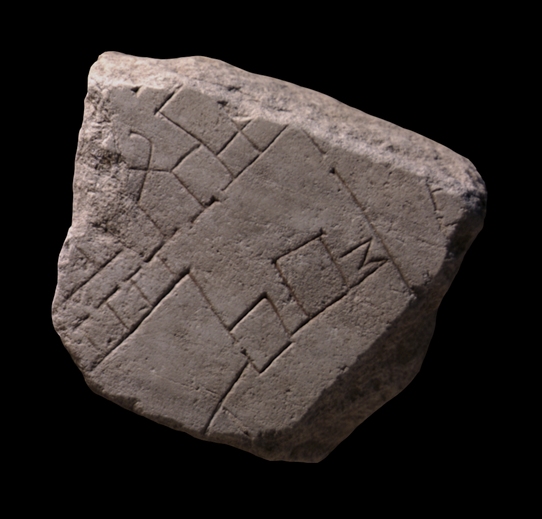
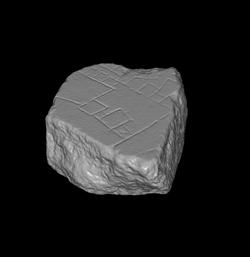
| Description A distinct, horizontal veining line crosses the fragment. In the center of the piece a large, rectangular hall is depicted. A narrow opening in its right wall gives access to another large space. Two smaller rooms and a staircase are situated at the bottom of the central hall. The rooms do not seem to be accessible from the large hall, but the one in the lower left corner opens onto another large hall or enclosure. This area is flanked on the left by a row of shops, parallel to the front of the central hall. In front, the central room has two openings; one leads to a room topped by a strange, caduceus-shaped feature which might represent an arch or barrel vault (is this an elaborate entrance?); another opens to a closed room. Three other rooms share the front wall of the central hall but do not seem to be related to it.
Identification: Subura The fragment has been joined to the top of the large fragment
10g
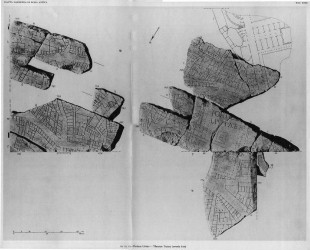
(PM 1960, p. 69, pl. 18; AG 1980, pl. 7) in slab VIII-3, which identifies it as a section of the Subura, right between the vicus Sabuci and the clivus Suburanus (see Rodríguez-Almeida 1970-71, fig. 12, or LTUR III, fig. 42, where the fragment is outlined between Via Giovanni Lanza and Via Equizia). The function of the central hall is uncertain. Its limited accessibility indicates a semi-private function, perhaps a meeting hall or schola for one of Rome's many collegia. Although there is no visible access between the large space to the left and the row of tabernae, it probably functioned as a common working area or extra living space for the shop owners and their families. Such open spaces must have been highly coveted in this crowded area of Rome.
Archaeological and epigraphical evidence, in conjunction with the names of Medieval churches and quotes from Martial, locate the residential and commercial district called the Subura. It began near the Argiletum and the Roman forum, and from there stretched, at least in imperial times, northward up the valley between the Quirinal and Viminal Hills and eastward between the Oppian and Cispian Hills, where it probably reached as far as the Esquiline Gate (LTUR IV, p. 379). An inscription (CIL 6.9526) indicates that in the imperial period the area was divided into two sections: the Subura maior and the Subura minor. The greater Subura has been identified with the largely commercial area near the Forum Romanum, between the Viminal and the Oppian Hills, and the lesser Subura with the upper section between the Cispian and Oppian Hills where the major thoroughfare of the Subura, the clivus Suburanus, ascended towards the Esquiline Gate (LTUR IV, p. 380).
Roman poets like Martial and Juvenal described the Subura as a sordid commercial area, riddled with violence, brothels, and collapsing buildings. In reality, it was probably not different from any other neighborhood in Rome where commercial activity intermingled with the religious and political life in the great public monuments and smaller local shrines and scholae, and where the large domus of the rich stood next to the decrepit apartment buildings that housed the poor. An abundance of evidence demonstrates that even in imperial times the Subura housed senators (probably on the upper slopes) as well as sandal makers, blacksmiths, and cloth sellers. Commercial activity was probably concentrated all along the clivus Suburanus. The many epigraphic references to the synagogue in the Subura, probably located in the Subura minor near the Esquiline Gate, suggest it was the center for the largest Jewish congregation in Rome (LTUR IV, pp. 382-383).
Significance The tabernae with added work or living space, the narrow alley, and the multi-storeyed structure depicted in this fragment support the description of the Subura as an active, crowded, and predominantly commercial area of Rome where artisans and craftsmen lived, worked, and sold their goods (see references to Martial and Juvenal in LTUR IV or Richardson 1992). |
 Prev
Prev