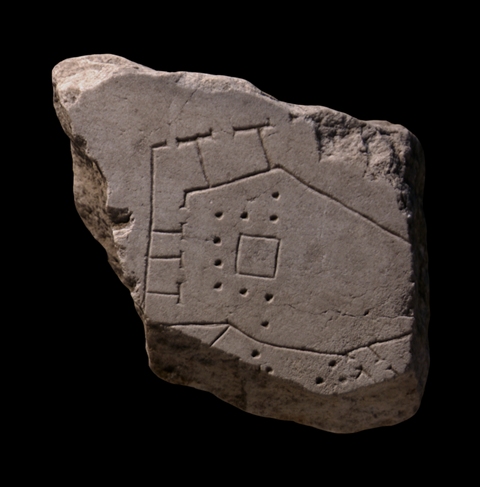
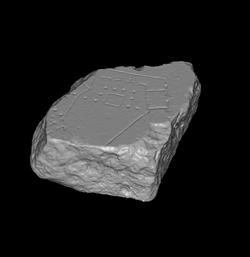
| Description The fragment depicts a large, irregular structure, probably open to the sky. At the left end a square feature is surrounded on three sides by columns. Four small rooms open onto the central space from the left. Two outward-facing rooms, perhaps tabernae, flank the large area at top; these face an open space or wide street which may turn and continue down the left side of the irregular central feature. At bottom, the hall shares a wall with another colonnaded, and perhaps arcaded, structure.
Identification: Schola for a collegium(?) The limited access to the central space in this fragment indicates that it served a semi-private purpose. The concentration of columns at one end of the building, framing the square feature which might represent an altar or a large statue base, gives the space a certain architectural formality that would be unusual in a strictly residential setting. The structure may instead have been used for ceremonies and/or meetings, and have functioned as the meeting hall, schola, of a religious or professional organization, a collegium. The location of this building at an intersection of the vicus Sabuci and a smaller street is especially intriguing in light of the discovery of a dedication to Vulcan by the magistri vici Sabuci (CIL 6.801) in the 18th c. in the Via Merulana near S. Martino ai Monti (Rodriguez-Almeida 1970-71, p. 125). The findspot is practically next door to the building in this fragment (see LTUR III, fig. 42) and it is not unlikely that the structure served as the headquarters of the magistri vici Sabuci. The statue base or altar would, in that case, have been a central feature in the worship of Vulcan. A collegium of any sort would have required a large room for meetings and communal dining, perhaps a sacellum or altar for the worship of the patron god, and the ability to restrict access to members only. The central space in this fragment seems to fulfill these requirements. The 18th-c. discovery in this area of an additional dedication to Vulcan (Bullettino della Commissione Archeologica Comunale di Roma 1877, pp. 161-62) increases the possibility that Vulcan was the patron god worshipped in this building.
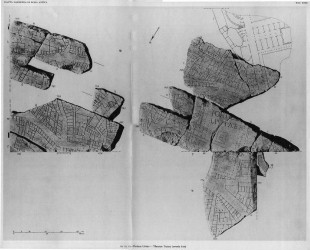
Identification: Subura The fragment has been joined to the top of fr.
10opqr
(PM 1960, figure on p. 69, pl. 18; AG 1980, pl. 7) in slab VIII-3 which locates it in the Subura, just east of the porticus Liviae. Archaeological and epigraphical evidence, in conjunction with the names of Medieval churches and quotes from Martial, locate the residential and commercial district called the Subura. It began near the Argiletum and the Roman Forum, and from there stretched, at least in imperial times, northward up the valley between the Quirinal and Viminal Hills and eastward between the Oppian and Cispian Hills, where it probably reached as far as the Esquiline Gate (LTUR IV, p. 379). An inscription (CIL 6.9526) indicates that in the imperial period the area was divided into two sections: the Subura maior and the Subura minor. The greater Subura has been identified with the largely commercial area near the Forum Romanum, between the Viminal and the Oppian Hills, and the lesser Subura with the upper section between the Cispian and Oppian Hills where the major thoroughfare of the Subura, the clivus Suburanus, ascended towards the Esquiline Gate (LTUR IV, p. 380).
Roman poets like Martial and Juvenal described the Subura as a sordid commercial area, riddled with violence, brothels, and collapsing buildings. In reality, it was probably not different from any other neighborhood in Rome where commercial activity intermingled with the religious and political life in the great public monuments and smaller local shrines and collegia, and where the large domus of the rich stood next to the decrepit apartment buildings that housed the poor. An abundance of evidence demonstrates that even in imperial times the Subura housed senators (probably on the upper slopes) as well as sandal makers, blacksmiths, and cloth sellers. Commercial activity was probably concentrated all along the clivus Suburanus. The many epigraphic references to the synagogue in the Subura, probably located in the Subura minor near the Esquiline Gate, suggest it was the center for the largest Jewish congregation in Rome (LTUR IV, pp. 382-383).
Identification: Vicus Sabuci The open space at top of this fragment is a section of a street that makes its way from the Baths of Trajan to the Esquiline Gate, also visible in frs. 10abcde, 10Aab and 10lm. Since the names of all the other streets in the neighborhood are known, this street must be the vicus Sabuci, attested in the inscription, mentioned above, that was found in the 18th c. in the Via Merulana near S. Martino ai Monti (CIL 6.801) and which was dedicated to Vulcan by the magistri vici Sabuci (Rodriguez-Almeida 1970-71, pp. 125).
Significance The identification of the central hall in this fragment as a schola for a collegium, possibly that of the magistri vici Sabuci, proposed here for the first time, puts a face on an otherwise unknown structure in this commercial and residential neighborhood of Rome.
|
 Prev
Prev