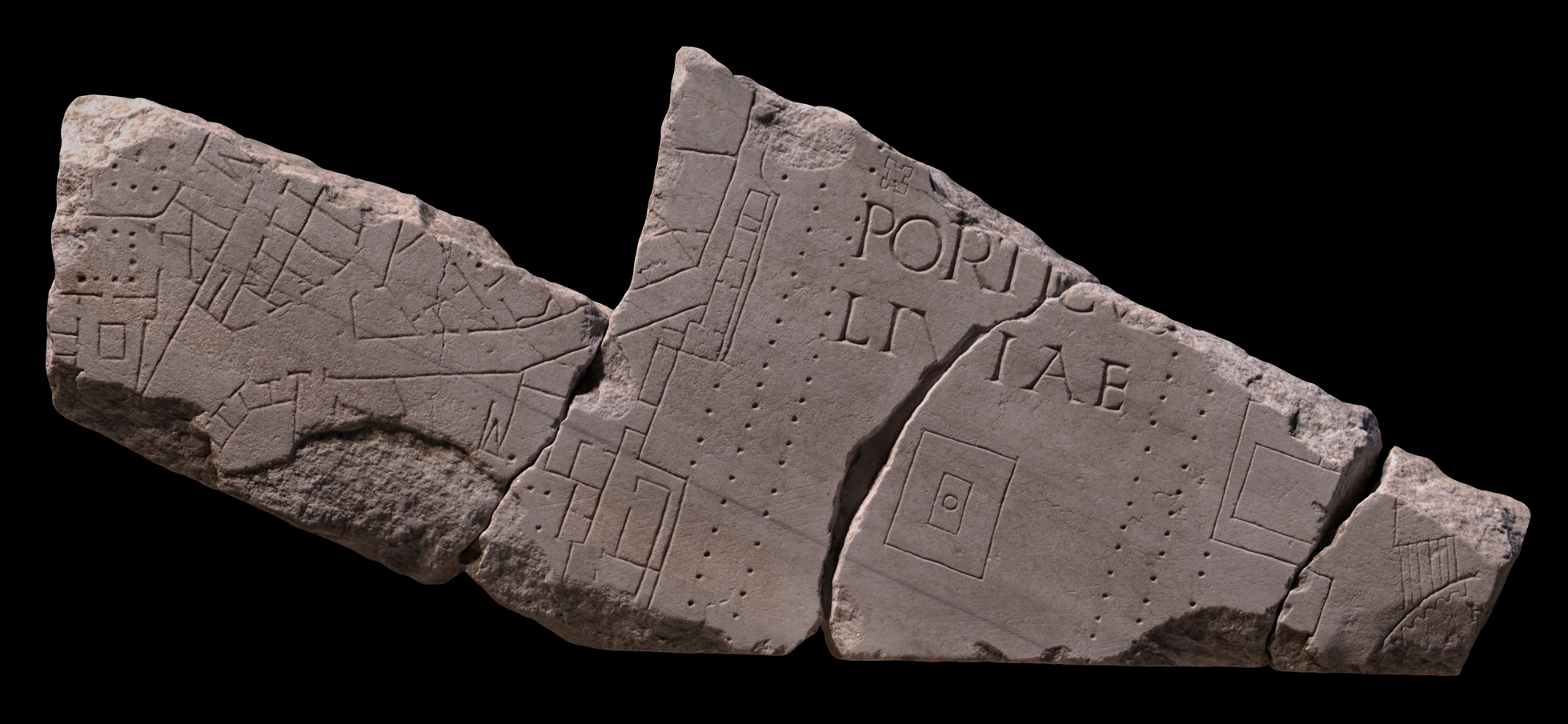
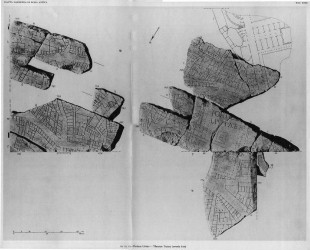
| DescriptionThree of the four joined fragments were part of a slab edge. A distinct veining line traverses the entire fragment group. Occupying most of the center is a large, three- or four-sided porticus with an inscription, PORTIC[US] LIVIAE, traversing the central courtyard. A double colonnade surrounds the courtyard. A small, square, crenellated feature appears right above the P of the inscription. Below the inscription, in the center of the courtyard, a large rectangle encloses a smaller rectangle with a circle inside. Two exedrae punctuate the left backwall of the porticus: a semicircular niche at top, and a rectangular, tetrastyle niche below. NB. In the drawing of this fragment in AG 1980, pl. 8, the rectangular niche is incorrectly shown as opening onto an elongated stretch of rooms outside of the building. As seen in the Stanford photograph, the niche is completely closed off from this row of rooms. A larger exedra is located behind the right wall. To the right of the porticus a section of a circle or semicircle with a crenellated interior edge is visible. A set of steps leads up to the building of which the semicircle was part. Between the steps and the exedra in the right side of the porticus is situated a square feature. A dense conglomeration of rooms, shops, alleys, streets, and porticoed courtyards crowd the area to the left of the porticus. A street runs from bottom left towards the upper right of fr. 10o where it splits in two. The left fork moves upwards and disappears at top of the fragment; the right fork continues its diagonal path towards the upper right. Where it meets with the porticus, it turns and follows the left side of the building to the top of the fragment. Tabernae flank a short stretch of the right side of this street at the bottom. Another four separate buildings are situated in the mainly triangular area between the diagonal street and the porticus. One seems to consist of a colonnaded courtyard with a large, distyle room at top and two smaller at the right side. Three others are flush against the left wall of the porticus. Of these, the elongated feature at top is the most interesting: it contains six rooms in a row, the first four interconnecting, and there is no visible access to the building. On the left side of the diagonal street, in the far left corner of the fragment lies a building that consists of a large room with a central rectangle and smaller rooms along the left side. It opens onto a peristyle which again gives access to a few irregular rooms on the right. Above it, the corner of another peristyle is visible. These two buildings are separated from a row of back-to-back tabernae by what looks like an alley. The back row of shops open onto this alley, the front row onto the left fork of the separated street. Between the two forks of the street a series of interconnected rooms, one of which is apsed, another colonnaded.
Identification: Porticus Liviae The inscription identifies the large, porticoed structure in the center of this fragment as the porticus Liviae. The N end of this building is partially visible in fr. 11a, the S end in fr. 10lm. Built by Augustus in the name of his wife Livia on the site of a luxurious domus which he had inherited from Vedius Pollio (Ovid, Fasti 6.637-648; Suetonius, Augustus 29.4; Cassius Dio 54.23.1-6, 55.8.2), the building was formally dedicated in January, 7 BCE, by Tiberius and his mother Livia (LTUR IV, p. 127). Explicitly dedicated to marital harmony, it was by all accounts magnificent, with a garden and a collection of paintings. The Marble Plan provides irreplaceable information about the exact location and design of this now-lost building. It was situated at the edge of the Oppian Hill, with its N (main) entrance facing the clivus Suburanus (see fr. 11a), and its rear backing onto the vicus Sabuci (in fr. 10lm). The building consisted of an enormous rectangle of about 120 x 70 m., with a large internal open space surrounded on all four sides by a double colonnade. The single vine stock that covered all of the walkways of the porticus Liviae, according to Pliny, HN 14.11 (Richardson 1992, p. 314), perhaps spread along these colonnades. Behind the double colonnades, exedrae of various shapes and sizes punctuated the back walls of the building. All exedrae were fronted by columns, thus giving the effect of a triple colonnade. The central exedra along the W wall in this fragment was set farther north than its counterpart on the opposite wall; it was also deeper and wider, perhaps because it had a different role. The square, crenellated features in each corner of the open courtyard, one seen here just inside the double colonnades, are perhaps fountains (LTUR IV, p. 127) or small structures with statue niches in each face. The rectangular feature at the center of the courtyard has been interpreted as a monumental fountain on a podium (PM 1960, p. 69; Richardson 1992, p. 314) or an altar or small temple to Concordia, the goddess to whom the complex was dedicated (see references in LTUR IV, p. 128). The main access to the building was from the clivus Suburanus (the modern Via in Selci) through a monumental entrance with a central staircase in two flights. Additional openings are seen behind the easternmost exedra in fr. 10lm, in the S end of the large niche in the E wall (this fragment), in the large, central exedra in the W wall and just north of the semicircular niche in fr. 11a. The stairs in the N and the W walls suggest that a platform had to be constructed as a level foundation for the building on the sloping hill side. A few remains of the floor of the central courtyard have been excavated, as have even deeper remnants of a floor from Pollio's residence, which was razed to the ground to make way for the public porticus (LTUR IV, p. 128). The building seems to have been in use until the 4th and perhaps even the 5th c. In the 6th c., it became a graveyard - an interesting testimony to the decline of this formerly so busy area of Rome (LTUR IV, pp. 128-129).
Identification: Thermae Traiani The monumental building partially visible in the right side of these fragments has been identified as the Baths of Trajan (PM 1960, pp. 69-70). Other parts of the Baths are depicted in frs.
10i (missing),
10opqr,
10s,
10wxy,
10z,
12,
13q,
13r,
13s
(see AG 1980, pl. 8), and fr. 565 (see Rodríguez-Almeida 1994b). This enormous bath complex was built between 104 and 109 CE by the architect Apollodorus of Damascus (Cassius Dio 69.4.1) on a great platform at the top of the Oppian Hill in Regio III (LTUR V, p. 67). Standing and excavated remains, Renaissance drawings, and the fragments of the FUR tell us of their internal design (see LTUR V, figs. 42-43 for Piranesi's drawing of the remains and for a reconstruction that includes the actual remains). Like all the imperial thermae of Rome from at least the Baths of Titus onward (fr. 110), these were designed as a central bathing block within a large open space (ca. 300 x 216 m.) surrounded by a precinct wall that included additional rooms and architectural features. The bathing block proper was placed against the center of the NE precinct wall to give maximum sun exposure to the hot rooms, which were situated in a row along the SW side of the building (partly visible on fr. 10xwy)(LTUR V, p. 68). The bathing rooms were symmetrically duplicated on either side of a central axis, the line of which is faintly visible in the guideline on this and on fr. 10xwy. This central axis began at the monumental entrance in the NE wall in this fragment and led directly into the natatio, depicted as a large, colonnaded square at the bottom right of this fragment (more of it is visible in the missing fr. 10i). From there, this axis extended through a great central cruciform hall, not visible on the surviving fragments of the Plan, and finally into the tepidarium and the caldarium, seen on fr. 10xwy. Visitors could move off this central axis into suites of small rooms near the entrance, perhaps dressing rooms (see fr. 10i). Two elaborately built rotundae with curving walls that were interrupted at each corner by triple niches, probably filled with statuary (frs. 10i and 10z), may have been frigidaria. There were rectangular palaestrae as well, not visible on the surviving Plan fragments, and numerous smaller rooms throughout. Along the SW side of the bathing block, on either side of the caldarium, is a row of sunrooms, placed to take maximum advantage of the sun. The visitor might also turn left or right from the monumental entrance along a colonnaded passageway which led to a suite of rooms within the NE precinct wall (as seen in this fragment and 10i) and ultimately to the great hemicycles at the far ends. A section of the northernmost hemicycle is visible in this fragment; the rest is seen in frs. 10s and 12. Fr. 10i depicts the southern hemicycle. These hemicycles are thought to have been monumental display fountains; they looked out onto the large open area that enclosed the bathing block on three sides. In these gardens were meeting rooms and libraries, the latter perhaps in the semicircular exedrae near the S and W corners of the outer wall, one of which survives to this day with two storeys of niches (LTUR V, p. 68). At the far end of this open area, at the center of the SW wall of the precinct, a vast hemicycle opened outward (frs. 13q and 13r). Seats around its curve suggest that this was a space for performances or athletic contests (Richardson 1992, p. 397). Staircases along the SW precinct wall and other minor entrances gave access to the Baths from multiple directions.
The Baths of Trajan were built on a massive platform supported by a series of vaulted tunnels; they covered much of the filled-in Esquiline wing of Nero's Golden House (domus Aurea), damaged in a fire in 104 CE and no longer in use. Some later sources refer to the emperor Domitian as the builder, but this is contradicted by the Trajanic brickstamps found in the complex, the building's unified design, and the epigraphic and textual evidence of the Baths' dedication in 109 CE (LTUR V, p. 67). The immense water supply needed was provided in part if not entirely by the aqua Traiana and distributed to the Baths from the huge nearby cistern divided into nine long chambers and known as the Sette Sale (LTUR V, pp. 68-69; this is not depicted on the surviving fragments of the Plan). The Baths remained in use into the 4th and 5th c. CE; they may have been experiencing gradual abandonment even before their decisive ending in 537 CE when the aqueducts were cut by Vitigis' Ostrogothic army. In the 16th c. and later, the surviving remains on the Oppian were referred to indiscriminately as the Baths of Trajan and the Baths of Titus until R. Lanciani (BullCom 1895, pp. 110-115) disentangled this conflation (LTUR V, p. 67). Only one fragment of the Plan, fr. 110, has been associated thus far with the adjacent Baths of Titus.
Identification: Subura This fragment group represents a section of the residential and commercial district called the Subura. Archaeological and epigraphical evidence, in conjunction with the names of Medieval churches and quotes from Martial, locate the approximate boundaries of the Subura neighborhood. It began near the Argiletum and the Roman forum, and from there stretched, at least in imperial times, northward up the valley between the Quirinal and Viminal Hills and eastward between the Oppian and Cispian Hills, where it probably reached as far as the Esquiline Gate (LTUR IV, p. 379). An inscription (CIL 6.9526) indicates that in the imperial period the area was divided into two sections: the Subura maior and the Subura minor. The greater Subura has been identified with the largely commercial area near the Forum Romanum, between the Viminal and the Oppian Hills, and the lesser Subura with the upper section between the Cispian and Oppian Hills where the major thoroughfare of the Subura, the clivus Suburanus, ascended towards the Esquiline Gate (LTUR IV, p. 380). Roman poets like Martial and Juvenal described the Subura as a sordid commercial area, riddled with violence, brothels, and collapsing buildings. In reality, it was probably not different from any other neighborhood in Rome where commercial activity intermingled with the religious and political life in the great public monuments and smaller local shrines and scholae, and where the large domus of the rich stood next to the decrepit apartment buildings that housed the poor. An abundance of evidence demonstrates that even in imperial times the Subura housed senators (probably on the upper slopes) as well as sandal makers, blacksmiths, and cloth sellers (LTUR IV, pp. 382-383). In fact, the building unit to the far left of fr. 10o, nestled between shops and apartment structures, may be a single-family residence, a domus. The entrance would have been at the bottom of the unit, now cut off, and it would have given access to the rectangular hall with a rectangular feature in center. This must be the atrium with a central compluvium and cubicula opening onto the atrium. From the atrium, there was access to the peristyle courtyard which may have served as a vegetable or flower garden. The rooms on the right of the peristyle were perhaps servants' quarters and/or a kitchen area. Despite its modest size, this house must have been considered a luxurious living unit in this crowded area of Rome. It is flanked on the right by back-to-back shops and what is perhaps apartment structures. The architectural units along the E side of the porticus Liviae defy identification. The architecture of the narrow, elongated structure which is tucked away between two of the exedrae in the E wall of the porticus is reminiscent of subterranean Mithraea. The diagonal street that ran along the N side of the porticus Liviae connected the vicus Sabuci, along the E side of the building, with the clivus Suburanus, the major thoroughfare of the Subura neighborhood.
Significance These joined fragments are significant on a variety of levels. They draw a vivid picture of the urban fabric that surrounded enormous public complexes like the Porticus of Livia and the Baths of Trajan. With frs. 10lm and 11a, they provide our only knowledge of the location and layout of the Porticus of Livia, of which nothing remains. In addition, they construct a real image of what textual sources infer about Augustan propaganda: The siting of this public building on top of the private property of Vedius Pollio, infamous for his luxurious lifestyle, was a visual reminder of the Augustan law against luxury. And the location of a building dedicated to marital bliss and virtue by Augustus' own wife and (adopted) son in a neighborhood known for sexual debauchery, was hardly coincidental when considering Augustus' promotion of marriage and family.
Along with the other fragments that depict the Baths of Trajan, this group is key to our knowledge of the architecture of this monument of which little remains; in addition, it gives us insight into the work of their architect, Apollodorus of Damascus (Cassius Dio 69.4.1) who also designed Trajan's Forum. Comparison to other imperial thermae on the Marble Plan (Baths of Agrippa in fr. 38 and Baths of Titus in fr. 110) shows great consistency in the rendering of the architecture of such buildings: Rooms are symmetrically arranged around the center axis; great hemicycles add variety to the otherwise rectilinear design, and the walls of the central bathing building proper are rendered with thick, recessed lines on the FUR. Whether these thick lines represent the thickness of the actual walls, or are merely symbolic renderings, is uncertain. The symmetrical and rectilinear architecture of these thermae forms a stark contrast to the small, irregular neighborhood baths, the balnea, usually hidden in crowded insulae. The difference is a direct result of the organic growth of small baths within already existing neighborhoods, as opposed to architecture designed for a blank space, where preexisting buildings had been removed to give the imperial architects free reigns to design these gargantuan structures.
The Baths of Trajan fragments are also invaluable in clarifying the role complexes such as these played in the social life of Rome. Women as well as men used these Baths (LTUR V, p. 67 with reference), and the complex included not only the great central bathing block, but also gardens, probably libraries, a large semicircular area with seating that would have provided room to watch sports or performances, clubrooms and informal meeting rooms.
|
 Prev
Prev