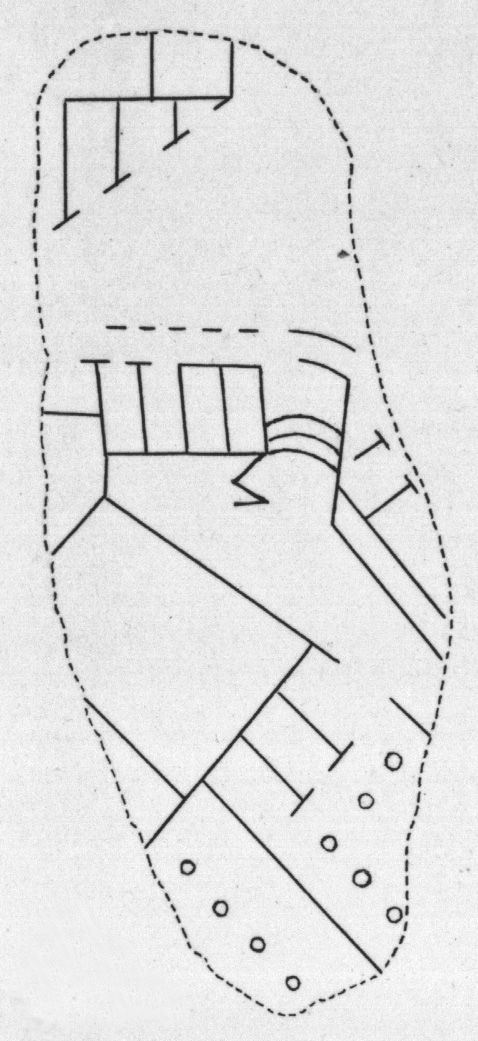
| Description This lost fragment was reproduced in Giovanni Pietro Bellori's 1673 publication (see the photo detail above from PM 1960, pl. 60, or the on-line view of Bellori's original plate 7). Bellori's drawing shows that the fragment depicted sections of two city blocks, separated by a triangular piazza or street. At top, three small tabernae faced the piazza. A passageway to the left led to an area behind them and to another room. Across the piazza was another row of shops, only two of which seemed to have had openings. They were faced by an arcade. To their right, the arcade and the buiding itself curved to the right and the beginning of another row of shops was visible. A curved set of stair between these two rows of shops led to an irregular space behind them. This gave access to two abutting rooms with internal colonnades and three small rooms at the rear. A large, trapezoidal room, seemingly with no means of access, connected these colonnaded rooms or peristyles to the first row of tabernae. The whole complex may have been a large domus with the irregular front hall functioning as an atrium.
Identification: The Subura The authors of PM 1960 briefly commented that the architecture depicted in this lost fragment was similar to that shown in fragment group 10 on the Marble Plan (PM 1960, p. 159). Later, E. Rodríguez-Almeida suggested that the fragment fit into a lacuna between frs. 10g, 10opqr, and 11c (Rodríguez-Almeida 1975-76, p. 270; AG 1980, pl. 7). This location would identify the architecture on the fragment as part of the residential and commercial district called the Subura. Archaeological and epigraphical evidence, in conjunction with the names of Medieval churches and quotes from Martial, locate the approximate boundaries of the Subura neighborhood. It began near the Argiletum and the Roman forum, and from there stretched, at least in Imperial times, northward up the valley between the Quirinal and Viminal hills and eastward between the Oppian and Cispian hills, where it probably reached as far as the Esquiline Gate (LTUR IV, p. 379). An inscription (CIL 6.9526) indicates that in the Imperial period the area was divided into two sections: the Subura maior and the Subura minor. The greater Subura has been identified with the largely commercial area near the Forum Romanum, between the Viminal and the Oppian hills, and the lesser Subura with the upper section between the Cispian and Oppian hills where the major thoroughfare of the Subura, the clivus Suburanus, ascended towards the Esquiline Gate (LTUR IV, p. 380).
Roman poets like Martial and Juvenal described the Subura as a sordid commercial area, riddled with violence, brothels, and collapsing buildings. In reality, it was probably not different from any other neighborhood in Rome where commercial activity intermingled with the religious and political life in the great public monuments and smaller local shrines and collegia, and where the large domus of the rich stood next to the decrepit apartment buildings that housed the poor. An abundance of evidence demonstrates that even in Imperial times the Subura housed senators (probably on the upper slopes) as well as sandal makers, blacksmiths, and cloth sellers. Pliny the Younger is known to have had a large house near the porticus Liviae and the lacus Orphei, and Rodríguez-Almeida has identified the trapezoidal entry hall and the two colonnaded rooms in this fragment as Pliny's house (Rodríguez-Almeida 1983b, p. 113; LTUR II, pp. 158-9. The identification is doubted by K. Welch [LTUR IV, p. 380]).
Significance If Rodríguez-Almeida's placement of this lost fragment is correct, then the triangular piazza depicted here represented a widening of the street that ran between the two major arteries of the Subura neighborhood, the clivus Suburanus and the vicus Sabuci (see AG 1980, pl. 7. The street continues in fr. 10opqr). It thus helps us understand the patterns of movement through this crowded area. The proximity of the large residential unit to small shops in this fragment underscores the mixed commercial and residential nature of the Subura.
|
 Prev
Prev