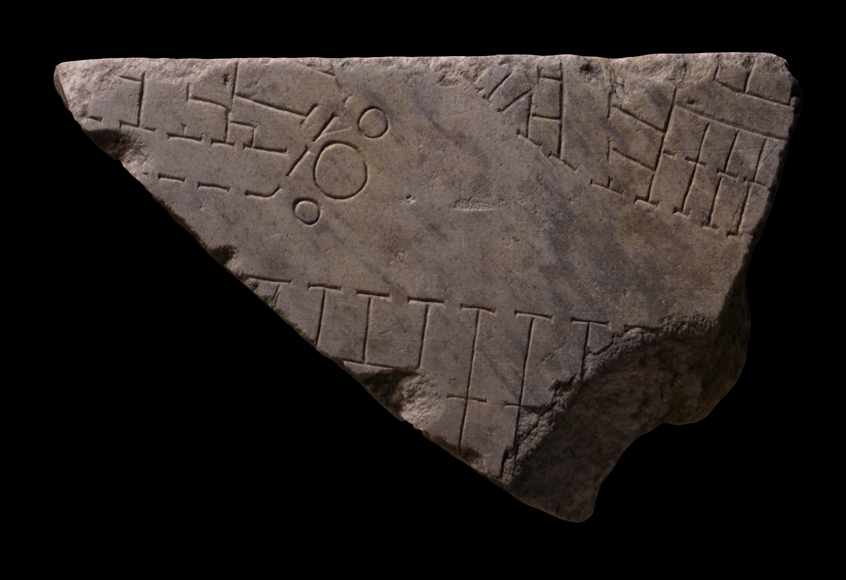
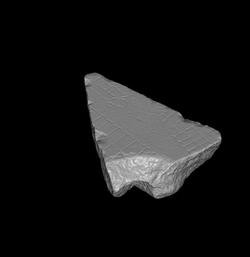
| Description The fragment was part of a slab edge; a clamp hole and part of a tassello are visible on the back. A wide street runs horizontally from right to left and splits into two smaller streets, effectively separating the depicted architecture into three distinct parts. At the bottom, a row of tabernae opens onto the street. The first three shops from the right have access to a back room.
In the top right corner, another row of tabernae with back rooms faces the street. Left of them, an alley or corridor gives access to small rooms that could be either shops or apartments. Another row of shops backs onto this corridor. The architecture in the top left corner is situated in the intersection where the street splits in two. Here, various rooms open up to either of the two streets. A portico lines the shops along the street that forks to the left. Three circular features, the central circle being almost twice the size of the two that flank it, are situated in front of the portico, exactly where the street splits. They may represent a fountain or a nymphaeum.
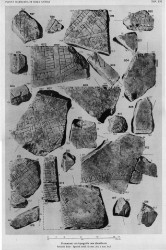
Identification: Clivus Suburanus Remains of a tassello allowed E. Rodríguez-Almeida to join this fragment with fr. 11d and to the already located fr. 11a. (Rodríguez-Almeida 1975-76, p. 268, fig. 5). Sawing irregularities (scalini) on the back of all these fragments confirm their position in slab VII-7 (Almeida 1992, pp. 66-68, figs. 15-16). This effectively placed the fragment along the top edge of slab VII-7 and identified the wide street that traverses its lower part as the clivus Suburanus, a major thoroughfare that ran from the Forum Romanum and the Argiletum through the Subura neighborhood to the Esquiline Gate in the Republican walls. The fronts of the tabernae that line the S side of the street in this fragment correspond to travertine remains near the Santa Lucia in Orphea at the end of the Via in Selci (Rodríguez-Almeida 1975-76, p. 271; 1983b, p. 113). Other sections of this street are visible on frs. 10Aab,
10g, and
11a. The clivus Suburanus exited the Forum just west of the Basilica Aemilia and entered the Argiletum quarter through the Forum Transitorium; this stretch of the street was called the Argiletum and was lined with the shops of artisans like sandal makers and book sellers (LTUR I, p. 287). Scholars believe that farther east, the street had a less commercial character, but frs. 10g and 10Aab show that it was lined with shops along its entire course. Its probable route can be traced in several streets surviving in the modern topography of Rome: the Via di S. Vito, the Via di S. Martino, the Via in Selci, and the Via della Madonna dei Monti. (Note that newer, wider, and straighter streets--the Via dello Statuto, the Via Giovanni Lanza, and the Via Cavour--have largely bypassed this narrow and somewhat winding route.)
Rodríguez-Almeida has identified the three circles in this fragment as the Fountain of Orpheus (see below). Since the 5th Augustan region is known to have begun at the lacus Orphei, Rodríguez-Almeida has proposed that the last stretch of the clivus Suburanus, between the lacus Orphei in this fragment and the Esquiline Gate, was not part of the Subura and that it therefore must have been called something else, perhaps vicus portae Esquilinae (Rodríguez-Almeida 1975-76, pp. 276-278). K. Welch has counterargued that this name is not corroborated by literary evidence and that CIL 531 confirms that the area near the Esquiline Gate was still part of the Subura (LTUR IV, p. 379).
Identification: Subura This fragment represents a section of the residential and commercial district called the Subura. Archaeological and epigraphical evidence, in conjunction with the names of Medieval churches and quotes from Martial, locate the approximate boundaries of the Subura neighborhood. It began near the Argiletum and the Forum Romanum, and from there stretched, at least in imperial times, northward up the valley between the Quirinal and Viminal Hills and eastward between the Oppian and Cispian Hills, where it probably reached as far as the Esquiline Gate (LTUR IV, p. 379). An inscription (CIL 6.9526) indicates that in the imperial period the area was divided into two sections: the Subura maior and the Subura minor. The greater Subura has been identified with the largely commercial area near the Forum Romanum, between the Viminal and the Oppian Hills, and the lesser Subura with the upper section between the Cispian and Oppian Hills where the major thoroughfare of the Subura, the clivus Suburanus, ascended towards the Esquiline Gate (LTUR IV, p. 380).
Roman poets like Martial and Juvenal described the Subura as a sordid commercial area, riddled with violence, brothels, and collapsing buildings. In reality, it was probably not different from any other neighborhood in Rome where commercial activity intermingled with the religious and political life in the great public monuments and smaller local shrines and scholae, and where the large domus of the rich stood next to the decrepit apartment buildings that housed the poor. An abundance of evidence demonstrates that even in imperial times the Subura housed senators (probably on the upper slopes) as well as sandal makers, blacksmiths, and cloth sellers. Commercial activity was probably concentrated all along the clivus Suburanus. The many epigraphic references to the synagogue in the Subura, perhaps located in the Subura minor near the Esquiline Gate, suggest it was the center for the largest Jewish congregation in Rome (LTUR IV, pp. 382-383).
Identification: Lacus Orphei Rodriguez-Almeida suggests that the triple fountain that crosses the clivus Suburanus in this fragment was located on the site of Piazza San Martino ai Monti, in the valley between the Cispian and the Oppian Hills, 40-50 m. from Santa Lucia in Selci (in Orphea), and 40-50 m. from San Martino ai Monti (San Silvestri in Orpheo)(Rodríguez-Almeida 1975-76, fig. 8). He further proposes that Martial's reference in 10.20.4-11 to climbing the short, steep road to the top of the Subura and seeing the Orphic feature straight ahead (illic Orphea protinus) identifies the triple fountain at the top of the Clivus Suburanus as the lacus Orphei (Rodríguez-Almeida 1975-76, pp. 275-278). This identification explains the many references to the name of Orpheus in the names of buildings in this area. The fountain is mentioned in the 4th c. Regionary Catalogues under Regio V but is otherwise unknown. The representation of the fountain in this fragment suggests that it consisted of three circular basins, the central basin measuring ca. 5-6 m. in diameter while the two smaller, lateral basins measured approximately 2.5-3 m. The porticoed wall section behind the fountain perhaps represents a type of scaenae frons that would have functioned as a back drop for the fountain and perhaps held statuary (LTUR III, p. 171). NB. Note that this section is incorrectly rendered with a continuous line in the drawing in AG 1980, pl. 9. Rodríguez-Almeida has further proposed that the Augustan reorganization of the water supply (more specifically the Anio Vetus aqueduct) in this area of the city and the revival of the Orpheus myth in Augustan poetry (Ovid's Metamorphosis) indicate that the nymphaeum itself was an Augustan monument (Rodríguez-Almeida 1983b, pp. 111-113).
Significance This fragment is key to our knowledge of the nature, and more importantly, the precise location of the lacus Orphei. This in turn indicates that the western boundary of the 5th Augustan region was inside the Republican walls, not outside, as formerly believed.
|
 Prev
Prev