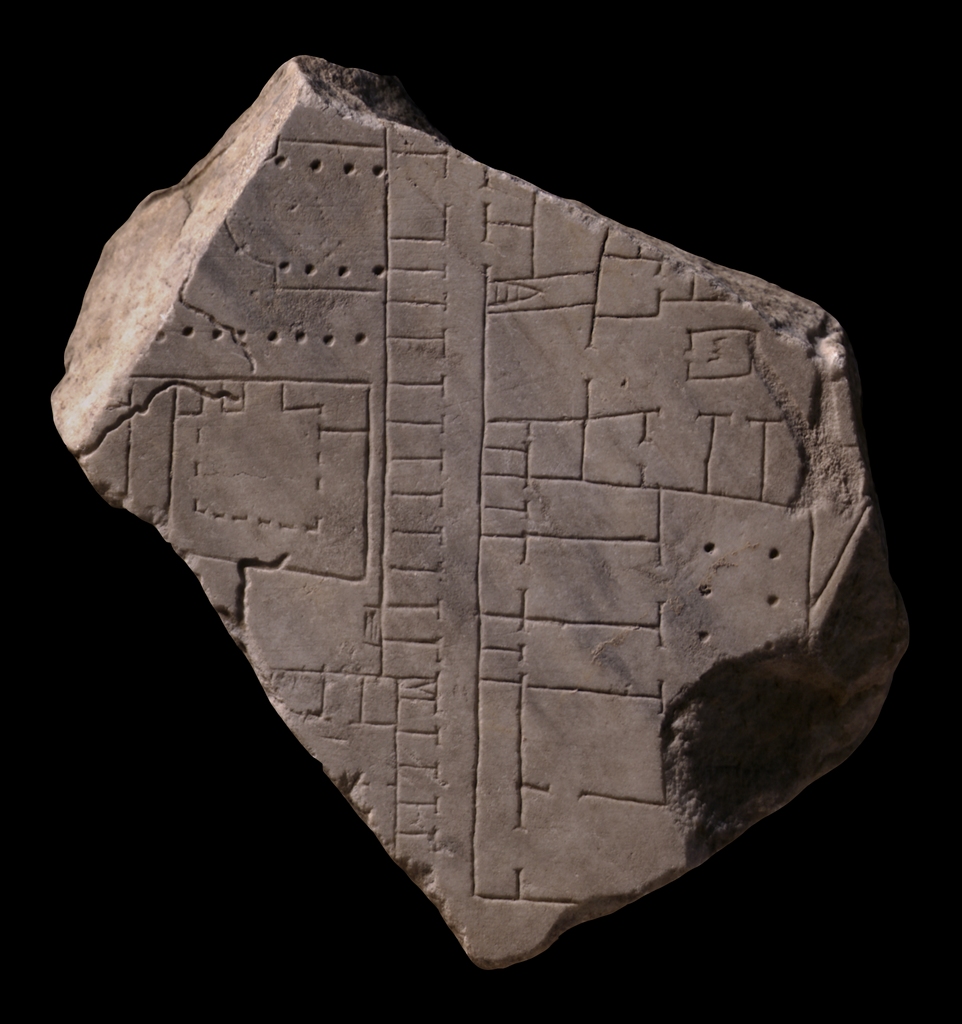
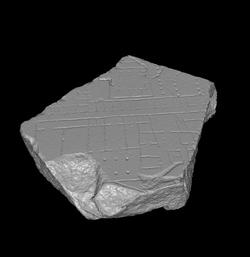
| Description A tassello is visible on the back of the fragment (AG 1980, pl. 9). Strange, worm-like crevices in the surface of the marble may have been caused by roots. A narrow, vertical street divides the architecture depicted on the fragment. It is flanked on the left side by a long row of tabernae. The last room at top of the row is larger than the others and may have had a different function. It perhaps served as an entrance (although no opening is indicated) into a large, apsidal building on the other side of the tabernae. Four columns flank the nave of the apsidal structure on each side. The apsidal building is separated from a large, square structure in the left side of the fragment by a single colonnade. The square building, like the apsidal edifice, has no visible means of access. It is basically a three-sided portico with two small and one large room flanking what must be the entrance to the building. One of the small rooms closest to the presumed entrance may be an altar or pedestal. The square building is separated from the back wall of the vertical row of tabernae by a narrow alley. A set of steps leads from the back of the shops to the large area in which the apsidal and the square buildings are situated. This suggests a change in elevation between this area and the tabernae. At bottom left, a horizontal row of shops back onto the sunken or raised area. A staircase suggests this section of shops was multi-storeyed. The lower right corner of the fragment, on the right side of the vertical street, is occupied by one single building. It has no visible means of access but the entry may have been located on the right side, where the building faced yet another vertical alley. This large building consists of a porticoed courtyard onto which opens a series of rooms. These large rooms all have smaller rooms in the rear. The large building shares a common wall with another large structure in the top right corner of the fragment. This building also does not have any visible means of access, unless the staircase that faces the vertical street represents a rear entry. This building almost has the shape of a traditional domus. What looks like a compluvium is centered in an atrium, which is flanked, at least on the left, by a few rooms. One of them, in the corner, may be a triclinium. The atrium leads to a tablinum which leads to a large space in the rear, perhaps open to the sky and possibly used as a vegetable garden (hortus). Beyond this house, top right, another row of tabernae seems to flank the right side of the vertical street.
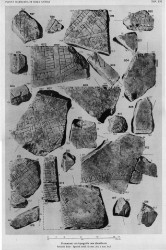
Identification: Subura Remains of a tassello allowed E. Rodríguez-Almeida to join this fragment with fr. 11c and to the already located fr. 11a (Rodríguez-Almeida 1975-76, p. 268, fig. 5). Sawing irregularities (scalini) on the back of all these fragments confirm their position in slab VII-7 (Almeida 1992, pp. 66-68, figs. 15-16). Rodríguez-Almeida's positioning of this fragment in slab VII-7 identifies it as a section of the residential and commercial district called the Subura. Archaeological and epigraphical evidence, in conjunction with the names of Medieval churches and quotes from Martial, locate the approximate boundaries of the Subura. It began near the Argiletum and the Forum Romanum, and from there stretched, at least in imperial times, northward up the valley between the Quirinal and Viminal Hills and eastward between the Oppian and Cispian Hills, where it probably reached as far as the Esquiline Gate (LTUR IV, p. 379). An inscription (CIL 6.9526) indicates that in the imperial period the area was divided into two sections: the Subura maior and the Subura minor. The greater Subura has been identified with the largely commercial area near the Forum Romanum, between the Viminal and the Oppian Hills, and the lesser Subura with the upper section between the Cispian and Oppian Hills where the major thoroughfare of the Subura, the clivus Suburanus, ascended towards the Esquiline Gate (LTUR IV, p. 380). In its SE course, the vertical street in this fragment would have connected to the clivus Suburanus (Rodríguez-Almeida 1975-76, p. 268).
Roman poets like Martial and Juvenal described the Subura as a sordid commercial area, riddled with violence, brothels, and collapsing buildings. In reality, it was probably not different from any other neighborhood in Rome where commercial activity intermingled with the religious and political life in the great public monuments and smaller local shrines and scholae, and where the large domus of the rich stood next to the decrepit apartment buildings that housed the poor. An abundance of evidence demonstrates that even in imperial times the Subura housed senators (probably on the upper slopes) as well as sandal makers, blacksmiths, and cloth sellers. Commercial activity was probably concentrated all along the clivus Suburanus. The many epigraphic references to the synagogue in the Subura, perhaps located in the Subura minor near the Esquiline Gate, suggest it was the center for the largest Jewish congregation in Rome (LTUR IV, pp. 382-383).
Identification: Single- and multi-family residences The two large buildings on the SW (right) side of the vertical street are shaped like residential units. The building in the top right corner might be a single-family residence (also identified as such in PM 1960, p. 152 and in Rodríguez-Almeida 1975-76, p. 268). Its layout is that of a typical atrium house: a central atrium with a compluvium and side rooms that functioned as bedrooms or, in the case of the corner room, as a dining room, a triclinium. The house is complete with a traditional tablinum and perhaps a hortus in the rear. The residence at the bottom right corner has also been identified as a traditional single-family residence, a domus (Rodríguez-Almeida 1975-76, p. 268). However, its layout is unusual in that all the rooms that are lined up behind the peristyle courtyard are of equal dimensions and shape. Rather than a domus, this building may be a luxurious apartment structure with three large apartments sharing a common courtyard. The large room at the bottom which gives access to a narrow, elongated room in the left corner of the house, may represent a common dining area with access to a small kitchen. These luxurious residential units are visual testimony to the epigraphical evidence that suggests that members of the elite lived in the Subura neighborhood along with the poor (see above).
Identification: Scholae (?)
The two monumental structures on the NE (left) side of the vertical road at first glance defy identification. They are not residences, nor do they have the shape of shops, workshops, or other commercial buildings. Their shapes and colonnaded interiors give the impression of ceremonial structures, yet they do not conform to traditional temple architecture. Rodríguez-Almeida has convincingly suggested that both buildings be identified as the headquarters (scholae) for one or two of Rome's many professional or religious associations (collegia) (Rodríguez-Almeida 1975-76, p. 269; also Bollmann 1998, cat. no. A25). A schola provided space for meetings, for communal dining, and for the worship of the patron divinity of a guild or a priesthood. Both the apsidal and the square edifice below it seem to fulfill those requirements. However, their proximity to each other may also indicate they were used by one group for different purposes. A religious organization, for example, may have used the apsidal building for the display of statuary and for the actual religious worship, and used the square portico for meetings and communal dining. A similar division of use, in this case by the Augustales, can be seen in two neighboring buildings in Herculaneum (see T. Najbjerg, JRA supplement 47 [2002] 122-165).
Significance This fragment is an excellent example of the variety of architecture found in the Subura. It demonstrates that the Subura was not a strictly commercial area but served a multitude of residential, social, and religious needs as well. |
 Prev
Prev