ID AND LOCATION
| Stanford #
| 118c |
| AG1980 #
| 118c |
| PM1960 #
| 130 |
| Slab #
| unknown |
| Adjoins
| 118ab |
CONDITION
| Located
| false |
| Incised
| true |
| Surviving
| true |
| Subfragments
| 1 |
| Plaster Parts
| 0 |
| Back Surface
| rough |
| Slab Edges
| 0 |
| Clamp Holes
| 0 |
| Tassello
| no |
TECHNICAL INFO
|
|
|
|
|
|
BIBLIOGRAPHY
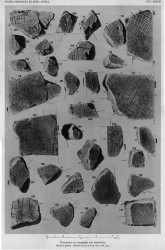
- AG 1980, p. 156, pl. 38 (N.B. Fr. 118c is incorrectly labeled 118b in pl. 38)
- PM 1960, p. 121, pl. 37
|
|
|
|
|
| ANALYSIS
|
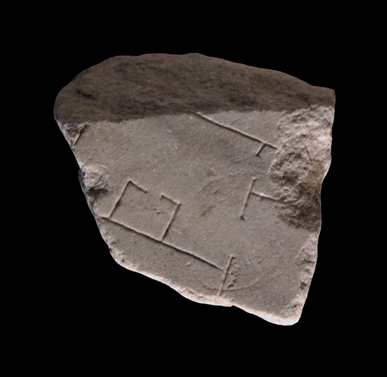
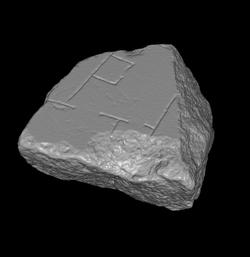
| Description The fragment depicts a large room with two openings to other rooms on the left. Along the top wall of the large hall lies a small enclosure with one central opening.
Identification: A schola? During the printing of PM 1960, the authors realized that this fragment joins with frs. 118ab and 118d. As a result, the upper right corner of the large hall in this fragment can be viewed in its entirety, along with the surrounding streets and buildings (see reconstruction of the group in PM 1960, p. 121 or AG 1980, pl. 38).
The large room may have been a schola or meeting hall for one of Rome's many collegia, or guilds. The small enclosure inside the hall is suggestive of a sacellum, which would have held a statue or altar dedicated to the patron god of the group. The smaller rooms to the left of the hall may have been used for communal meals. As seen in fr. 118ab, access to the great room was through an opening in the upper right corner of the building (lower left in the reconstruction in PM 1960 and in AG 1980). Immediately outside this door lies a small, square feature which was either a fountain, or an altar that would have provided the guild and/or the entire neighborhood with a place for making sacrifices to the gods.
Significance Schola, or meeting halls for collegia, could take many forms and their architectural shapes are notoriously difficult to identify. What they all seem to have in common, however, is a large room for meetings, a sacellum, and access to an altar. For what has been tentatively identified as the urban seat of the collegium of the Augustales Claudiales, see fr. 4b. In combination with frs. 118 ab and d, this piece also presents a fascinating view of structures that probably are representative of a typical, non-monumental, Roman neighborhood: Tabernae whose owners worked and lived in one single room; a city block made up of larger shops, workshops(?), and individual apartments; a single-family domus that occupied an entire block; a structure that perhaps functioned as a meeting hall for Rome's many middle- or lower-class guilds; and a central fountain or altar that would have been the focal point for the entire neighborhood.
|
|
| HISTORY OF FRAGMENT |
| Like the majority of FUR fragments, this piece was discovered in 1562 in a garden behind the Church of Saints Cosmas and Damian. From here, it was transferred to the Palazzo Farnese and stored there. The fragment was later used as building material in the 17th-c. construction of the Farnese family's Giardino Segreto (Secret Garden) near the Via Giulia, and was rediscovered in 1888 or 1898 when the walls of the garden were demolished. Since then, it has been stored with the other known FUR fragments in various places: the storerooms of the Commissione Archeologica (1888/1898-1903), the Antiquarium Comunale (1924-1939), the Capitoline Museums (1939-1955), the Palazzo Braschi (1955-1998), and since 1998 in the Museo della Civiltà Romana in EUR under the auspices of the Sovraintendenza ai Beni Culturali del Comune di Roma. (This fragment's history corresponds to Iter E'' as summarized in PM 1960, p. 56.) N.B. PM 1960 does not reveal the whereabouts of the fragment between 1903 and 1924.
Text by Tina Najbjerg |
|
| KEYWORDS
|
| schola, collegium, guild, sacellum |
|
 Prev
Prev