ID AND LOCATION
| Stanford #
| 118ab |
| AG1980 #
| 118a-b |
| PM1960 #
| 118 a b |
| Slab #
| unknown |
| Adjoins
| 118c 118d |
CONDITION
| Located
| false |
| Incised
| true |
| Surviving
| true |
| Subfragments
| 2 |
| Plaster Parts
| 0 |
| Back Surface
| rough |
| Slab Edges
| 1 |
| Clamp Holes
| 1 |
| Tassello
| no |
TECHNICAL INFO
|
|
|
|
|
|
BIBLIOGRAPHY
- AG 1980, p. 156, pl. 38 (N.B. Fr. 118b is incorrectly labeled 118c in pl. 38)
- PM 1960, pp. 120-121, pl. 37
|
|
|
|
|
| ANALYSIS
|
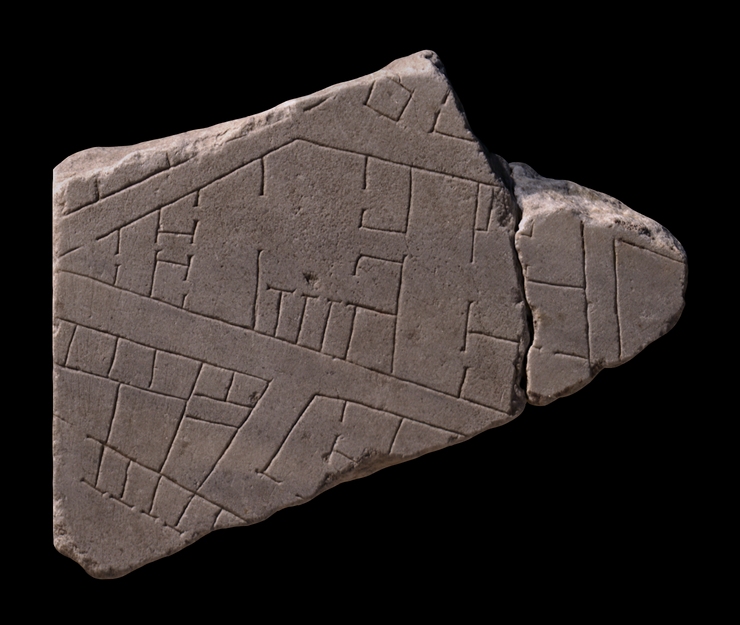
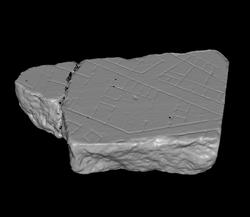
| Description Fr. 118a was part of a slab edge; a partial clamp hole is visible on the side in the bottom left corner. A large city block (an insula?) of trapezoidal shape occupies the top half of the two joining fragments. It is surrounded on all sides by streets. Below, two partial city blocks are visible; they are divided by an L-shaped alley or street. The block to the left backs on to a row of tabernae. To the right of the central city block one sees the partial outline of what is possibly an open space (N.B. The top, horizontal line of this space is missing in Rodríguez-Almeida's drawing in AG 1980, pl. 38). At top, an open space divides two large structures from each other. In the center of this open space lies a small, square feature.
During the printing of PM 1960, the authors realized that these fragments joined frs. 118c and 118d (see reconstruction of group in PM 1960, p. 121). Fr. 118c depicts the remainder of the structure in the upper right corner of fr. 118a, which is a large hall with a small enclosure at the bottom and two smaller rooms to the right. The only entrance to the hall seems to be from the open piazza to the left. Fr. 118d enlarges the bottom right corner of fr. 118a and illustrates that the L-shaped street there continues indefinitely, dividing the bottom right city block from the row of tabernae that backs onto it.
Identification: A domus? The large, trapezoidally shaped city block in the center of these fragments seems to have had one entrance only: a small opening in the farthest left corner. The restricted accessibility and the fact that movement through the block from front to rear fell along the central axis suggest that this was a single, residential unit, a domus. From the two front rooms, one entered through the fauces into a large hall or atrium. A wide opening led from the atrium into the tablinum. The tablinum gave access to four small rooms or cubicula on the right, and two larger rooms in the back. From the tablinum one entered a large space, which was probably open to the sky and which may have functioned as a garden, a hortus. Two openings provided access from the hortus to four large rooms in the back of the house. A clamp-shaped feature in the top room may represent a permanent triclinium, suggesting the room was used for dining in the summer. The rooms in the lower right probably functioned as kitchen and/or slaves quarters. There may have been another means of access to the structure in the upper or lower right corner of the building.
Identification: A schola? The large building in the upper right corner of the fragments, mainly fr. 118c, may have been a schola or meeting hall for one of Rome's many professional or religious organizations (collegia). The small enclosure in the great hall is suggestive of a sacellum, which would have held a statue or altar dedicated to the patron god of the group. The smaller rooms to the right may have been used for communal meals.
Identification: The remaining architecture The small quadrant in the piazza at top probably represents either a fountain or an altar. If the large hall to the right of the piazza was indeed the meeting place for a collegium, it is not unlikely that the square depicts an altar. It would have provided the collegium and probably the entire neighborhood with a place to make sacrifices to the gods. The two city blocks in the bottom of the four fragments are more difficult to identify. There are no openings to any of the rooms in the block to the left, making it impossible to interpret their use. It is possible that the engravers of the Plan forgot to carve openings in the upper row of rooms, and that these in reality depicted tabernae, facing the street. The city block in the bottom right has numerous means of access to the L-shaped street below it. Its many rooms of varying shapes and sizes were probably a mixture of commercial and residential units.
Significance Combined with frs. 118 c and d, these two pieces provide a fascinating view of what was probably a typical, non-monumental neighborhood in Rome: Tabernae, whose owners worked and lived in one single room; a city block made up of larger shops, workshops(?), and individual apartments; a single-family domus that occupied an entire block; a structure that perhaps functioned as a meeting hall for one of Rome's many middle- or lower-class guilds, and a central fountain or altar, that would have been the focal point for the entire neighborhood.
|
|
| HISTORY OF FRAGMENT |
| Like the majority of FUR fragments, these pieces were discovered in the garden behind the Church of Saints Cosmas and Damian in 1562. From here, they were transferred to and stored in the Palazzo Farnese. They were not reproduced in the Renaissance drawings that are now kept in the Vatican, but Giovanni Pietro Bellori included them in his publication of the Plan in 1673. In 1742, the fragments were moved to the Capitoline museums and exhibited in wooden frames along the main staircase. Since then, they have been stored with the other FUR fragments in various places: In the storerooms of the Capitoline museums (1903-1924), in the Antiquarium Comunale (1924-1939), in the Capitoline museums (1939-1955), in the Braschi palace (1955-1998), and since 1998 in the Museo della Civiltà Romana in EUR under the auspices of the Archaeological Superintendency of Rome (the Sovraintendenza ai Beni Culturali del Comune di Roma).
Text by Tina Najbjerg
|
|
| KEYWORDS
|
| domus, insula, fauces, atrium, tablinum, alae, cubiculum, kitchen, hortus, triclinium, schola, collegium, altar, fountain, garden, |
|
 Prev
Prev