ID AND LOCATION
| Stanford #
| 118d |
| AG1980 #
| 118d |
| PM1960 #
| 131 |
| Slab #
| unknown |
| Adjoins
| 118ab |
CONDITION
| Located
| false |
| Incised
| true |
| Surviving
| true |
| Subfragments
| 1 |
| Plaster Parts
| 0 |
| Back Surface
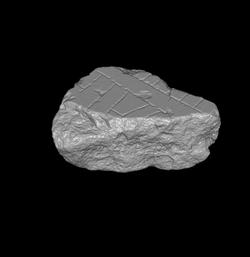
| rough |
| Slab Edges
| 0 |
| Clamp Holes
| 0 |
| Tassello
| no |
TECHNICAL INFO
|
|
|
|
|
|
|
|
|
|
|
| ANALYSIS
|
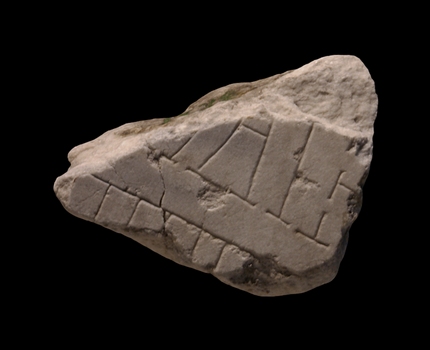
| Description A street divides a row of rooms from a building that consists of several rooms of varying shapes and sizes, all with access to the street.
Identification During the printing of PM 1960, the authors realized that this fragment joins with frs. 118ab and 118c (see reconstruction in PM 1960, p. 121). It is thus possible to identify the row of rooms at the bottom of this fragment as a long line of tabernae, backing onto the street and to another building to the left in fr. 118ab. The street makes a sharp turn to the right in fr. 118ab and connects with a thoroughfare that traverses the entire fragment. The thoroughfare separates a large, single-family house that occupies most of the space in fr. 118ab from the multi-roomed building in this fragment. The varying shapes and sizes of the rooms in this building, all with direct or indirect access to the L-shaped street, suggest that they served as shops, work spaces, and apartments. Although the building is only partially preserved, the lack of staircases in the visible part of the structure indicates that it was single-storeyed.
Significance As witnessed by ample evidence in towns like Ostia, multi-purpose buildings like the one depicted in this fragment were an integral part of larger Roman cityscapes. They must have been ubiquitous in Rome itself, yet today there are hardly any remains of this type of architecture in Rome. This fragment not only provides important evidence for the architecture of such buildings in Rome, together with frs. 118ab and 118c, it also presents a fascinating view of how such multi-faceted structures interlaced with other types of buildings in a non-monumental, Roman neighborhood (see frs. 118ab and 118c for more information about the architecture represented there). |
|
| HISTORY OF FRAGMENT |
| Like the majority of FUR fragments, this piece was discovered in 1562 in a garden behind the Church of Saints Cosmas and Damian. From here, it was transferred to the Palazzo Farnese and stored there. The fragment was later used as building material in the 17th-c. construction of the Farnese family's Giardino Segreto (Secret Garden) near the Via Giulia, and was rediscovered in 1888 or 1898 when the walls of the garden were demolished. Since then, it has been stored with the other known FUR fragments in various places: the storerooms of the Commissione Archeologica (1888/1898-1903), the Antiquarium Comunale (1924-1939), the Capitoline Museums (1939-1955), the Palazzo Braschi (1955-1998), and since 1998 in the Museo della Civiltà Romana in EUR under the auspices of the Sovraintendenza ai Beni Culturali del Comune di Roma. (This fragment's history corresponds to Iter E'' as summarized in PM 1960, p. 56.) N.B. PM 1960 does not reveal the whereabouts of the fragment between 1903 and 1924.
Text by Tina Najbjerg.
|
|
| KEYWORDS
|
| tabernae, apartments, workshop, street |
|
 Prev
Prev