ID AND LOCATION
| Stanford #
| 11b |
| AG1980 #
| 11b |
| PM1960 #
| 553 |
| Slab #
| VII-7 |
| Adjoins
| 11a |
CONDITION
| Located
| true |
| Incised
| true |
| Surviving
| true |
| Subfragments
| 1 |
| Plaster Parts
| 0 |
| Back Surface
| smooth |
| Slab Edges
| 1 |
| Clamp Holes
| 0 |
| Tassello
| no |
TECHNICAL INFO
|
|
|
|
|
|
|
|
|
|
|
| ANALYSIS
|
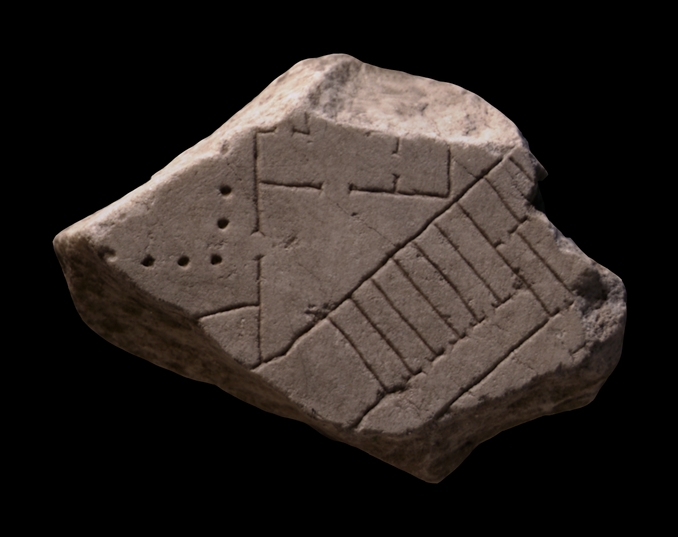
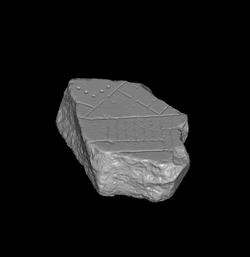
| Description The far right corner of the fragment was part of a slab edge. A diagonal line traverses the piece from top right to bottom left. It functions as the back wall of a row of tabernae. The majority of these shops is accessed from a corridor or narrow alley. On the left side of the dividing wall are the corners of two separate buildings: One is a porticoed courtyard with access to a triangular space to the right. This triangle also has an opening into the second building, which is divided by short walls or arcades.
Identification: Subura E. Rodríguez-Almeida joined this fragment to the already located fr. 11a and placed it along the right edge of slab VII-7 (Rodríguez-Almeida 1975-76, p. 268, fig. 5). Sawing irregularities (scalini) on the back of the fragment confirm this position (Almeida 1992, pp. 66-68, figs. 15-16). This location identifies the fragment as a section of the residential and commercial district called the Subura. Archaeological and epigraphical evidence, in conjunction with the names of Medieval churches and quotes from Martial, locate the approximate boundaries of the Subura. It began near the Argiletum and the Roman forum, and from there stretched, at least in imperial times, northward up the valley between the Quirinal and Viminal Hills and eastward between the Oppian and Cispian Hills, where it probably reached as far as the Esquiline Gate (LTUR IV, p. 379). An inscription (CIL 6.9526) indicates that in the imperial period the area was divided into two sections: the Subura maior and the Subura minor. The greater Subura has been identified with the largely commercial area near the Forum Romanum, between the Viminal and the Oppian Hills, and the lesser Subura with the upper section between the Cispian and Oppian Hills where the major thoroughfare of the Subura, the clivus Suburanus, ascended towards the Esquiline Gate (LTUR IV, p. 380). This fragment is located just north of the clivus Suburanus (see AG 1980, pl. 9). The remainder of the porticoed courtyard in the top left corner of this piece is visible on fr. 11a; it seems to be a single-residence house of fair size, with a narrow entrance from the street, a few more or less secluded rooms and an open, colonnaded courtyard.
Roman poets like Martial and Juvenal described the Subura as a sordid commercial area, riddled with violence, brothels, and collapsing buildings. In reality, it was probably not different from any other neighborhood in Rome where commercial activity intermingled with the religious and political life in the great public monuments and smaller local shrines and scholae, and where the large domus of the rich stood next to the decrepit apartment buildings that housed the poor. An abundance of evidence demonstrates that even in imperial times the Subura housed senators (probably on the upper slopes) as well as sandal makers, blacksmiths, and cloth sellers. Commercial activity was probably concentrated all along the clivus Suburanus.
Significance The partial domus in this fragment lends credibility to the thesis that the Subura was not strictly a commercial area but also served the residential needs of the elite.
|
|
| HISTORY OF FRAGMENT |
| Like the majority of FUR fragments, this piece was discovered in 1562 in a garden behind the Church of Saints Cosmas and Damian. From here, it was transferred to the Palazzo Farnese and stored there. It was not among the fragments that were reproduced in the Renaissance drawings that are now kept in the Vatican, but Giovanni Pietro Bellori included it in his 1673 publication. In 1742, the fragment was moved to the Capitoline Museums and exhibited with some of the other known fragments in wooden frames along the main staircase. Since then, it has been stored with the other FUR fragments in various places: the storerooms of the Capitoline Museums (1903-1924), the Antiquarium Comunale (1924-1939), the Capitoline Museums again (1939-1955), the Palazzo Braschi (1955-1998), and since 1998 in the Museo della Civiltà Romana in EUR under the auspices of the Sovraintendenza ai Beni Culturali del Comune di Roma. (This fragment's history corresponds to Iter E' as summarized in PM 1960, p. 56.)
Text by Tina Najbjerg |
|
| KEYWORDS
|
| domus, tabernae, portico, colonnade, corridor, alley, subura |
|
 Prev
Prev